



Question: Hi. Could you assist me with this physics problems? I also need explanation please. Thank you! 5. A 1000 kg car traveling east at 20
Hi. Could you assist me with this physics problems? I also need explanation please. Thank you!
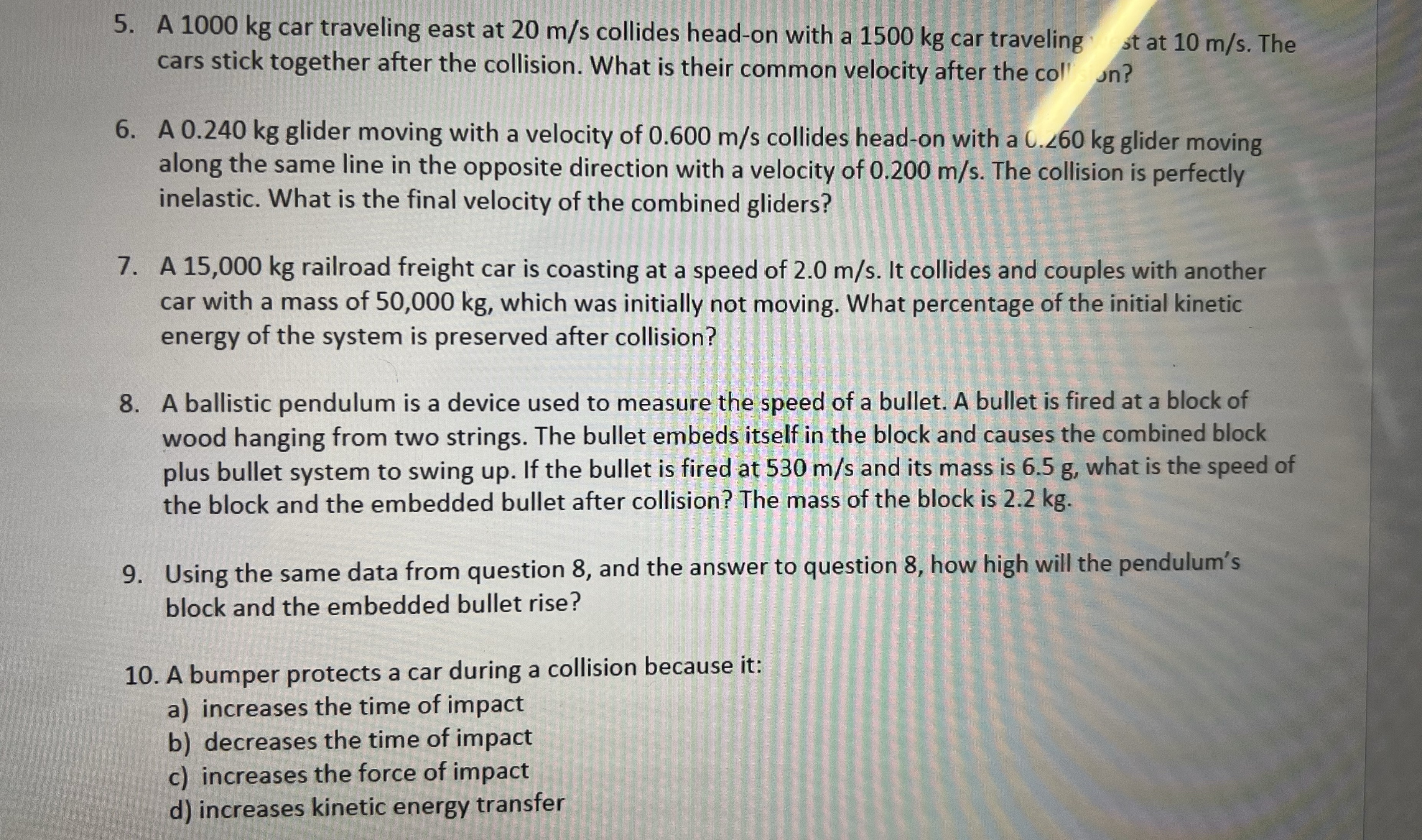
5. A 1000 kg car traveling east at 20 m/s collides head-on with a 1500 kg car traveling st at 10 m/s. The cars stick together after the collision. What is their common velocity after the col' on? 6. A 0.240 kg glider moving with a velocity of 0.600 m/s collides head-on with a 0.460 kg glider moving along the same line in the opposite direction with a velocity of 0.200 m/s. The collision is perfectly inelastic. What is the final velocity of the combined gliders? 7. A 15,000 kg railroad freight car is coasting at a speed of 2.0 m/s. It collides and couples with another car with a mass of 50,000 kg, which was initially not moving. What percentage of the initial kinetic energy of the system is preserved after collision? 8. A ballistic pendulum is a device used to measure the speed of a bullet. A bullet is fired at a block of wood hanging from two strings. The bullet embeds itself in the block and causes the combined block plus bullet system to swing up. If the bullet is fired at 530 m/s and its mass is 6.5 g, what is the speed of the block and the embedded bullet after collision? The mass of the block is 2.2 kg. 9. Using the same data from question 8, and the answer to question 8, how high will the pendulum's block and the embedded bullet rise? 10. A bumper protects a car during a collision because it: a) increases the time of impact b) decreases the time of impact c) increases the force of impact d) increases kinetic energy transfer
Step by Step Solution
There are 3 Steps involved in it

Get step-by-step solutions from verified subject matter experts