Question: hi expert help me answer section 1 and section 2 thank you Abstract Purpose: Little research has been contributed to how the behaviors associated with
hi expert help me answer section 1 and section 2 thank you
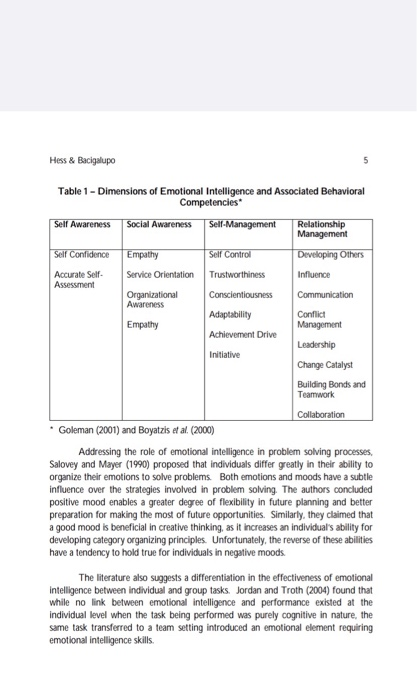
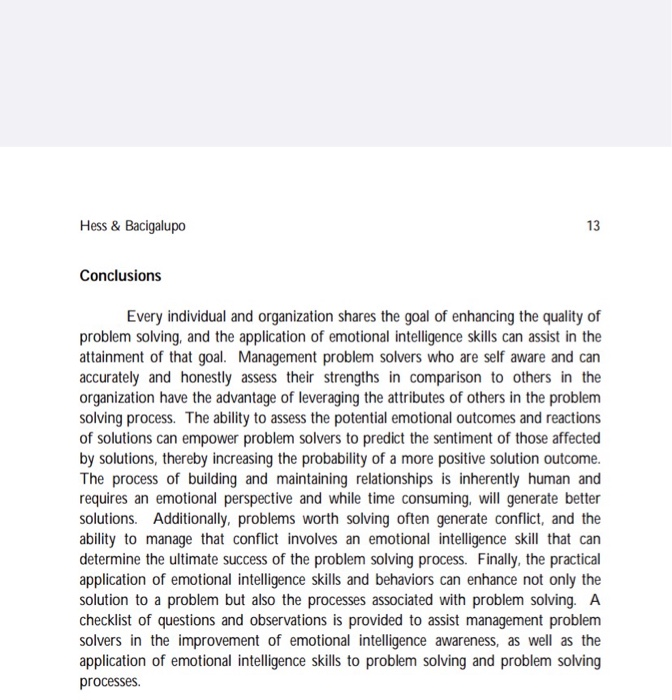
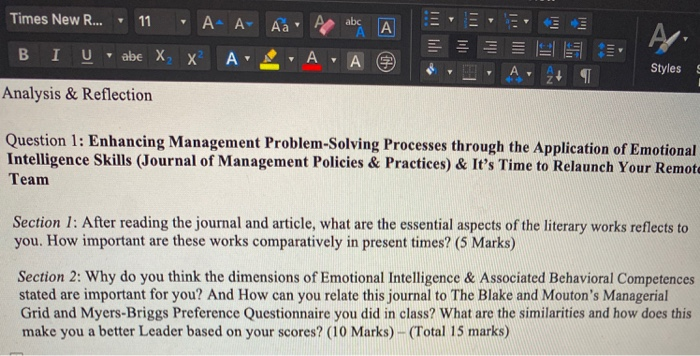
Abstract Purpose: Little research has been contributed to how the behaviors associated with emotional intelligence may be practically applied to enhance both individual and group management problem-solving. The purpose of this paper is to identify practical approaches to the application of emotional intelligence to the complexity of the management problem-solving process. These practical approaches are designed to instruct and aid problem solvers in the utilization of emotional intelligence skills to improve management problem solving skills and processes. Design/Methodology/Approach: Goleman's (2001) and Boyatzis' et al. (2000) four essential elements of emotional intelligence and their associated 20 behavioral competencies are utilized to develop a methodology for the practical application of emotional intelligence skills to management problem-solving. A series of questions, observations and action steps are outlined to improve emotional intelligence awareness, as well as the utilization of emotional intelligence skills to enhance management problem-solving processes. Findings: Organizations and individuals may benefit from the development and utilization of behaviors attributed to emotional intelligence. The practical application of emotional intelligence skills can enhance individual and group complex management problem-solving skills and outcomes. Originality/Value: The practical application of emotional intelligence skills becomes a strategy for the development of the individual's and organization's ability to assess the impact and consequences of management problem-solving, while simultaneously improving the quality and effectiveness of the management problem-solving process. 2 Journal of Management Policies and Practices, Vol. 231. September 2014 Introduction The ability of organizations, corporations and entities to contemplate, evaluate and solve complex problems is dependent upon a multitude of intrinsic and extrinsic factors. While the management of extrinsic variables may be more difficult to control, the identification and management of human variables such as emotion and logic are pivotal in the effort to increase the quality of solutions as well as management problem solving processes One of the most fascinating dichotomies in contemporary thought surrounding problem solving is the apparent conflict between the roles of emotion and rationality. Stanovich and West (2000) divided cognitive functions between those that were faster, effortless, implicit and emotional as compared to those that were slower, conscious explicit and logical. The authors believed better decisions and solutions could be derived by shifting problem solvers and decision-makers from intuitive and emotional thinking to logical and rational thinking. Moreover, the authors concluded replacing intuition with more intensive data collection and analytical processes enabled the problem solver to construct linear models to produce relevant predictors. The suggestion here is that human beings will make better decisions on complex problems if we transform our cognitive functions to resemble those of an emotion-free microprocessor There is an alternate research process proceeding in artificial intelligence to inject learned emotions into microprocessor driven problem solving IBM is developing a cognitive computing processor to emulate the patterns of human thinking (Bai, 2008). Additionally, the MIT Artificial Intelligence Laboratory has developed an artificially intelligent machine that has defined elements of sensory and emotional systems (Velasquez, 1998). The computerized platform is capable of modeling six different emotions for decision-making: anger, fear, distress/sadness, joy/happiness, disgust and surprise. Velasquez's premise based upon previous work (Damasio, 1994) is that intuition and emotions play crucial roles in the ability to make smart, rational decisions in problem solving situations Thus the ironic dichotomy of current thought is that some researchers believe human beings will reach better solutions to management problems when emotions are removed, and the mind is bent to perform more like a data-analyzing machine. Hess & Bacigalupo 3 Concomitantly, some researchers contend data-analyzing machines will make better decisions in problem solving circumstances when they are capable of utilizing intuition and emotions. So who is right? We believe both are fundamentally correct. Further we have concluded that consistent with Simon's (1967, 1971) notion that emotion and rationality are inextricably linked, emotional intelligence can serve as the necessary bridge between the two. Moreover, the behaviors most often identified with emotional intelligence may be learned and applied in a practical manner to improve the overall quality of solutions to management problems and problem solving processes. Purpose of Paper Emotional intelligence has been the subject of a significant amount of literature over the past two decades, ranging from debate over whether emotional intelligence is innate or learned to the categorization of specific behaviors that define emotional intelligence. However, little has been contributed to how the behaviors associated with emotional intelligence may be practically applied to enhance both individual and group problem solving. The purpose of this paper is to review relevant emotional intelligence literature and to identify practical approaches to the application of emotional intelligence skills to the managemet problem solving process. Relevant Emotional Intelligence Research The definition of emotional intelligence and the context in which the term should be used has been a matter of debate in the literature over a number of years (Mayer et al., 2008). Thorndike (1920) first coined the term "social intelligence" to describe the skills utilized in understanding and managing people. Later in 1940 Wechsler (Bar-On, 2006) noted the influence of other factors on intelligent behavior and posited that models of intelligence could not be complete until those factors were more fully understood. The term "emotional intelligence was first used in the United States in a doctoral dissertation studying the acknowledgement and effects of emotion (Payne, 1985). This work was followed by an emotional intelligence model described by Salovey and Mayer (1990), articulating emotions could enhance rationality and that individuals would be better served to work with, rather than against their emotions. Journal of Management Policies and Practices, Vol. 2(3), September 2014 Bradberry and Greaves (2003) noted emotional intelligence skills, when considered cumulatively, were vital in representing mental and behavioral functions of individuals beyond their native intelligence, The bulk of the literature in emotional intelligence may be encapsulated in the description of three models: 1) ability model 2) trait model and 3) mixed model. The ability model as described by Satovey and Grewal (2005) posited that individuals have varied abilities to process and react to emotional circumstances and as a result develop adaptive behaviors to deal with social situations. The trait model proposed by Petrides et al. (2007) was based upon the premise emotional intelligence represents a cluster of self perceptions operating at the lower levels of personality. This focus on behavioral dispositions relied heavily on self measurement and as such was more resistant to Scientific calibration (Petridese , 2007). The mixed model was best characterized by Goleman's (1995) description of emotional Intelligence as a wide array of competencies and skills driving leadership performance. Goleman's model was based on the premise emotional competencies are not innate traits, but rather learned skills that may be developed and improved In a follow-up study Goleman (1998) noted the very best corporate leaders, while diverse in their leadership styles, share in common the characteristics of self- awareness, self-regulation, motivation, empathy and social skill. These skills according to Goleman allow superb leaders to understand their own as well as others' emotional makeup well enough to move people to accomplish institutional objectives Goleman's (1995) original work on emotional intelligence described the following essential elements or abilities: 1) knowing one's emotions 2) managing emotions: 3) motivating oneself: 4) recognizing emotions in others and S) handling relationships Goleman's theory of emotional intelligence and its characteristic behaviors has been further refined to include both individual and organizational behaviors and outcomes. The more fully developed emotional intelligence model as described by Goleman (2001) and Boyatzis et al. (2000) refined the original five elements into four dimensions and further subdivided these characteristics into 20 behavioral competencies as outlined in the following table. Hess & Bacigalupo Table 1 - Dimensions of Emotional Intelligence and Associated Behavioral Competencies Self Awareness Social Awareness Self-Management Relationship Management Self Confidence Empathy Self Control Developing Others Accurate Self Service Orientation Trustworthiness Influence Assessment Organizational Conscientiousness Communication Awareness Adaptability Conflict Empathy Management Achievement Drive Leadership Initiative Change Catalyst Building Bonds and Teamwork Collaboration Goleman (2001) and Boyatzis et al. (2000) Addressing the role of emotional intelligence in problem solving processes, Salovey and Mayer (1990) proposed that individuals differ greatly in their ability to organize their emotions to solve problems. Both emotions and moods have a subtle influence over the strategies involved in problem solving. The authors concluded positive mood enables a greater degree of flexibility in future planning and better preparation for making the most of future opportunities. Similarly, they claimed that a good mood is beneficial in creative thinking, as it increases an individual's ability for developing category organizing principles. Unfortunately, the reverse of these abilities have a tendency to hold true for individuals in negative moods. The literature also suggests a differentiation in the effectiveness of emotional intelligence between individual and group tasks. Jordan and Troth (2004) found that while no link between emotional intelligence and performance existed at the individual level when the task being performed was purely cognitive in nature, the same task transferred to a team setting introduced an emotional element requiring emotional intelligence skills Journal of Management Policies and Practices. Vol. 213. September 2014 More specifically the authors concluded a team's overall level of emotional intelligence and the ability of team members to deal with their own emotions impacted performance. Druskat and Wolff (2001) and Jordan et al (2002) noted that teams comprised of members with higher levels of emotional intelligence will perform better on tasks than teams comprised of members exhibiting lower levels of emotional intelligence Applying Emotional Intelligence Skills to Problem Solving While much of the literature has focused on the theoretical aspects of emotional intelligence, a significant gap exists in the practical application of these skills to management problem solving. If one believes emotional intelligence adds value to the individual and/or group problem solving process, the question arises how can it be practically applied to achieve that desired result? Management problem solvers are often faced with problems that cannot be easily solved and in some cases have negative impacts on some constituency even when they have been declared solved. Thus the consideration of the effect of problem solutions on others should be an important element of the problem solving process. While determining "who" will be affected by problem solutions may be a more pragmatic function requiring rationality and logic, determining how the solution will be interpreted and its subsequent effect on others requires the skills associated with emotional intelligence. Self Awareness... Evaluating the Role of the Problem Solver Self awareness and its representative competencies of accurate self assessment and self confidence (Table 1) enable the emotionally intelligent problem solver to determine his or her appropriate role in the problem solving process (Goleman, 2001 and Boyatzis et al. 2000). Specifically, these skills enable problem solvers to determine if they have the requisite orientation to a problem and have enough self confidence to assess their own skills in comparison to others. Accordingly, these emotional intelligence skills create a decision path to determine who is the most appropriate person or group to consider, design and implement the best solution in any given circumstance. Without emotional intelligence, problem solvers fail the first and most important decision, which is who is the best problem solver for this particular problem? Hess & Bacigalupo Application of Self Awareness Skills Applying these self awareness skills to management problem solving situations is a process that can be learned. The following questions, observations and action steps can serve as a practical guide for individuals and organizational leaders and managers in problem solving circumstances. 1) Is the potential problem solver aware of his or her problem solving skills and styles? The emotionally intelligent problem solver will make an honest self assessment of skills and styles, noting the differences in his or her behaviors and abilities as compared to others. 2) Would others describe the problem solver as inclusive or exclusive in problem solving processes? The leadership and problem solving styles as described by Vroom and Yetton (1973) are useful here. The authors described a range of behaviors beginning with the pure autocratic style, to partial inclusion and pure delegation. While a problem solver may describe himself or herself as more democratic or participatory, the more critical aspect is the perception of others. While it is not appropriate to be inclusive in every problem solving process, the emotional intelligence function suggests it is important to communicate to others when and why inclusive or exclusive methodologies are utilized. 3) Is the problem solver confident in his or her problem solving skills? Tsai and Young (2009) concluded that fear makes individuals second-guess themselves and abandon support for efforts that have gone even slightly off track The emotionally intelligent problem solver must exude confidence in his or her problem solving style. Being self aware also implies acknowledging one's weaknesses and having the confidence to recognize the strengths of others in the problem solving process. Self awareness also includes the skill of recognizing the impact of one's styles and behaviors on others. The emotionally intelligent problem solver views every solution as a potential opportunity to develop themselves as well as those around them. Problem Solving Action Steps. Consider the steps most often utilized in the natural problem solving style. Is there a tendency to reach first for the emotional elements of a solution circumstance, or conversely, to reach for the rational analysis components? Problem solvers should also ask themselves whether they are inclusive or exclusive in the problem solving process. Journal of Management Policies and Practices, Vol. 2(3), September 2014 Given the human tendency to avoid areas of perceived weakness, it is important to identify the most uncomfortable aspects of the problem solving process and will oneself to spend more time in that domain in order to dispel the discomfort. Social Awareness... Assessing the Problem Solving Environment The emotional intelligence skill of social awareness and its core competencies of empathy, service orientation and organizational awareness enable problem solvers to judge the impact of not only their solutions but also the manner in which those solutions are reached (Goleman, 2001 and Boyatzis et al. 2000). The best solutions are those that can be understood and accepted by the individuals most affected by the solution. Whether they are individuals or groups, problem solvers who practice the value of empathy can foresee the impact of their solutions before implementation (Goleman, 2001). Likewise, exhibiting a servant philosophy can greatly enhance the quality of solutions. If problem solvers view those affected by solutions as customers who may be retained or lost, they are more likely to consider the outcomes and consequences of solutions (Miller, 2009). Finally, it seems obvious being aware of the organization's culture, values and mores will enable the problem solver to make a more rational judgment in the solution itself, as well as the process by which the solution is reached Application of Social Awareness Skills In assessing and developing social awareness skills, problem solvers might consider the following questions, practical observations and action steps 1) What individuals, groups or constituents will be most affected by the problem and solution? Social awareness implies the problem solver has adequately contemplated the impact and consequences of the problem and solution before it is implemented. This emotional intelligence skill requires the problem solver to play out scenarios of solutions to determine both their short and long-term consequences and effects (Huy. 1999). 2) Should those most impacted by the problem and solution be involved in the problem solving process? The skill of social awareness includes the skill of scanning the environment to determine if and when inclusion or exclusion is necessary or appropriate. When contemplating an action, it is critical to determine whether those impacted by a solution will receive the change more positively if they are involved in the problem solving process. Hess & Bacigalupo 3) What problem solving processes are most appropriate given the culture and/or values of the organization? Being socially aware requires the problem solver to assess the historical and cultural mores of the organization to determine appropriate actions. For example, if the culture of the organization is team oriented and participatory in nature, it would be important to design problem solving processes consistent with those values 4) How will the problem solution and problem solving process be viewed in retrospect? Emotionally intelligent problem solving requires looking forward and backward simultaneously. Reliving past problems and solutions through the lens of their impact assists the emotionally intelligent problem solver in playing out the future of current contemplated actions Problem Solving Action Steps: In recalling a problem and solutions that affected others negatively reflect on the negative consequences experienced and how the solution made others feel. Now identify how the problem solving process should have been executed. Identify a solution within an organization that was inconsistent with the values and culture of the organization and note the values that were violated. Problems solvers can benefit by determining how the solution could have been handled to be more consistent with the values of the organization. Self Management... Determining the Motivations of Problem Solving Self-management and its components of self-control, trustworthiness, conscientiousness, adaptability, achievement drive and initiative are arguably the most important emotional intelligence skills for problem solvers (Goleman, 2001 and Boyatzis et al. 2000). Controlling the impulse to solve every problem individually can sometimes fly in the face of the need to show initiative and achievement (Bazerman and Malhorta, 2006). Additionally, in order for a problem solver to gain moral authority on an issue, he or she must first be viewed as trustworthy by those affected by a problem and its solution Problem solvers can utilize self management skills to establish a consistent record of achievement, while simultaneously earning trust from both internal and external audiences In settings where the speed at which technical issues can be resolved or new products, applications or solutions can be made available is highly valued, the temptation is to avoid problem solving processes which occupy valuable time. 10 Journal of Management Policies and Practices. Vol. 213), September 2014 However, the emotionally intelligent problem solver will evaluate the longer term consequences of losing trust among workers and teams when speed wins outs over participation (Bazerman and Malhorta, 2006). Suppressing the need for personal achievement and relying on adaptability, the emotionally intelligent manager will assess the best problem solving process for each circumstance and be conscientious in engaging the appropriate individuals and groups. Application of Self Management skills The following interrogatories and observations will enable problem solvers to establish or more fully develop their self-management emotional intelligence skill set. 1) Is the problem solver merely focused on his or her pursuits or are they truly interested in achieving the best solution results? Emotionally intelligent problem solvers are characterized by their ability to suppress their own desires and interests for the common good 2) Is the problem solver focusing too much on the desire for a speedy resul? Bazerman and Malhotra (2006) noted that time pressures often lead problem solvers to bad judgments. Patience is pivotal in achieving the desired solution outcome 3) How may a problem solving process be utilized to build trust amongd the appropriate constituents? Mayer and Caruso (2002) noted that leaders high in emotional intelligence build real social fabric within an organization, as well as between the organization and those it serves. Accordingly, emotionally intelligent solutions are those that are grounded in the feelings, values and beliefs of the organization. Complex problems and solutions resulting in negative consequences will be more readily accepted by those impacted if they trust the solution reached is consistent with the values of the organization. 4) is the problem solver willing to adapt to new problem solving processes rather than relying upon the entrenched processes of the past? When the need for a new problem solving process arises, those who can self manage and correct course will earn the trust of those involved in the process. The honest acknowledgement of a need to break with the practices of the past is critical to building self confidence, as well as developing the relationships necessary to affect a positive solution result (Huy, 1999). Hess & Bacigalupo 11 5) Is the problem solver willing to quickly admit to and correct misjudgments? No other self management characteristic is as important in the development of emotional intelligence behaviors as the ability to openly admit to mistakes. Mistakes make emotionally intelligent human beings stronger and give them the opportunity to truly connect with others in honesty and humility. Problem Solving Action Steps: It is useful for problem solvers to recall a complex and important solution reached without involving others. Was there a negative outcome? Did the solution decrease the level of trust others have in the problem solver? How could others have been involved in the problem solving process? It is also helpful here to identify what actions could have been taken to develop the problem solving skills of someone else. In replaying a scenario when a problem solver failed to acknowledge and correct a misjudgment, what consequences or impacts did that failure cause? How could the scenario have played out differently if the individual had openly acknowledged and corrected the mistake? Relationship Management... Managing the Problem Solving Process As noted previously in Table 1, relationship management includes developing others, influence, communications, conflict management, leadership, change catalyst, building bonds and teamwork (Goleman, 2001 and Boyatzis ef al., 2000). The enhancement of problem solving processes is dependent upon the ability to effectively communicate desired outcomes, influence stakeholders and manage conflict. In both individual and group problem solving processes, the ability to manage relationships is pivotal to success. Even the best of solutions can have negative results if not properly communicated, including the proper articulation of problem solving processes. Solutions that bring about fundamental change are fraught with potential conflict, regardless of the original intent of the change. The ability to manage that conflict is central to both the process and outcome of solutions, requiring problem solvers to exercise emotional skills while simultaneously attempting to steer necessary changes Application of Relationship Management skills Conflict, communication and relationship management are all inextricably linked to the problem solving process 12 Journal of Management Policies and Practices. Vol. 23). September 2014 Problem solvers should consider the following questions and actions in the effort to more fully develop the relationship Management skill set. 1) Are solutions viewed as a means of developing or furthering relationships with those with whom the problem solver works? Relationships are based upon communication and trust, and the emotionally intelligent individual looks at every problem solving circumstance as an opportunity to develop or improve the relationship with another person 2) How does the problem solver communicate with others engaged in the problem solving process? This aspect of relationship management requires a regular and consistent method of communication that reinforces the role of each person in the problem solving process. When a problem has been delegated it remains critical to support that delegation in all communications 3) Are communications in conflict situations regarding management problem solving direct and forthright? Emotional intelligence is exhibited in conflict settings by seeking first to understand the position and feelings of the other person (Mayer and Caruso, 2002). Thus in circumstances of conflict, the emotionally intelligent problem solver listens more than they speak and seeks opportunities to learn the opinions of others. Being direct about conflicting views is important to demonstrate honesty, and exhibiting compassion in moments of tension develops the trust necessary to foster long-term relationships 4) What are the problem solver's attributes in managing conflict? The emotionally intelligent response in moments of conflict requires an examination of one's own emotions. The emotionally intelligent problem solver manages volatility by expressing compassion while exhibiting and furthering the values of the organization in the problem solving process (Huy. 1999). Problem Solving Action Steps: While reflecting on a problem and solution that created a large amount of conflict or controversy, recall the methods used to communicate the solution. How could the process have been handled to lessen the conflict or controversy? It is most important to identify those who may have been negatively impacted, and inquire of those individuals how the process should have been handled from their perspective. Hess & Bacigalupo 13 Conclusions Every individual and organization shares the goal of enhancing the quality of problem solving, and the application of emotional intelligence skills can assist in the attainment of that goal. Management problem solvers who are self aware and can accurately and honestly assess their strengths in comparison to others in the organization have the advantage of leveraging the attributes of others in the problem solving process. The ability to assess the potential emotional outcomes and reactions of solutions can empower problem solvers to predict the sentiment of those affected by solutions, thereby increasing the probability of a more positive solution outcome. The process of building and maintaining relationships is inherently human and requires an emotional perspective and while time consuming, will generate better solutions. Additionally, problems worth solving often generate conflict, and the ability to manage that conflict involves an emotional intelligence skill that can determine the ultimate success of the problem solving process. Finally, the practical application of emotional intelligence skills and behaviors can enhance not only the solution to a problem but also the processes associated with problem solving. A checklist of questions and observations is provided to assist management problem solvers in the improvement of emotional intelligence awareness, as well as the application of emotional intelligence skills to problem solving and problem solving processes. Times New R... 11 A A Aa' abc TIL lili A loli ilil BIU.abe X III x Ar Y A Y A 4+ Styles Analysis & Reflection Question 1: Enhancing Management Problem Solving Processes through the Application of Emotional Intelligence Skills (Journal of Management Policies & Practices) & It's Time to Relaunch Your Remote Team Section 1: After reading the journal and article, what are the essential aspects of the literary works reflects to you. How important are these works comparatively in present times? (5 Marks) Section 2: Why do you think the dimensions of Emotional Intelligence & Associated Behavioral Competences stated are important for you? And How can you relate this journal to The Blake and Mouton's Managerial Grid and Myers-Briggs Preference Questionnaire you did in class? What are the similarities and how does this make you a better Leader based on your scores? (10 Marks) - (Total 15 marks) Abstract Purpose: Little research has been contributed to how the behaviors associated with emotional intelligence may be practically applied to enhance both individual and group management problem-solving. The purpose of this paper is to identify practical approaches to the application of emotional intelligence to the complexity of the management problem-solving process. These practical approaches are designed to instruct and aid problem solvers in the utilization of emotional intelligence skills to improve management problem solving skills and processes. Design/Methodology/Approach: Goleman's (2001) and Boyatzis' et al. (2000) four essential elements of emotional intelligence and their associated 20 behavioral competencies are utilized to develop a methodology for the practical application of emotional intelligence skills to management problem-solving. A series of questions, observations and action steps are outlined to improve emotional intelligence awareness, as well as the utilization of emotional intelligence skills to enhance management problem-solving processes. Findings: Organizations and individuals may benefit from the development and utilization of behaviors attributed to emotional intelligence. The practical application of emotional intelligence skills can enhance individual and group complex management problem-solving skills and outcomes. Originality/Value: The practical application of emotional intelligence skills becomes a strategy for the development of the individual's and organization's ability to assess the impact and consequences of management problem-solving, while simultaneously improving the quality and effectiveness of the management problem-solving process. 2 Journal of Management Policies and Practices, Vol. 231. September 2014 Introduction The ability of organizations, corporations and entities to contemplate, evaluate and solve complex problems is dependent upon a multitude of intrinsic and extrinsic factors. While the management of extrinsic variables may be more difficult to control, the identification and management of human variables such as emotion and logic are pivotal in the effort to increase the quality of solutions as well as management problem solving processes One of the most fascinating dichotomies in contemporary thought surrounding problem solving is the apparent conflict between the roles of emotion and rationality. Stanovich and West (2000) divided cognitive functions between those that were faster, effortless, implicit and emotional as compared to those that were slower, conscious explicit and logical. The authors believed better decisions and solutions could be derived by shifting problem solvers and decision-makers from intuitive and emotional thinking to logical and rational thinking. Moreover, the authors concluded replacing intuition with more intensive data collection and analytical processes enabled the problem solver to construct linear models to produce relevant predictors. The suggestion here is that human beings will make better decisions on complex problems if we transform our cognitive functions to resemble those of an emotion-free microprocessor There is an alternate research process proceeding in artificial intelligence to inject learned emotions into microprocessor driven problem solving IBM is developing a cognitive computing processor to emulate the patterns of human thinking (Bai, 2008). Additionally, the MIT Artificial Intelligence Laboratory has developed an artificially intelligent machine that has defined elements of sensory and emotional systems (Velasquez, 1998). The computerized platform is capable of modeling six different emotions for decision-making: anger, fear, distress/sadness, joy/happiness, disgust and surprise. Velasquez's premise based upon previous work (Damasio, 1994) is that intuition and emotions play crucial roles in the ability to make smart, rational decisions in problem solving situations Thus the ironic dichotomy of current thought is that some researchers believe human beings will reach better solutions to management problems when emotions are removed, and the mind is bent to perform more like a data-analyzing machine. Hess & Bacigalupo 3 Concomitantly, some researchers contend data-analyzing machines will make better decisions in problem solving circumstances when they are capable of utilizing intuition and emotions. So who is right? We believe both are fundamentally correct. Further we have concluded that consistent with Simon's (1967, 1971) notion that emotion and rationality are inextricably linked, emotional intelligence can serve as the necessary bridge between the two. Moreover, the behaviors most often identified with emotional intelligence may be learned and applied in a practical manner to improve the overall quality of solutions to management problems and problem solving processes. Purpose of Paper Emotional intelligence has been the subject of a significant amount of literature over the past two decades, ranging from debate over whether emotional intelligence is innate or learned to the categorization of specific behaviors that define emotional intelligence. However, little has been contributed to how the behaviors associated with emotional intelligence may be practically applied to enhance both individual and group problem solving. The purpose of this paper is to review relevant emotional intelligence literature and to identify practical approaches to the application of emotional intelligence skills to the managemet problem solving process. Relevant Emotional Intelligence Research The definition of emotional intelligence and the context in which the term should be used has been a matter of debate in the literature over a number of years (Mayer et al., 2008). Thorndike (1920) first coined the term "social intelligence" to describe the skills utilized in understanding and managing people. Later in 1940 Wechsler (Bar-On, 2006) noted the influence of other factors on intelligent behavior and posited that models of intelligence could not be complete until those factors were more fully understood. The term "emotional intelligence was first used in the United States in a doctoral dissertation studying the acknowledgement and effects of emotion (Payne, 1985). This work was followed by an emotional intelligence model described by Salovey and Mayer (1990), articulating emotions could enhance rationality and that individuals would be better served to work with, rather than against their emotions. Journal of Management Policies and Practices, Vol. 2(3), September 2014 Bradberry and Greaves (2003) noted emotional intelligence skills, when considered cumulatively, were vital in representing mental and behavioral functions of individuals beyond their native intelligence, The bulk of the literature in emotional intelligence may be encapsulated in the description of three models: 1) ability model 2) trait model and 3) mixed model. The ability model as described by Satovey and Grewal (2005) posited that individuals have varied abilities to process and react to emotional circumstances and as a result develop adaptive behaviors to deal with social situations. The trait model proposed by Petrides et al. (2007) was based upon the premise emotional intelligence represents a cluster of self perceptions operating at the lower levels of personality. This focus on behavioral dispositions relied heavily on self measurement and as such was more resistant to Scientific calibration (Petridese , 2007). The mixed model was best characterized by Goleman's (1995) description of emotional Intelligence as a wide array of competencies and skills driving leadership performance. Goleman's model was based on the premise emotional competencies are not innate traits, but rather learned skills that may be developed and improved In a follow-up study Goleman (1998) noted the very best corporate leaders, while diverse in their leadership styles, share in common the characteristics of self- awareness, self-regulation, motivation, empathy and social skill. These skills according to Goleman allow superb leaders to understand their own as well as others' emotional makeup well enough to move people to accomplish institutional objectives Goleman's (1995) original work on emotional intelligence described the following essential elements or abilities: 1) knowing one's emotions 2) managing emotions: 3) motivating oneself: 4) recognizing emotions in others and S) handling relationships Goleman's theory of emotional intelligence and its characteristic behaviors has been further refined to include both individual and organizational behaviors and outcomes. The more fully developed emotional intelligence model as described by Goleman (2001) and Boyatzis et al. (2000) refined the original five elements into four dimensions and further subdivided these characteristics into 20 behavioral competencies as outlined in the following table. Hess & Bacigalupo Table 1 - Dimensions of Emotional Intelligence and Associated Behavioral Competencies Self Awareness Social Awareness Self-Management Relationship Management Self Confidence Empathy Self Control Developing Others Accurate Self Service Orientation Trustworthiness Influence Assessment Organizational Conscientiousness Communication Awareness Adaptability Conflict Empathy Management Achievement Drive Leadership Initiative Change Catalyst Building Bonds and Teamwork Collaboration Goleman (2001) and Boyatzis et al. (2000) Addressing the role of emotional intelligence in problem solving processes, Salovey and Mayer (1990) proposed that individuals differ greatly in their ability to organize their emotions to solve problems. Both emotions and moods have a subtle influence over the strategies involved in problem solving. The authors concluded positive mood enables a greater degree of flexibility in future planning and better preparation for making the most of future opportunities. Similarly, they claimed that a good mood is beneficial in creative thinking, as it increases an individual's ability for developing category organizing principles. Unfortunately, the reverse of these abilities have a tendency to hold true for individuals in negative moods. The literature also suggests a differentiation in the effectiveness of emotional intelligence between individual and group tasks. Jordan and Troth (2004) found that while no link between emotional intelligence and performance existed at the individual level when the task being performed was purely cognitive in nature, the same task transferred to a team setting introduced an emotional element requiring emotional intelligence skills Journal of Management Policies and Practices. Vol. 213. September 2014 More specifically the authors concluded a team's overall level of emotional intelligence and the ability of team members to deal with their own emotions impacted performance. Druskat and Wolff (2001) and Jordan et al (2002) noted that teams comprised of members with higher levels of emotional intelligence will perform better on tasks than teams comprised of members exhibiting lower levels of emotional intelligence Applying Emotional Intelligence Skills to Problem Solving While much of the literature has focused on the theoretical aspects of emotional intelligence, a significant gap exists in the practical application of these skills to management problem solving. If one believes emotional intelligence adds value to the individual and/or group problem solving process, the question arises how can it be practically applied to achieve that desired result? Management problem solvers are often faced with problems that cannot be easily solved and in some cases have negative impacts on some constituency even when they have been declared solved. Thus the consideration of the effect of problem solutions on others should be an important element of the problem solving process. While determining "who" will be affected by problem solutions may be a more pragmatic function requiring rationality and logic, determining how the solution will be interpreted and its subsequent effect on others requires the skills associated with emotional intelligence. Self Awareness... Evaluating the Role of the Problem Solver Self awareness and its representative competencies of accurate self assessment and self confidence (Table 1) enable the emotionally intelligent problem solver to determine his or her appropriate role in the problem solving process (Goleman, 2001 and Boyatzis et al. 2000). Specifically, these skills enable problem solvers to determine if they have the requisite orientation to a problem and have enough self confidence to assess their own skills in comparison to others. Accordingly, these emotional intelligence skills create a decision path to determine who is the most appropriate person or group to consider, design and implement the best solution in any given circumstance. Without emotional intelligence, problem solvers fail the first and most important decision, which is who is the best problem solver for this particular problem? Hess & Bacigalupo Application of Self Awareness Skills Applying these self awareness skills to management problem solving situations is a process that can be learned. The following questions, observations and action steps can serve as a practical guide for individuals and organizational leaders and managers in problem solving circumstances. 1) Is the potential problem solver aware of his or her problem solving skills and styles? The emotionally intelligent problem solver will make an honest self assessment of skills and styles, noting the differences in his or her behaviors and abilities as compared to others. 2) Would others describe the problem solver as inclusive or exclusive in problem solving processes? The leadership and problem solving styles as described by Vroom and Yetton (1973) are useful here. The authors described a range of behaviors beginning with the pure autocratic style, to partial inclusion and pure delegation. While a problem solver may describe himself or herself as more democratic or participatory, the more critical aspect is the perception of others. While it is not appropriate to be inclusive in every problem solving process, the emotional intelligence function suggests it is important to communicate to others when and why inclusive or exclusive methodologies are utilized. 3) Is the problem solver confident in his or her problem solving skills? Tsai and Young (2009) concluded that fear makes individuals second-guess themselves and abandon support for efforts that have gone even slightly off track The emotionally intelligent problem solver must exude confidence in his or her problem solving style. Being self aware also implies acknowledging one's weaknesses and having the confidence to recognize the strengths of others in the problem solving process. Self awareness also includes the skill of recognizing the impact of one's styles and behaviors on others. The emotionally intelligent problem solver views every solution as a potential opportunity to develop themselves as well as those around them. Problem Solving Action Steps. Consider the steps most often utilized in the natural problem solving style. Is there a tendency to reach first for the emotional elements of a solution circumstance, or conversely, to reach for the rational analysis components? Problem solvers should also ask themselves whether they are inclusive or exclusive in the problem solving process. Journal of Management Policies and Practices, Vol. 2(3), September 2014 Given the human tendency to avoid areas of perceived weakness, it is important to identify the most uncomfortable aspects of the problem solving process and will oneself to spend more time in that domain in order to dispel the discomfort. Social Awareness... Assessing the Problem Solving Environment The emotional intelligence skill of social awareness and its core competencies of empathy, service orientation and organizational awareness enable problem solvers to judge the impact of not only their solutions but also the manner in which those solutions are reached (Goleman, 2001 and Boyatzis et al. 2000). The best solutions are those that can be understood and accepted by the individuals most affected by the solution. Whether they are individuals or groups, problem solvers who practice the value of empathy can foresee the impact of their solutions before implementation (Goleman, 2001). Likewise, exhibiting a servant philosophy can greatly enhance the quality of solutions. If problem solvers view those affected by solutions as customers who may be retained or lost, they are more likely to consider the outcomes and consequences of solutions (Miller, 2009). Finally, it seems obvious being aware of the organization's culture, values and mores will enable the problem solver to make a more rational judgment in the solution itself, as well as the process by which the solution is reached Application of Social Awareness Skills In assessing and developing social awareness skills, problem solvers might consider the following questions, practical observations and action steps 1) What individuals, groups or constituents will be most affected by the problem and solution? Social awareness implies the problem solver has adequately contemplated the impact and consequences of the problem and solution before it is implemented. This emotional intelligence skill requires the problem solver to play out scenarios of solutions to determine both their short and long-term consequences and effects (Huy. 1999). 2) Should those most impacted by the problem and solution be involved in the problem solving process? The skill of social awareness includes the skill of scanning the environment to determine if and when inclusion or exclusion is necessary or appropriate. When contemplating an action, it is critical to determine whether those impacted by a solution will receive the change more positively if they are involved in the problem solving process. Hess & Bacigalupo 3) What problem solving processes are most appropriate given the culture and/or values of the organization? Being socially aware requires the problem solver to assess the historical and cultural mores of the organization to determine appropriate actions. For example, if the culture of the organization is team oriented and participatory in nature, it would be important to design problem solving processes consistent with those values 4) How will the problem solution and problem solving process be viewed in retrospect? Emotionally intelligent problem solving requires looking forward and backward simultaneously. Reliving past problems and solutions through the lens of their impact assists the emotionally intelligent problem solver in playing out the future of current contemplated actions Problem Solving Action Steps: In recalling a problem and solutions that affected others negatively reflect on the negative consequences experienced and how the solution made others feel. Now identify how the problem solving process should have been executed. Identify a solution within an organization that was inconsistent with the values and culture of the organization and note the values that were violated. Problems solvers can benefit by determining how the solution could have been handled to be more consistent with the values of the organization. Self Management... Determining the Motivations of Problem Solving Self-management and its components of self-control, trustworthiness, conscientiousness, adaptability, achievement drive and initiative are arguably the most important emotional intelligence skills for problem solvers (Goleman, 2001 and Boyatzis et al. 2000). Controlling the impulse to solve every problem individually can sometimes fly in the face of the need to show initiative and achievement (Bazerman and Malhorta, 2006). Additionally, in order for a problem solver to gain moral authority on an issue, he or she must first be viewed as trustworthy by those affected by a problem and its solution Problem solvers can utilize self management skills to establish a consistent record of achievement, while simultaneously earning trust from both internal and external audiences In settings where the speed at which technical issues can be resolved or new products, applications or solutions can be made available is highly valued, the temptation is to avoid problem solving processes which occupy valuable time. 10 Journal of Management Policies and Practices. Vol. 213), September 2014 However, the emotionally intelligent problem solver will evaluate the longer term consequences of losing trust among workers and teams when speed wins outs over participation (Bazerman and Malhorta, 2006). Suppressing the need for personal achievement and relying on adaptability, the emotionally intelligent manager will assess the best problem solving process for each circumstance and be conscientious in engaging the appropriate individuals and groups. Application of Self Management skills The following interrogatories and observations will enable problem solvers to establish or more fully develop their self-management emotional intelligence skill set. 1) Is the problem solver merely focused on his or her pursuits or are they truly interested in achieving the best solution results? Emotionally intelligent problem solvers are characterized by their ability to suppress their own desires and interests for the common good 2) Is the problem solver focusing too much on the desire for a speedy resul? Bazerman and Malhotra (2006) noted that time pressures often lead problem solvers to bad judgments. Patience is pivotal in achieving the desired solution outcome 3) How may a problem solving process be utilized to build trust amongd the appropriate constituents? Mayer and Caruso (2002) noted that leaders high in emotional intelligence build real social fabric within an organization, as well as between the organization and those it serves. Accordingly, emotionally intelligent solutions are those that are grounded in the feelings, values and beliefs of the organization. Complex problems and solutions resulting in negative consequences will be more readily accepted by those impacted if they trust the solution reached is consistent with the values of the organization. 4) is the problem solver willing to adapt to new problem solving processes rather than relying upon the entrenched processes of the past? When the need for a new problem solving process arises, those who can self manage and correct course will earn the trust of those involved in the process. The honest acknowledgement of a need to break with the practices of the past is critical to building self confidence, as well as developing the relationships necessary to affect a positive solution result (Huy, 1999). Hess & Bacigalupo 11 5) Is the problem solver willing to quickly admit to and correct misjudgments? No other self management characteristic is as important in the development of emotional intelligence behaviors as the ability to openly admit to mistakes. Mistakes make emotionally intelligent human beings stronger and give them the opportunity to truly connect with others in honesty and humility. Problem Solving Action Steps: It is useful for problem solvers to recall a complex and important solution reached without involving others. Was there a negative outcome? Did the solution decrease the level of trust others have in the problem solver? How could others have been involved in the problem solving process? It is also helpful here to identify what actions could have been taken to develop the problem solving skills of someone else. In replaying a scenario when a problem solver failed to acknowledge and correct a misjudgment, what consequences or impacts did that failure cause? How could the scenario have played out differently if the individual had openly acknowledged and corrected the mistake? Relationship Management... Managing the Problem Solving Process As noted previously in Table 1, relationship management includes developing others, influence, communications, conflict management, leadership, change catalyst, building bonds and teamwork (Goleman, 2001 and Boyatzis ef al., 2000). The enhancement of problem solving processes is dependent upon the ability to effectively communicate desired outcomes, influence stakeholders and manage conflict. In both individual and group problem solving processes, the ability to manage relationships is pivotal to success. Even the best of solutions can have negative results if not properly communicated, including the proper articulation of problem solving processes. Solutions that bring about fundamental change are fraught with potential conflict, regardless of the original intent of the change. The ability to manage that conflict is central to both the process and outcome of solutions, requiring problem solvers to exercise emotional skills while simultaneously attempting to steer necessary changes Application of Relationship Management skills Conflict, communication and relationship management are all inextricably linked to the problem solving process 12 Journal of Management Policies and Practices. Vol. 23). September 2014 Problem solvers should consider the following questions and actions in the effort to more fully develop the relationship Management skill set. 1) Are solutions viewed as a means of developing or furthering relationships with those with whom the problem solver works? Relationships are based upon communication and trust, and the emotionally intelligent individual looks at every problem solving circumstance as an opportunity to develop or improve the relationship with another person 2) How does the problem solver communicate with others engaged in the problem solving process? This aspect of relationship management requires a regular and consistent method of communication that reinforces the role of each person in the problem solving process. When a problem has been delegated it remains critical to support that delegation in all communications 3) Are communications in conflict situations regarding management problem solving direct and forthright? Emotional intelligence is exhibited in conflict settings by seeking first to understand the position and feelings of the other person (Mayer and Caruso, 2002). Thus in circumstances of conflict, the emotionally intelligent problem solver listens more than they speak and seeks opportunities to learn the opinions of others. Being direct about conflicting views is important to demonstrate honesty, and exhibiting compassion in moments of tension develops the trust necessary to foster long-term relationships 4) What are the problem solver's attributes in managing conflict? The emotionally intelligent response in moments of conflict requires an examination of one's own emotions. The emotionally intelligent problem solver manages volatility by expressing compassion while exhibiting and furthering the values of the organization in the problem solving process (Huy. 1999). Problem Solving Action Steps: While reflecting on a problem and solution that created a large amount of conflict or controversy, recall the methods used to communicate the solution. How could the process have been handled to lessen the conflict or controversy? It is most important to identify those who may have been negatively impacted, and inquire of those individuals how the process should have been handled from their perspective. Hess & Bacigalupo 13 Conclusions Every individual and organization shares the goal of enhancing the quality of problem solving, and the application of emotional intelligence skills can assist in the attainment of that goal. Management problem solvers who are self aware and can accurately and honestly assess their strengths in comparison to others in the organization have the advantage of leveraging the attributes of others in the problem solving process. The ability to assess the potential emotional outcomes and reactions of solutions can empower problem solvers to predict the sentiment of those affected by solutions, thereby increasing the probability of a more positive solution outcome. The process of building and maintaining relationships is inherently human and requires an emotional perspective and while time consuming, will generate better solutions. Additionally, problems worth solving often generate conflict, and the ability to manage that conflict involves an emotional intelligence skill that can determine the ultimate success of the problem solving process. Finally, the practical application of emotional intelligence skills and behaviors can enhance not only the solution to a problem but also the processes associated with problem solving. A checklist of questions and observations is provided to assist management problem solvers in the improvement of emotional intelligence awareness, as well as the application of emotional intelligence skills to problem solving and problem solving processes. Times New R... 11 A A Aa' abc TIL lili A loli ilil BIU.abe X III x Ar Y A Y A 4+ Styles Analysis & Reflection Question 1: Enhancing Management Problem Solving Processes through the Application of Emotional Intelligence Skills (Journal of Management Policies & Practices) & It's Time to Relaunch Your Remote Team Section 1: After reading the journal and article, what are the essential aspects of the literary works reflects to you. How important are these works comparatively in present times? (5 Marks) Section 2: Why do you think the dimensions of Emotional Intelligence & Associated Behavioral Competences stated are important for you? And How can you relate this journal to The Blake and Mouton's Managerial Grid and Myers-Briggs Preference Questionnaire you did in class? What are the similarities and how does this make you a better Leader based on your scores? (10 Marks) - (Total 15 marks)









 Study Help