Question: hi expert help me perform 5 forces industry using the information from the attached case thank you The Chinese Beverage Industry Size and Characteristics In
hi expert help me perform 5 forces industry using the information from the attached case thank you
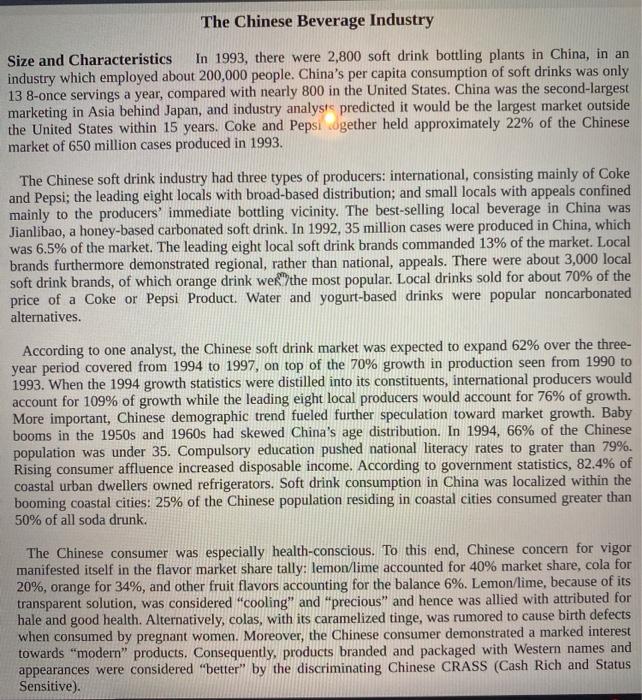
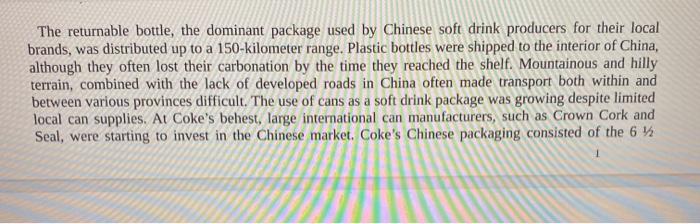
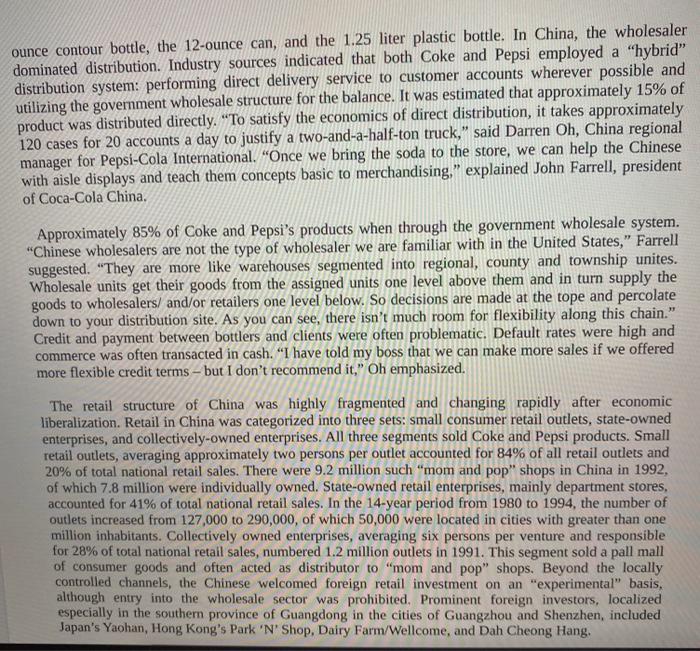
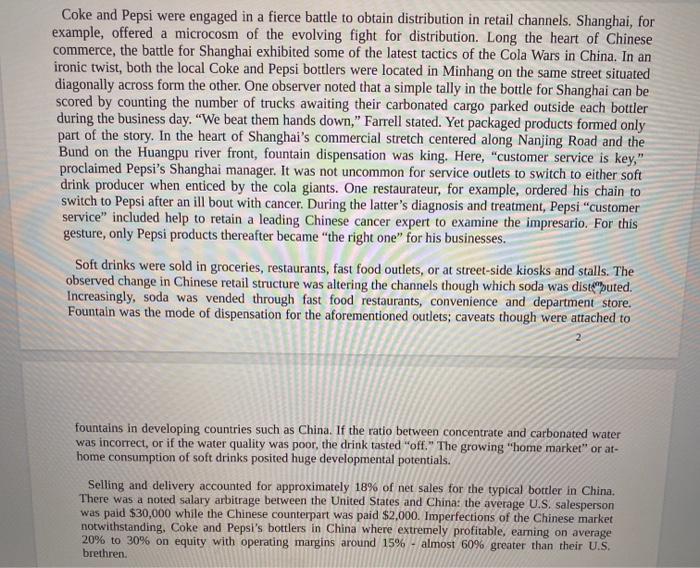
The Chinese Beverage Industry Size and Characteristics In 1993, there were 2,800 soft drink bottling plants in China, in an industry which employed about 200,000 people. China's per capita consumption of soft drinks was only 13 8-once servings a year, compared with nearly 800 in the United States. China was the second-largest marketing in Asia behind Japan, and industry analysts predicted it would be the largest market outside the United States within 15 years. Coke and Pepsi cogether held approximately 22% of the Chinese market of 650 million cases produced in 1993. The Chinese soft drink industry had three types of producers: international, consisting mainly of Coke and Pepsi; the leading eight locals with broad-based distribution; and small locals with appeals confined mainly to the producers' immediate bottling vicinity. The best-selling local beverage in China was Jianlibao, a honey-based carbonated soft drink. In 1992, 35 million cases were produced in China, which was 6.5% of the market. The leading eight local soft drink brands commanded 13% of the market. Local brands furthermore demonstrated regional, rather than national, appeals. There were about 3,000 local soft drink brands, of which orange drink wer"/the most popular. Local drinks sold for about 70% of the price of a Coke or Pepsi Product. Water and yogurt-based drinks were popular noncarbonated alternatives. According to one analyst, the Chinese soft drink market was expected to expand 62% over the three- year period covered from 1994 to 1997, on top of the 70% growth in production seen from 1990 to 1993. When the 1994 growth statistics were distilled into its constituents, international producers would account for 109% of growth while the leading eight local producers would account for 76% of growth. More important, Chinese demographic trend fueled further speculation toward market growth. Baby booms in the 1950s and 1960s had skewed China's age distribution. In 1994, 66% of the Chinese population was under 35. Compulsory education pushed national literacy rates to grater than 79%. Rising consumer affluence increased disposable income. According to government statistics, 82.4% of coastal urban dwellers owned refrigerators. Soft drink consumption in China was localized within the booming coastal cities: 25% of the Chinese population residing in coastal cities consumed greater than 50% of all soda drunk. The Chinese consumer was especially health-conscious. To this end, Chinese concern for vigor manifested itself in the flavor market share tally: lemon/lime accounted for 40% market share, cola for 20%, orange for 34%, and other fruit flavors accounting for the balance 6%. Lemon/lime, because of its transparent solution, was considered "cooling" and "precious" and hence was allied with attributed for hale and good health. Alternatively, colas, with its caramelized tinge, was rumored to cause birth defects when consumed by pregnant women. Moreover, the Chinese consumer demonstrated a marked interest towards "modern" products. Consequently, products branded and packaged with Western names and appearances were considered "better" by the discriminating Chinese CRASS (Cash Rich and Status Sensitive) The returnable bottle, the dominant package used by Chinese soft drink producers for their local brands, was distributed up to a 150-kilometer range. Plastic bottles were shipped to the interior of China, although they often lost their carbonation by the time they reached the shelf. Mountainous and hilly terrain, combined with the lack of developed roads in China often made transport both within and between various provinces difficult. The use of cans as a soft drink package was growing despite limited local can supplies. At Coke's behest, large international can manufacturers, such as Crown Cork and Seal, were starting to invest in the Chinese market. Coke's Chinese packaging consisted of the 6 % ounce contour bottle, the 12-ounce can, and the 1.25 liter plastic bottle. In China, the wholesaler dominated distribution. Industry sources indicated that both Coke and Pepsi employed a "hybrid" distribution system: performing direct delivery service to customer accounts wherever possible and utilizing the government wholesale structure for the balance. It was estimated that approximately 15% of product was distributed directly. To satisfy the economics of direct distribution, it takes approximately 120 cases for 20 accounts a day to justify a two-and-a-half-ton truck," said Darren Oh, China regional manager for Pepsi-Cola International. "Once we bring the soda to the store, we can help the Chinese with aisle displays and teach them concepts basic to merchandising," explained John Farrell, president of Coca-Cola China. Approximately 85% of Coke and Pepsi's products when through the government wholesale system. "Chinese wholesalers are not the type of wholesaler we are familiar with in the United States," Farrell suggested. "They are more like warehouses segmented into regional, county and township unites. Wholesale units get their goods from the assigned units one level above them and in turn supply the goods to wholesalers/ and/or retailers one level below. So decisions are made at the tope and percolate down to your distribution site. As you can see, there isn't much room for flexibility along this chain." Credit and payment between bottlers and clients were often problematic. Default rates were high and commerce was often transacted in cash. I have told my boss that we can make more sales if we offered more flexible credit terms - but I don't recommend it," Oh emphasized. The retail structure of China was highly fragmented and changing rapidly after economic liberalization. Retail in China was categorized into three sets: small consumer retail outlets, state-owned enterprises, and collectively-owned enterprises. All three segments sold Coke and Pepsi products. Small retail outlets, averaging approximately two persons per outlet accounted for 84% of all retail outlets and 20% of total national retail sales. There were 9.2 million such "mom and pop" shops in China in 1992, of which 7.8 million were individually owned. State-owned retail enterprises, mainly department stores, accounted for 41% of total national retail sales. In the 14-year period from 1980 to 1994, the number of outlets increased from 127,000 to 290,000, of which 50,000 were located in cities with greater than one million inhabitants. Collectively owned enterprises, averaging six persons per venture and responsible for 28% of total national retail sales, numbered 1.2 million outlets in 1991. This segment sold a pall mall of consumer goods and often acted as distributor to "mom and pop" shops. Beyond the locally controlled channels, the Chinese welcomed foreign retail investment on an "experimental" basis, although entry into the wholesale sector was prohibited, Prominent foreign investors, localized especially in the southern province of Guangdong in the cities of Guangzhou and Shenzhen, included Japan's Yaohan, Hong Kong's Park 'N' Shop, Dairy Farm/Wellcome, and Dah Cheong Hang. Coke and Pepsi were engaged in a fierce battle to obtain distribution in retail channels. Shanghai, for example, offered a microcosm of the evolving fight for distribution. Long the heart of Chinese commerce, the battle for Shanghai exhibited some of the latest tactics of the Cola Wars in China. In an ironic twist, both the local Coke and Pepsi bottlers were located in Minhang on the same street situated diagonally across form the other. One observer noted that a simple tally in the bottle for Shanghai can be scored by counting the number of trucks awaiting their carbonated cargo parked outside each bottler during the business day. We beat them hands down," Farrell stated. Yet packaged products formed only part of the story. In the heart of Shanghai's commercial stretch centered along Nanjing Road and the Bund on the Huangpu river front, fountain dispensation was king. Here, "customer service is key," proclaimed Pepsi's Shanghai manager. It was not uncommon for service outlets to switch to either soft drink producer when enticed by the cola giants. One restaurateur, for example, ordered his chain to switch to Pepsi after an ill bout with cancer. During the latter's diagnosis and treatment, Pepsi "customer service" included help to retain a leading Chinese cancer expert to examine the impresario. For this gesture, only Pepsi products thereafter became "the right one" for his businesses. Soft drinks were sold in groceries, restaurants, fast food outlets, or at street-side kiosks and stalls. The observed change in Chinese retail structure was altering the channels though which soda was dist">uted. Increasingly, soda was vended through fast food restaurants, convenience and department store. Fountain was the mode of dispensation for the aforementioned outlets; caveats though were attached to fountains in developing countries such as China. If the ratio between concentrate and carbonated water was incorrect, or if the water quality was poor, the drink tasted "off." The growing "home market" or at- home consumption of soft drinks posited huge developmental potentials. Selling and delivery accounted for approximately 18% of net sales for the typical bottler in China. There was a noted salary arbitrage between the United States and China: the average U.S. salesperson was paid $30,000 while the Chinese counterpart was paid $2,000. Imperfections of the Chinese market notwithstanding, Coke and Pepsi's bottlers in China where extremely profitable, earning on average 20% to 30% on equity with operating margins around 15% - almost 60% greater than their U.S. brethren. Bottling franchise rights negotiated by Coke or Pepsi with the government were geographic, and there were many unlicensed areas. In those grey areas, the bottlers competed fiercely with each other - one observer called it a "free for all. The smaller players, such as RC Cola and Dr. Pepper, were importing product or were using production subcontractors. The bottling infrastructure in China was very expensive, and it was hard to penetrate without significant capital investments. A typical bottling plant in China cost $20 million to $25 million to build and consisted of two lines" one exclusively for cans and the other a convertible line for either PET or returnable glass. Industry sources estimated the approximately 100 plants were required to saturate the Chinese market of 1994. The price for a Coke or Pepsi varied by geographic market. For example, in 1994, a can of Coke cost 3.00RMB in Beijing, whereas it cost 2.30-2.70 RMB in Shanghai. Coke and Pepsi used media advertising to promote lifestyle and image. Advertising slots were purchased by directly approaching the main media outlets - television stations, newspapers and radio stations. The contacted medium allocated space under set guidelines, Reserving the right of refusal to publicize material deemed incompatible with established policy. Most media purchases were transacted locally at the provincial level. Though the advertising industry was in its incipient stages and statistic concerning the efficacy of public campaigns was as yet unresolved, television was the medium of promotional choice as an estimated 91% of Chinese urban households owned televisions. In 1994, a 45- second television slot during primetime cost between RMB 25,000 and 45,000. Signs and billboards served an alternative conduit for display. Space was leased by approaching the local office of the Administration of Industry and Commerce and the local neighborhood management committee which rendered decisions concerning spatial allotments. Sponsorship of sports spectacles provided another boulevard for public notice. Government Regulation Historically, the government regulated joint venture agreements with the aim of protecting ht large domestic soft drink industry. There were restrictions imposed on building new plants, on the size of the plants, and the number of tons of concentrated that each plant could produce, bottle, and sell. The foreign cola congestion created by these restrictions waseinally broken by Coke in 1992. Coke was persistent with the Chinese government in requesting approval for the construction of new plants. In late 1992, the Chinese government grated Coke the rights to build 10 new plants. Pepsi received authorization to build 10 new plants in January 1994. The vigor of competition from local brands oscillated along the roller-coaster opinions of government toward foreign businesses. In the early years after entry, Coke could sell only to tourists and other foreigners to guarantee foreign exchange needed for the import of concentrate. Within a short time of Coke's availability, Tianfu, a local Chinese imitation cola, appeared. Tianfu was reported in papers to be "the same as Coca-Cola in color, smell and tasted, but different in its makeup and contents." The Tianfu concoction was futher clamed to possess cure-all effects to strengthen the liver and spleen. By definition, the government in a centrally planned economy subjugated all mechanisms of the value chain from production to sales. The Chinese government had the power to raise wages, alter distribution channels, cancel or approve advertising, reallocate resources, and create instant markets by intervening as a buyer or seller. It was not uncommon, as in its support of Tianfu, for capricious government intervention to reshape company strategies. The Chinese government tried to keep Coke and Pepsi from competing in the same cities, except in Beijing, Shanghai, and Guangzhou. In the most recent agreements, both companies were given exclusive rights to setup bottlers in individual cities. For these new cities exclusive to either Coke or Pepsi, the average income of the aggregate Coke cities was 1,133 RMB versus 659 RMB for the 10 Pepsi cities. The government used the ploy of having Coke and Pepsi big against each other. In the Chongqing, Pepsi outmaneuvered Coke for the franchise by agreeing to keep the local Tianfu soft drink brand alive. Coke wanted only the bottling plant and had planned to discontinue the Tianfu line. Petty jealousies between municipal governments further complicated matters. In general, concessions made to one city would become the baseline for opening bargaining session with other cities. This vicious cycle of "deal sweeteners epitomized the contexity of negotiations with the Chinese government. Such ploys, though, painted the larger canvas of a Chinese cultural wall separating East from West. Viewed from a Western perspective, these cultural traits were obstacles to be scaled; and no cultural obstacle presented a more mired tangle than guanxi. For in attempts to obtain guanxi, foreign ventures were often asked to balance relation building and adherence to Western ethical practices along a razor's edge. Guanxi A Chinese them meaning" connections" or "relations" lined a cultural dimension unfamiliar to many accustomed to business in the West. According to sinologist Lucian Pye: Guanxi involves far more than just the Western notion of social contacts and connections related to influence. In the West, the key to the flow of personal influence in particularistic relations, say, in an "old boy network," is actual acquaintanceship: in the case of guanxi, it is enough that the social roles are seen as related, even though the individuals may not have previously known each other. It is not just that the dividing line between acquaintanceship and friendship is different in the two cultures; there is also a difference in what can be legitimately expected of even the most limited connection. In a culture where power was essentially fluid, guanxi, and whether one had quanxi, often determined the success of failure of ventures. It was therefore unsurprising that Steve Chan, China Region Manager of Coca-Cola China, spent almost 50% of his time cultivating relations with Chinese officials. A sample of Chan's travelogue to China included dinner with the Secretary General of the State Council, a meeting with the head of the Chinese Trademark Department, and a banquet with the Minister of Light Industry. "I sang a karaoke with the vice Minister of Light Industryl. a duet. Karaoke is part of business in China today." Corruption and Fraud In a business environment where the legal outlines of commerce where murky at best, and where prosecution and punishment were often papered over with clemency, corruption was common in China. Coke was adamant in its stand against graft. "If it cost us a deal, it cost us a deal," related Chan. Gray areas existed, though, as Chinese officials often asked fore company- sponsored visits abroad. In addition, negotiations with the Chinese often entailed discussion which lasted beyond the allotted sessions into lunches and dinners. Such out-of-pocket entertainment expenses were often borne by foreign firms, and Chinese guests at times included relatives of relatives of the principals









 Study Help