



Question: hi expert please help me answer questions 1. with the constant changes in the needs of the customers, what would be your suggestions for McDonald
hi expert please help me answer questions 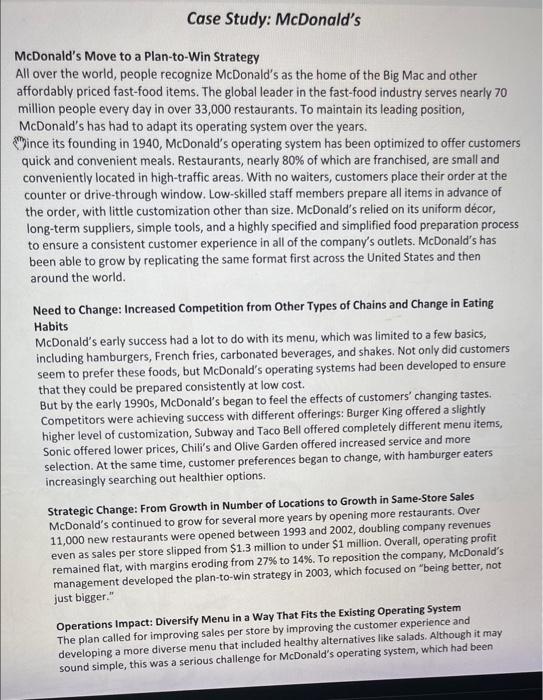
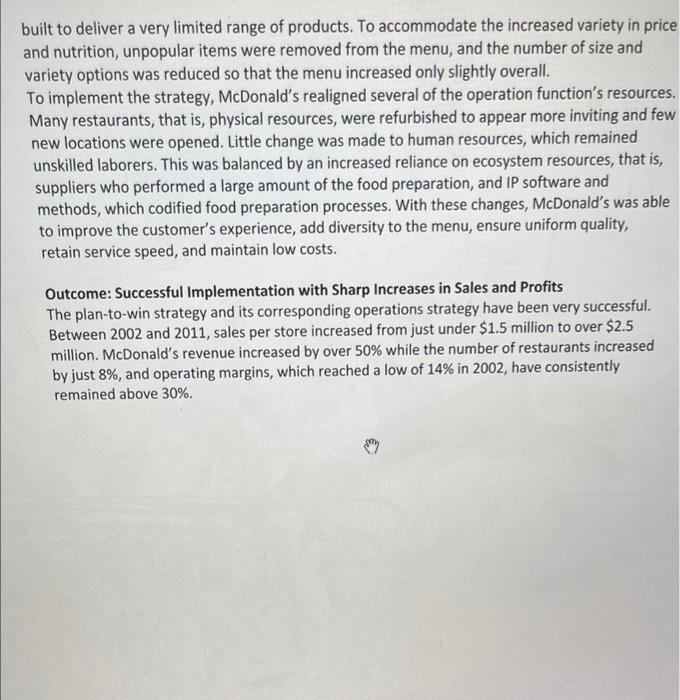
a Case Study: McDonald's McDonald's Move to a Plan-to-Win Strategy All over the world, people recognize McDonald's as the home of the Big Mac and other affordably priced fast-food items. The global leader in the fast-food industry serves nearly 70 million people every day in over 33,000 restaurants. To maintain its leading position, McDonald's has had to adapt its operating system over the years. Mince its founding in 1940, McDonald's operating system has been optimized to offer customers quick and convenient meals. Restaurants, nearly 80% of which are franchised, are small and conveniently located in high-traffic areas. With no waiters, customers place their order at the counter or drive-through window. Low-skilled staff members prepare all items in advance of the order, with little customization other than size. McDonald's relied on its uniform dcor, long-term suppliers, simple tools, and a highly specified and simplified food preparation process to ensure a consistent customer experience in all of the company's outlets. McDonald's has been able to grow by replicating the same format first across the United States and then around the world. Need to Change: Increased Competition from Other Types of Chains and Change in Eating Habits McDonald's early success had a lot to do with its menu, which was limited to a few basics, including hamburgers, French fries, carbonated beverages, and shakes, Not only did customers seem to prefer these foods, but McDonald's operating systems had been developed to ensure that they could be prepared consistently at low cost. But by the early 1990s, McDonald's began to feel the effects of customers' changing tastes. Competitors were achieving success with different offerings: Burger King offered a slightly higher level of customization, Subway and Taco Bell offered completely different menu items, Sonic offered lower prices, Chili's and Olive Garden offered increased service and more selection. At the same time, customer preferences began to change with hamburger eaters increasingly searching out healthier options. Strategic Change: From Growth in Number of Locations to Growth in Same-Store Sales McDonald's continued to grow for several more years by opening more restaurants. Over 11,000 new restaurants were opened between 1993 and 2002, doubling company revenues even as sales per store slipped from $1.3 million to under $1 million. Overall, operating profit remained flat, with margins eroding from 27% to 14%. To reposition the company, McDonald's management developed the plan-to-win strategy in 2003, which focused on "being better, not just bigger." Operations Impact: Diversify Menu in a Way That Fits the Existing Operating System The plan called for improving sales per store by improving the customer experience and developing a more diverse menu that included healthy alternatives like salads. Although it may sound simple, this was a serious challenge for McDonald's operating system, which had been built to deliver a very limited range of products. To accommodate the increased variety in price and nutrition, unpopular items were removed from the menu, and the number of size and variety options was reduced so that the menu increased only slightly overall. To implement the strategy, McDonald's realigned several of the operation function's resources. Many restaurants, that is, physical resources, were refurbished to appear more inviting and few new locations were opened. Little change was made to human resources, which remained unskilled laborers. This was balanced by an increased reliance on ecosystem resources, that is, suppliers who performed a large amount of the food preparation, and IP software and methods, which codified food preparation processes. With these changes, McDonald's was able to improve the customer's experience, add diversity to the menu, ensure uniform quality, retain service speed, and maintain low costs. Outcome: Successful Implementation with Sharp Increases in Sales and Profits The plan-to-win strategy and its corresponding operations strategy have been very successful. Between 2002 and 2011, sales per store increased from just under $1.5 million to over $2.5 million. McDonald's revenue increased by over 50% while the number of restaurants increased by just 8%, and operating margins, which reached a low of 14% in 2002, have consistently remained above 30%
1. with the constant changes in the needs of the customers, what would be your suggestions for McDonald to learn from this particular story you have just read. Try to answer to term of strategy change that will effect operations as well.
2. what do you think the next change in trends in fast food restaurant would be?
thank you please witg no plagiarism
Step by Step Solution
There are 3 Steps involved in it
1 Expert Approved Answer
Step: 1 Unlock

Question Has Been Solved by an Expert!
Get step-by-step solutions from verified subject matter experts
Step: 2 Unlock
Step: 3 Unlock