







Question: Hi, for the question below, the answer is provided. However, I could not understand the answer. For R2, why does it use ((80 000 *
Hi, for the question below, the answer is provided. However, I could not understand the answer. For R2, why does it use ((80 000 * 8)/500k)but does not just use one bit.
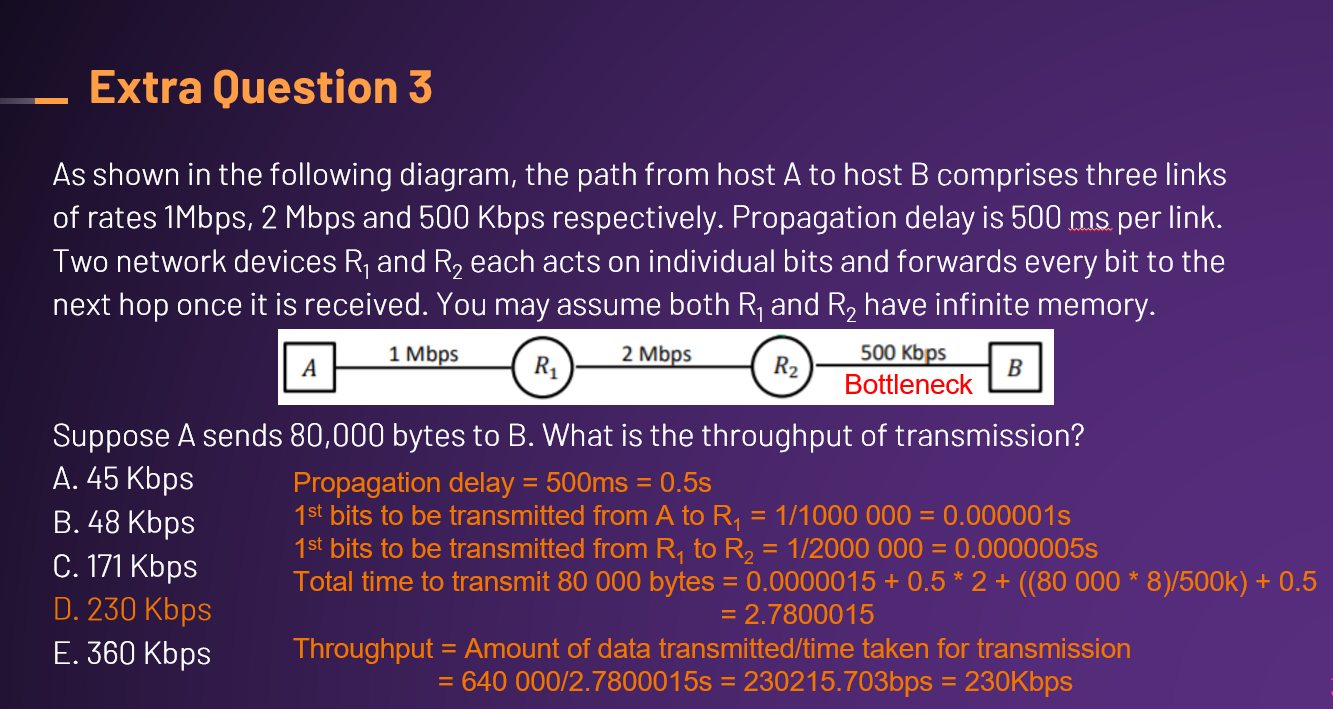
Extra Question 3 A B As shown in the following diagram, the path from host A to host B comprises three links of rates 1Mbps, 2 Mbps and 500 Kbps respectively. Propagation delay is 500 ms per link. Two network devices R, and R2 each acts on individual bits and forwards every bit to the next hop once it is received. You may assume both R, and Ry have infinite memory. 1 Mbps 2 Mbps 500 Kbps R1 R2 Bottleneck Suppose A sends 80,000 bytes to B. What is the throughput of transmission? A. 45 Kbps Propagation delay = 500ms = 0.5s B. 48 Kbps 1st bits to be transmitted from A to R1 = 1/1000 000 = 0.000001s 1st bits to be transmitted from R, to R2 = 1/2000 000 = 0.00000055 C. 171 Kbps Total time to transmit 80 000 bytes = 0.0000015 +0.5 * 2 + ((80 000 * 8)/500k) + 0.5 D. 230 Kbps = 2.7800015 E. 360 Kbps Throughput = Amount of data transmitted/time taken for transmission = 640 000/2.7800015s = 230215.703bps = 230Kbps
Step by Step Solution
There are 3 Steps involved in it

Get step-by-step solutions from verified subject matter experts
 Study Help