



Question: hi guys would you please help me see this question attached below? Consider an economy that lasts for 2 periods, t = 1,2. There are
hi guys would you please help me see this question attached below?
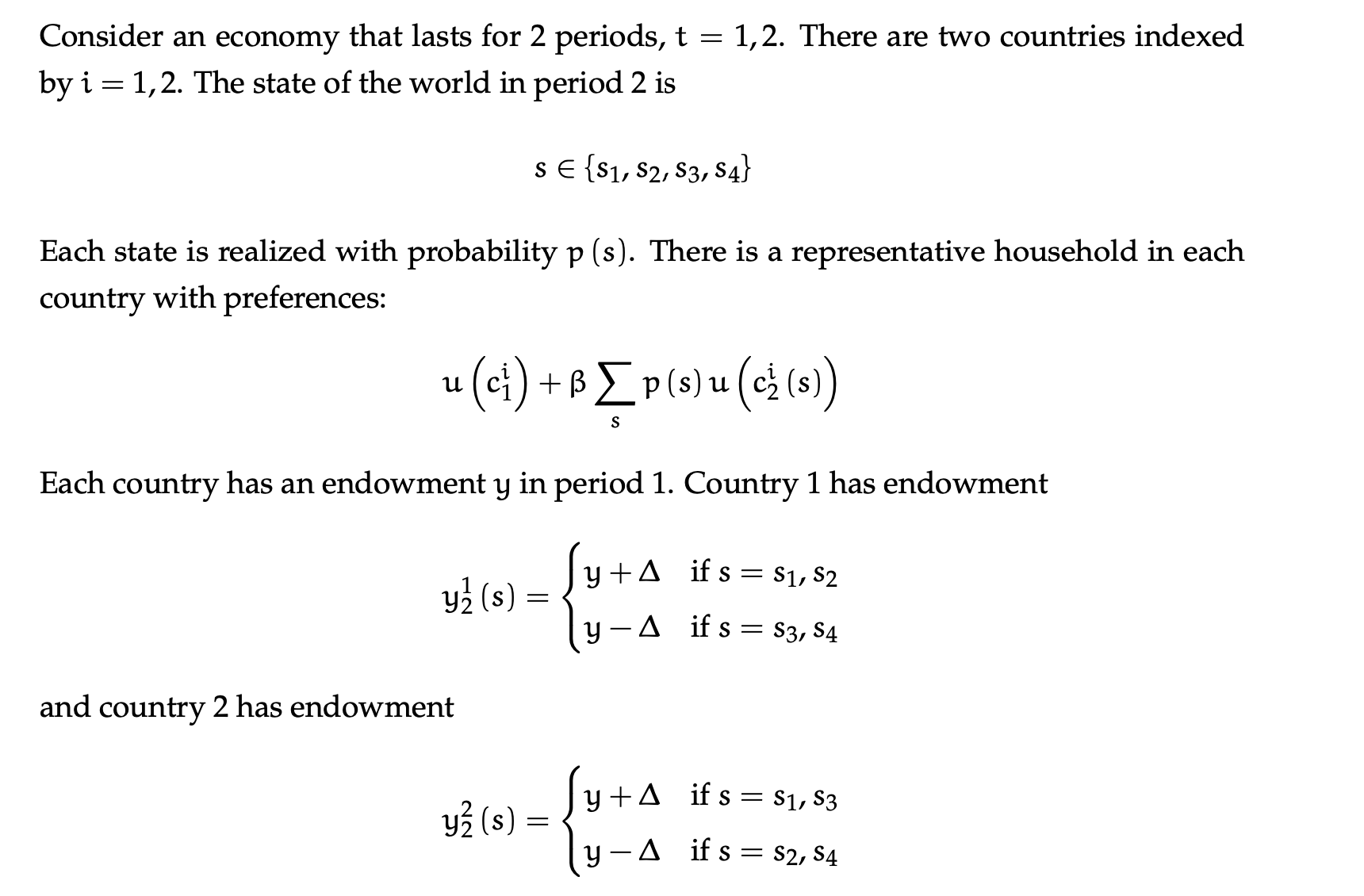
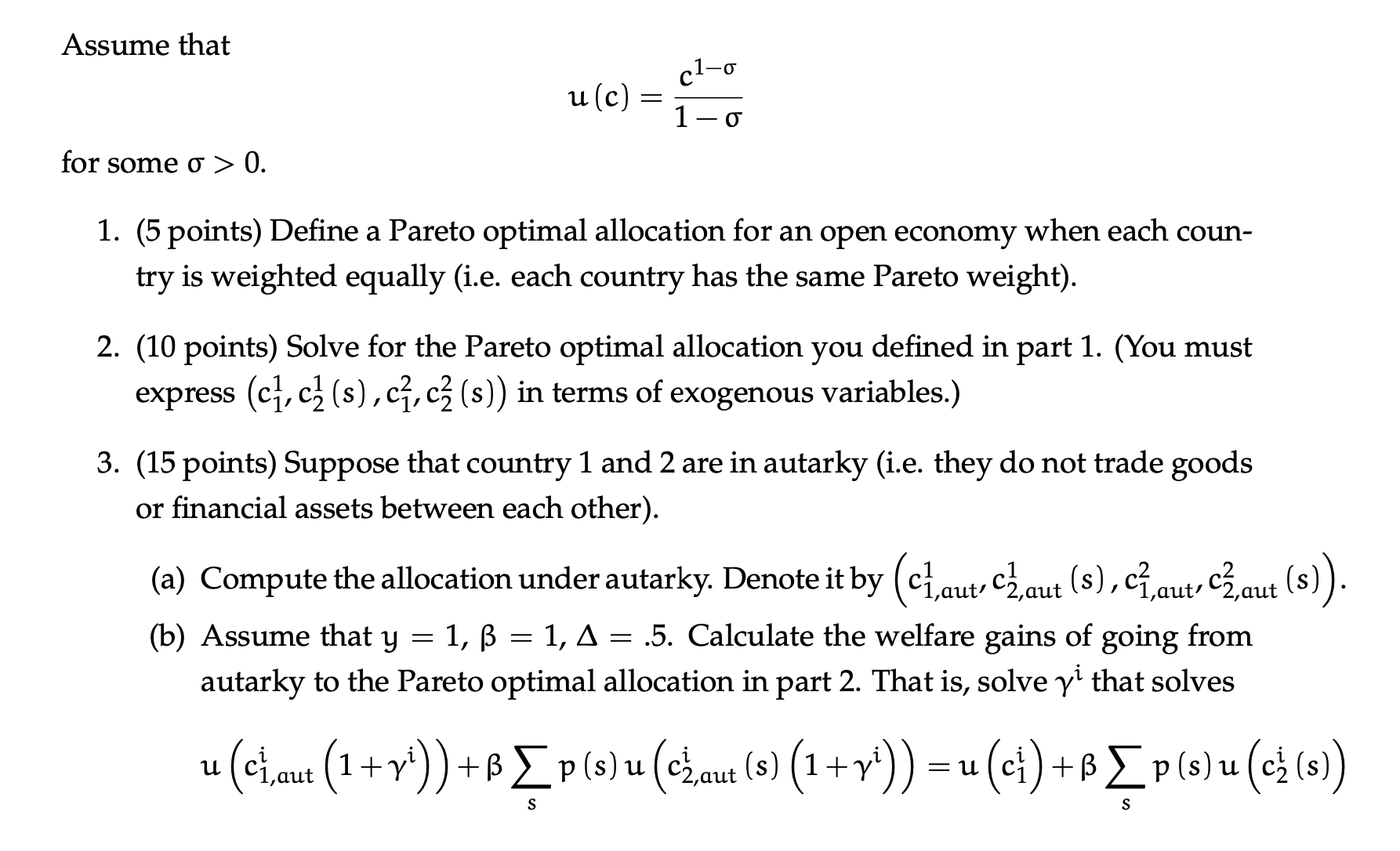
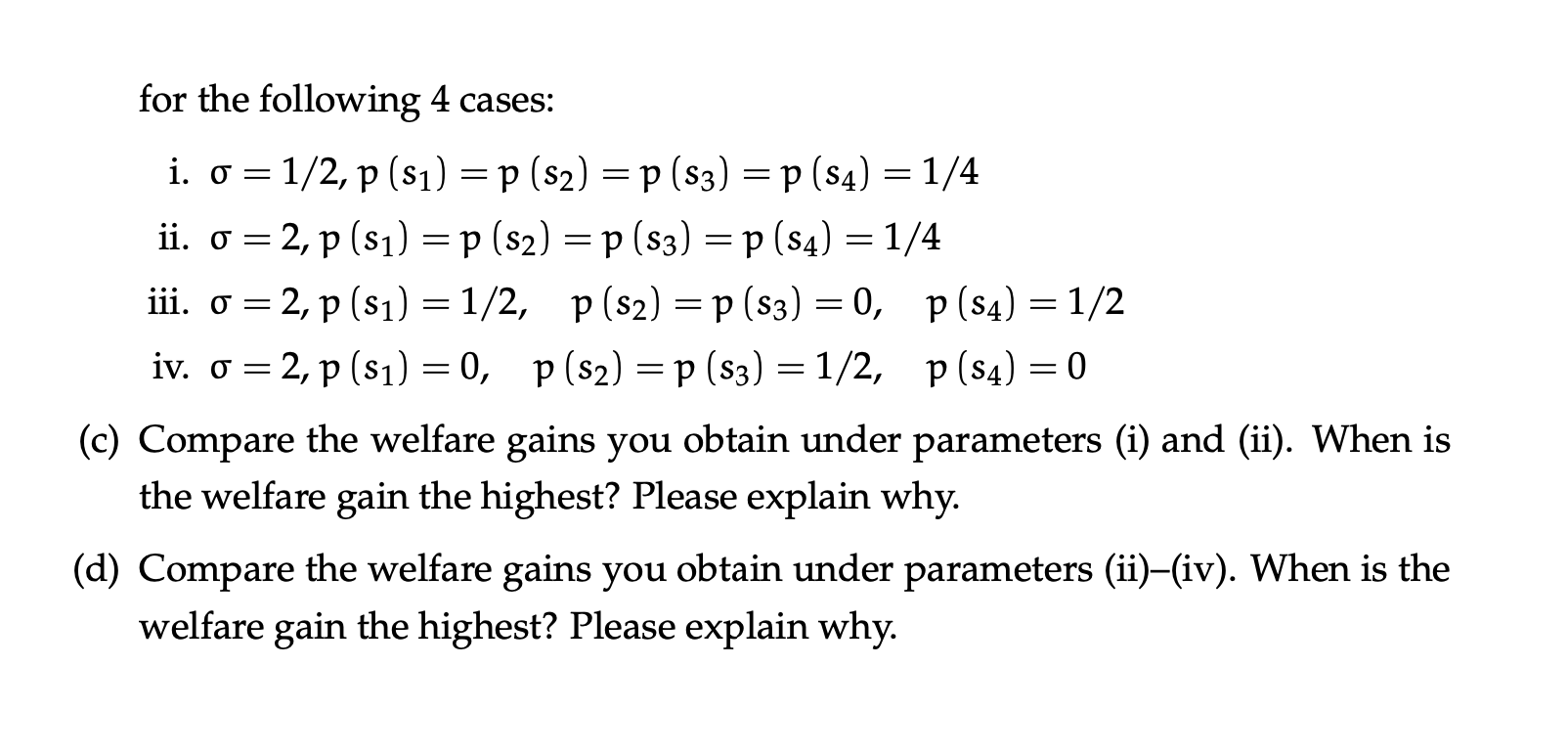
Consider an economy that lasts for 2 periods, t = 1,2. There are two countries indexed by i = 1,2. The state of the world in period 2 is s e {31, 3283,84} Each state is realized with probability p (3). There is a representative household in each country with preferences: u (c1) + [5 Zp (s) u (c5 (5)) Each country has an endowment y in period 1. Country 1 has endowment 92 ll) y+A ifs=sl,sz S : yA if3233,s4 and country 2 has endowment y+A ifs=sl,53 yA ifs=sz,s4 Assume that cl-o u(C) = 1-0 for some o > 0. 1. (5 points) Define a Pareto optimal allocation for an open economy when each coun- try is weighted equally (i.e. each country has the same Pareto weight). 2. (10 points) Solve for the Pareto optimal allocation you defined in part 1. (You must express (c1, c2 (s) , ca, c? (s) ) in terms of exogenous variables.) 3. (15 points) Suppose that country 1 and 2 are in autarky (i.e. they do not trade goods or financial assets between each other). (a) Compute the allocation under autarky. Denote it by (C],aut, C2,aut (s) , C,aut, C2, aut (s) ). (b) Assume that y = 1, B = 1, A = .5. Calculate the welfare gains of going from autarky to the Pareto optimal allocation in part 2. That is, solve y' that solves u ci,aut ( 1 + y' ) ) +B [ p (s)u cz, aut (s) ( 1 + y') ) = u (c; ) + B [ p (s)u (cz (s)) S Sfor the following 4 cases: i. o = 1/2, p ($1) = p ($2) = p ($3) = p ($4) = 1/4 ii. o = 2, p (s1) = p ($2) = p ($3) = p ($4) = 1/4 iii. o = 2, p (s1) = 1/2, p (s2) = p ($3) = 0, p($4) = 1/2 iv. o = 2, p (s1) = 0, p ($2) = p ($3) = 1/2, p ($4) = 0 (c) Compare the welfare gains you obtain under parameters (i) and (ii). When is the welfare gain the highest? Please explain why. (d) Compare the welfare gains you obtain under parameters (ii)-(iv). When is the welfare gain the highest? Please explain why
Step by Step Solution
There are 3 Steps involved in it

Get step-by-step solutions from verified subject matter experts