







Question: Hi . help me with this Complete the following problems showing your work and clearly communicating your answers. Submit this assignment via email by making
Hi . help me with this
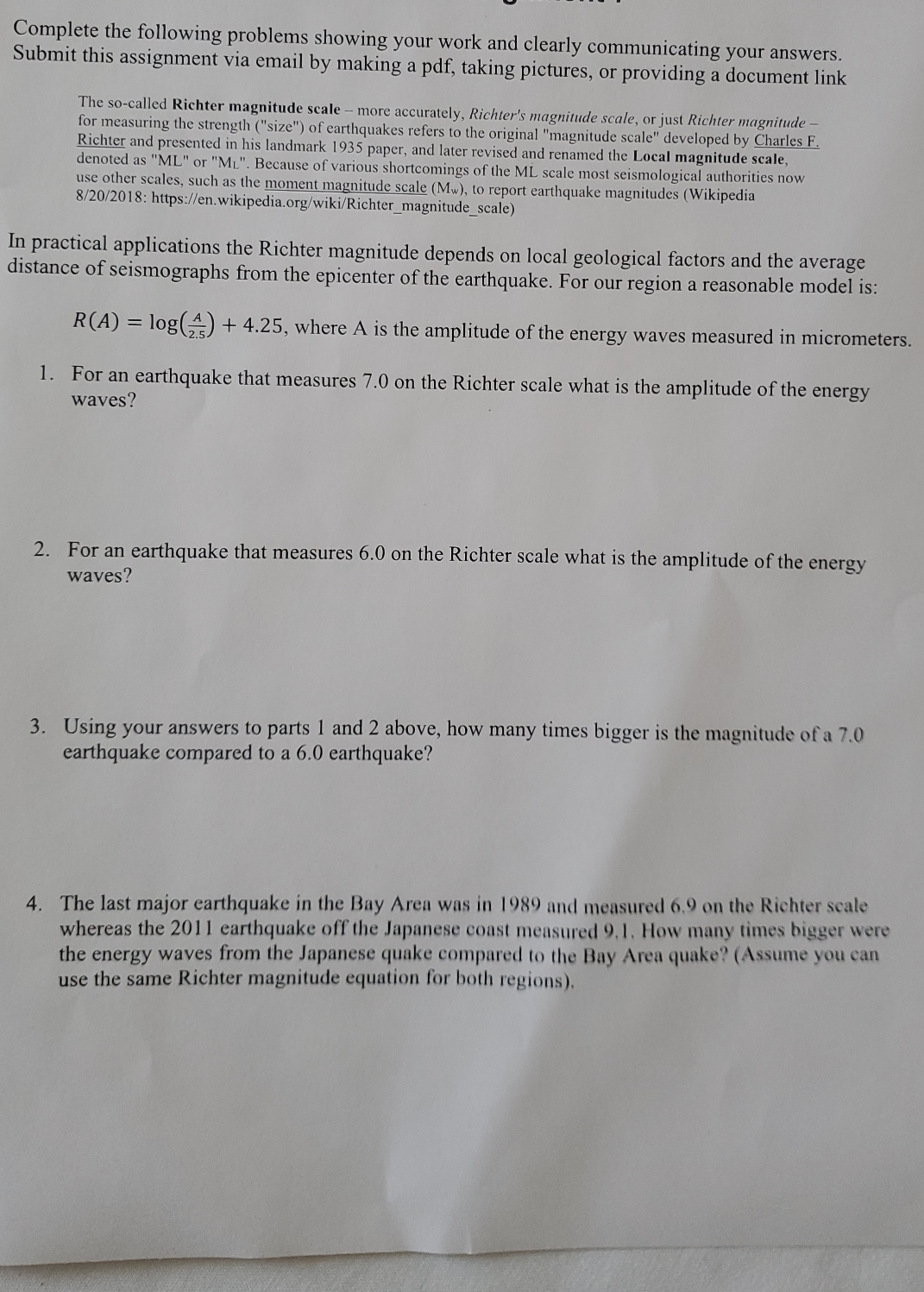
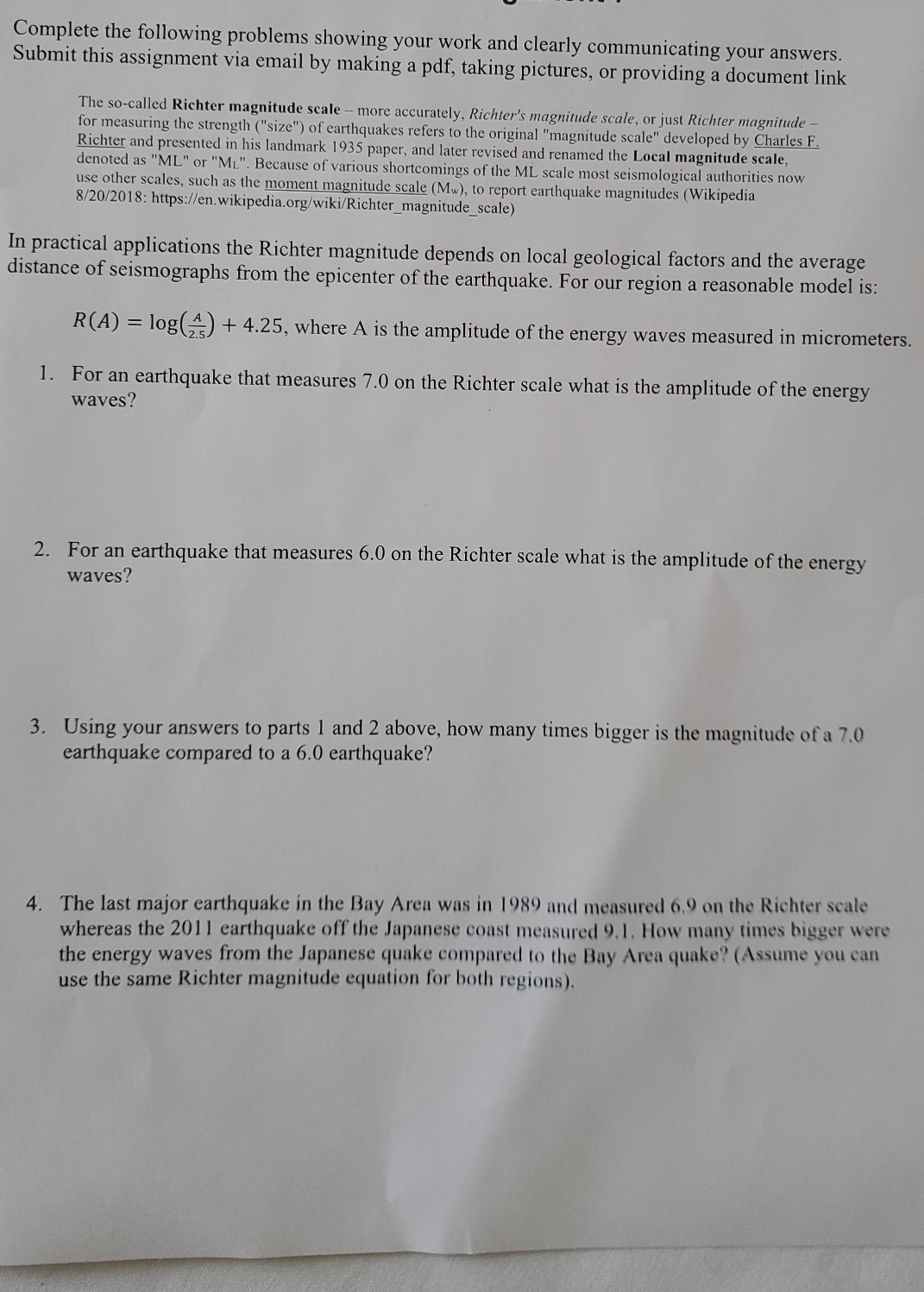
Complete the following problems showing your work and clearly communicating your answers. Submit this assignment via email by making a pdf, taking pictures, or providing a document link The so-called Richter magnitude scale - more accurately, Richter's magnitude scale, or just Richter magnitude - for measuring the strength ("size") of earthquakes refers to the original "magnitude scale" developed by Charles F. Richter and presented in his landmark 1935 paper, and later revised and renamed the Local magnitude scale, denoted as "ML" or "ML". Because of various shortcomings of the ML scale most seismological authorities now use other scales, such as the moment magnitude scale (Mw), to report earthquake magnitudes (Wikipedia 8/20/2018: https://en.wikipedia.org/wiki/Richter_magnitude_scale) In practical applications the Richter magnitude depends on local geological factors and the average distance of seismographs from the epicenter of the earthquake. For our region a reasonable model is: R(A) = log(4) + 4.25, where A is the amplitude of the energy waves measured in micrometers. 1. For an earthquake that measures 7.0 on the Richter scale what is the amplitude of the energy waves? 2. For an earthquake that measures 6.0 on the Richter scale what is the amplitude of the energy waves? 3. Using your answers to parts 1 and 2 above, how many times bigger is the magnitude of a 7.0 earthquake compared to a 6.0 earthquake? 4. The last major earthquake in the Bay Area was in 1989 and measured 6.9 on the Richter scale whereas the 2011 earthquake off the Japanese coast measured 9,1. How many times bigger were the energy waves from the Japanese quake compared to the Bay Area quake? (Assume you can use the same Richter magnitude equation for both regions)
Step by Step Solution
There are 3 Steps involved in it

Get step-by-step solutions from verified subject matter experts
 Study Help