







Question: Hi, I have started this problem however, I am unsure how to finish the rest. Are birthdays evenly distributed throughout the year, or are they
Hi, I have started this problem however, I am unsure how to finish the rest.
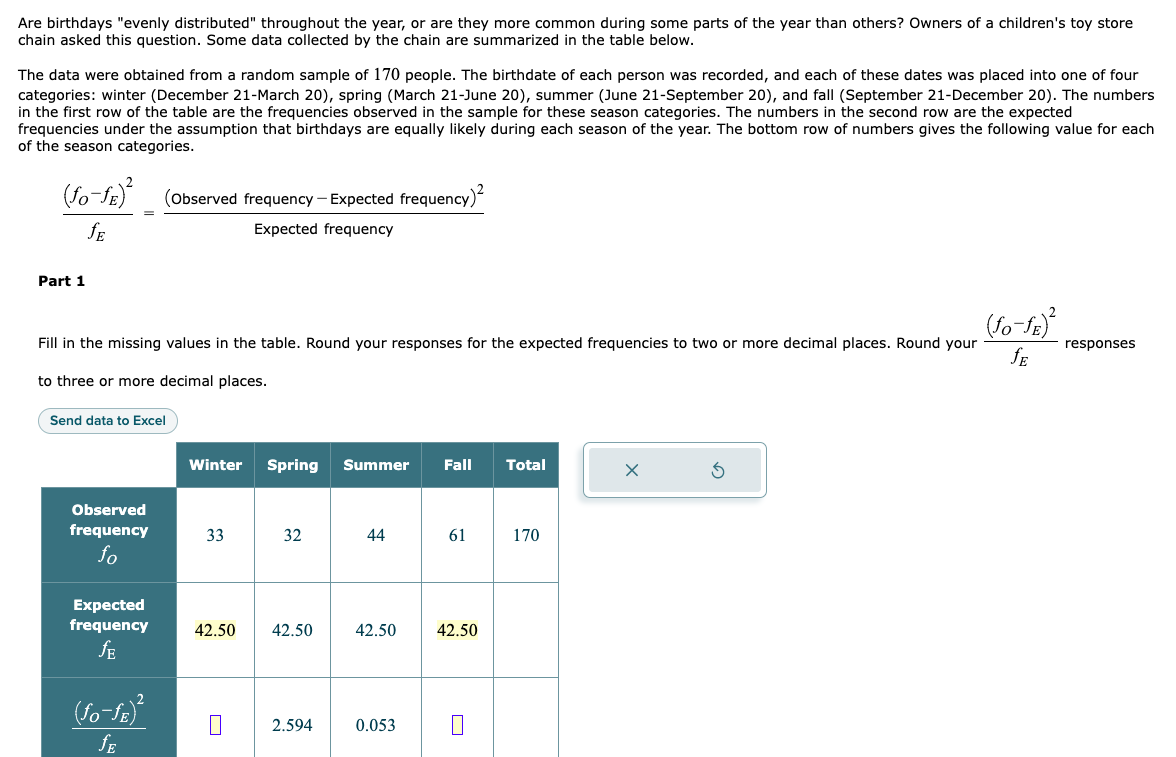
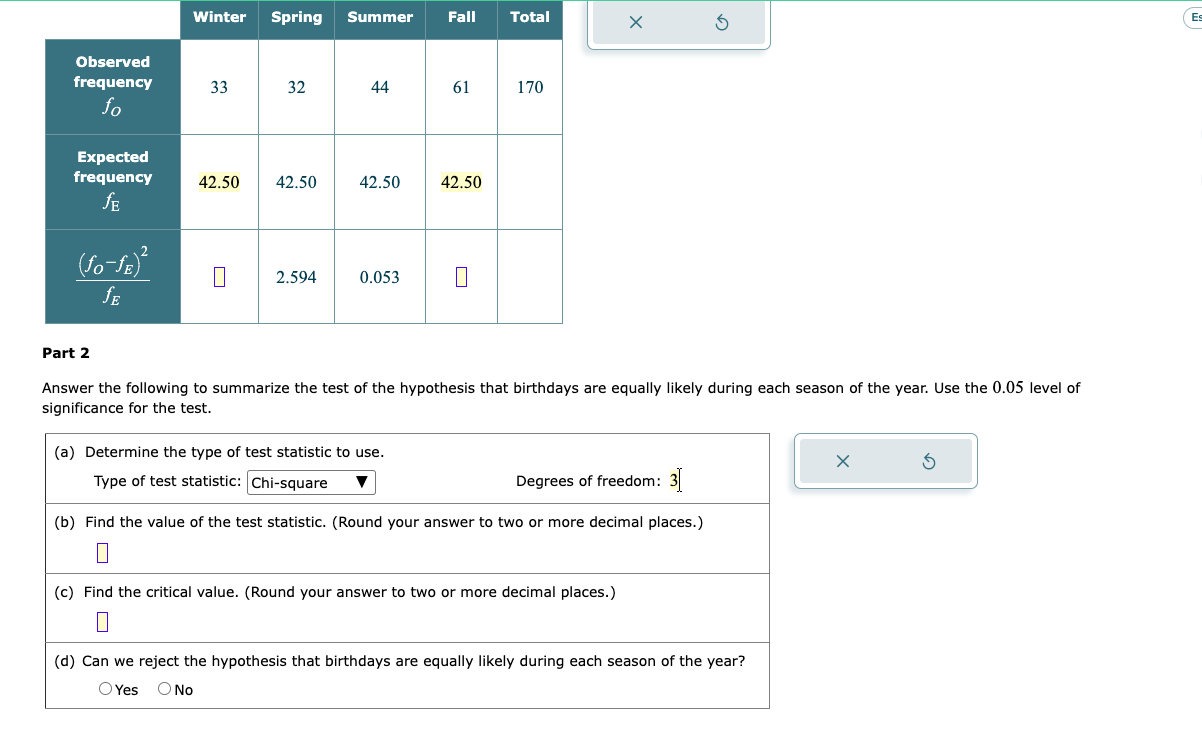
Are birthdays "evenly distributed" throughout the year, or are they more common during some parts of the year than others? Owners of a children's toy store chain asked this question. Some data collected by the chain are summarized in the table below. The data were obtained from a random sample of 1T0 people. The birthdate of each person was recorded, and each of these dates was placed into one of four categories: winter (December 21March 20), spring (March 21June 20), summer (June 21September 20), and fall (September 21December 20). The numbers in the rst row of the table are the frequencies observed in the sample for these season categories. The numbers in the second row are the expected frequencies under the assumption that birthdays are equally likely during each season of the year. The bottom row of numbers gives the following value for each of the season categories. 2 (f0 TfE) (Observed frequency 7 Expected frequency)2 fE Expected frequency Part 1 (f0 19): f5 Fill in the missing values in the table. Round your responses for the expected frequencies to two or more decimal places. Round your responses to three or more decimal places. Send data to Excel Winter Spring Summer Fall Total Observed freq uency f0 Expected frequency 1E Winter Spring Summer Fall Total X 53 Observed frequency fa Expected frequency 1;- Part 2 Answer the following to summarize the test of the hypothesis that birthdays are equally likely during each season of the year. Use the 0.05 level of signicance for the test. (a) Determine the type of test statistic to use. X 53 Type of test statistic: Chisquare Y Degrees of freedom: 31 (b) Find the value ofthe test statistic. (Round your answer to two or more decimal places.) (c) Find the critical value. (Round your answer to two or more decimal places.) (d) Can we reject the hypothesis that birthdays are equally likely during each season of the year? OYes ONO
Step by Step Solution
There are 3 Steps involved in it

Get step-by-step solutions from verified subject matter experts
 Study Help