Question: Hi, I need help calculating the ratios on this Excel sheet, please also explain all the details of the calculations. For example, for each ratio

Hi, I need help calculating the ratios on this Excel sheet, please also explain all the details of the calculations. For example, for each ratio expain what numbers were used in the numerator and what numbers were used in the denominator.

here's the link to the excel sheet and a photo

https://drive.google.com/file/d/10Nn7KqLJ_Hzp7oy6AdvioaiUunA9HSmt/view?usp=sharing
Hi, I need help calculating the ratios on thisHi, I need help calculating the ratios on thisHi, I need help calculating the ratios on this
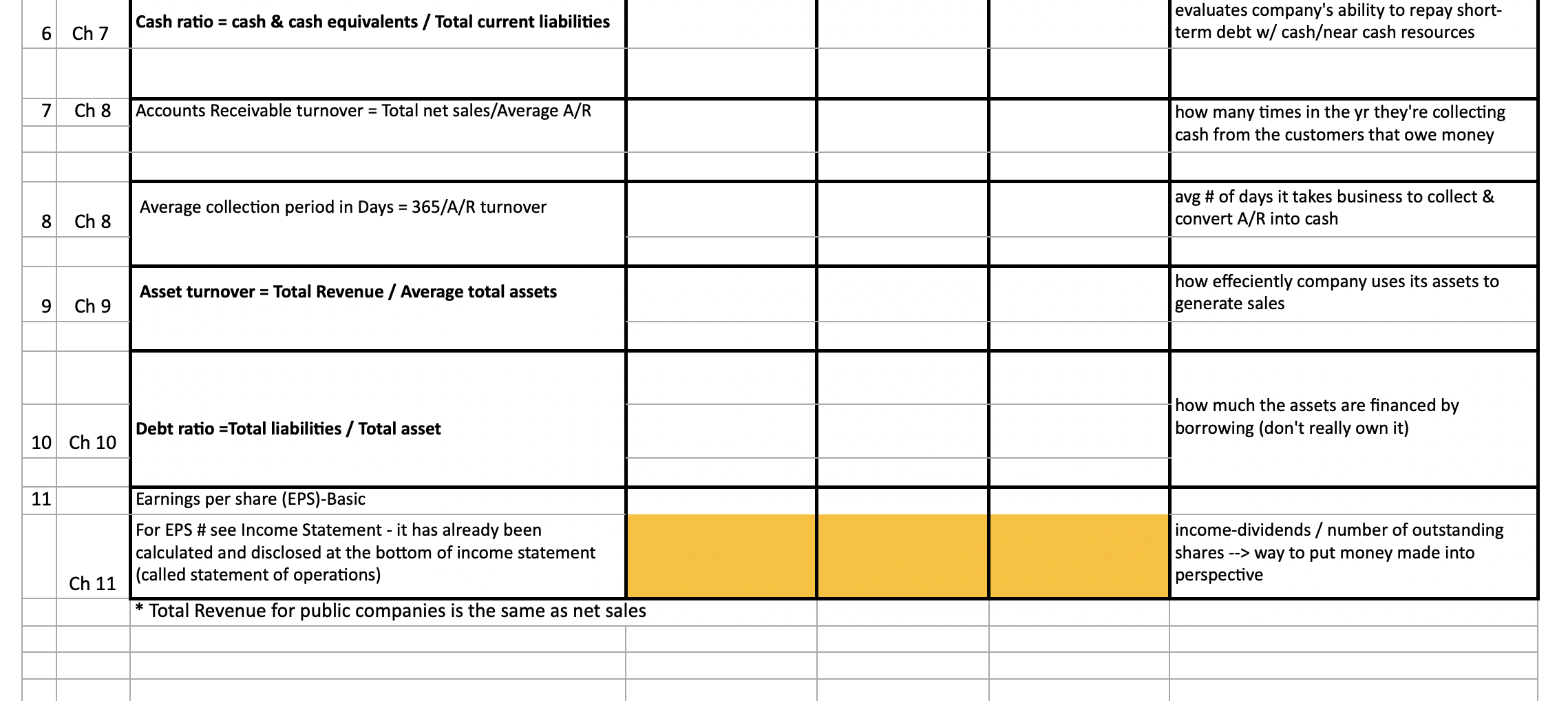
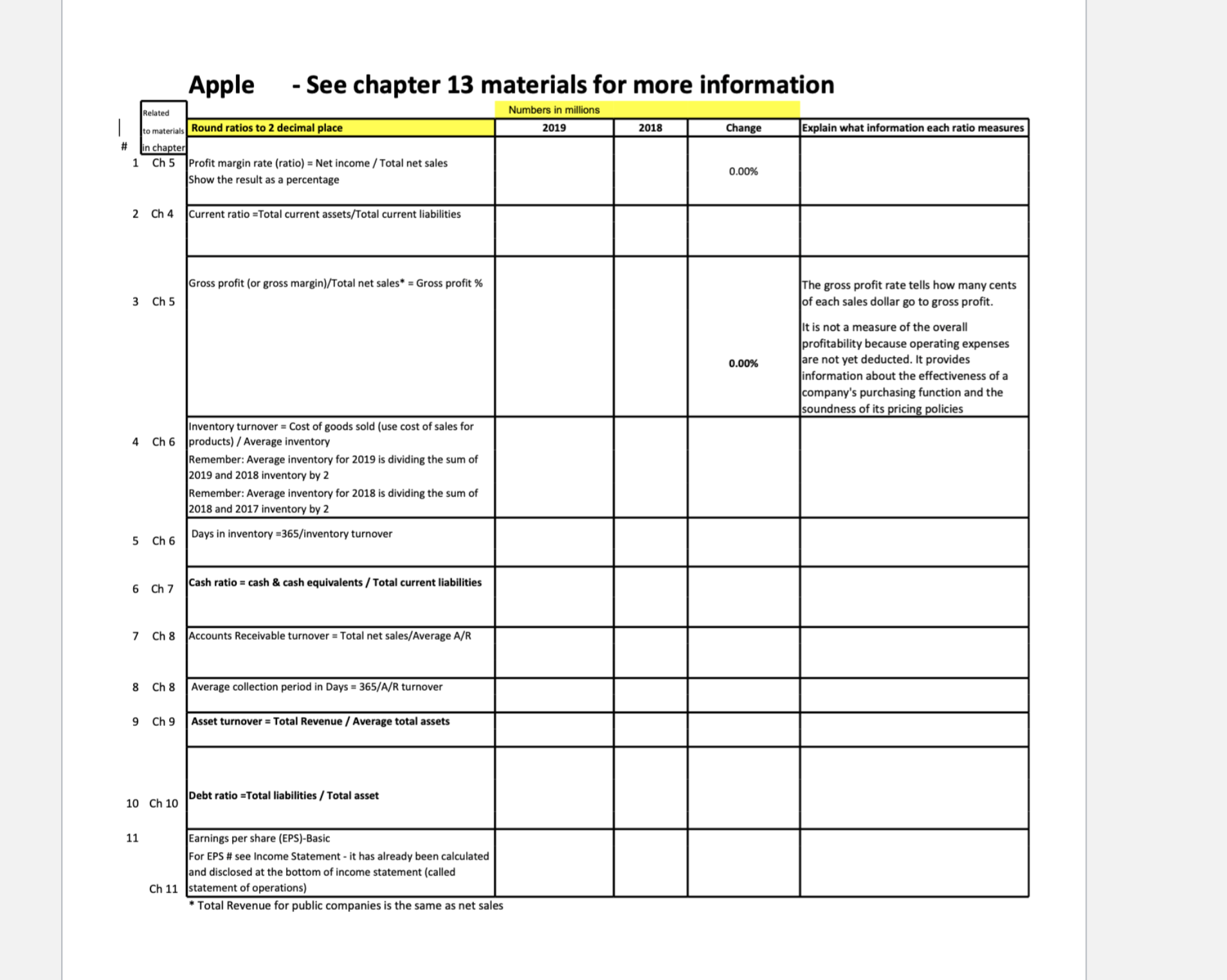
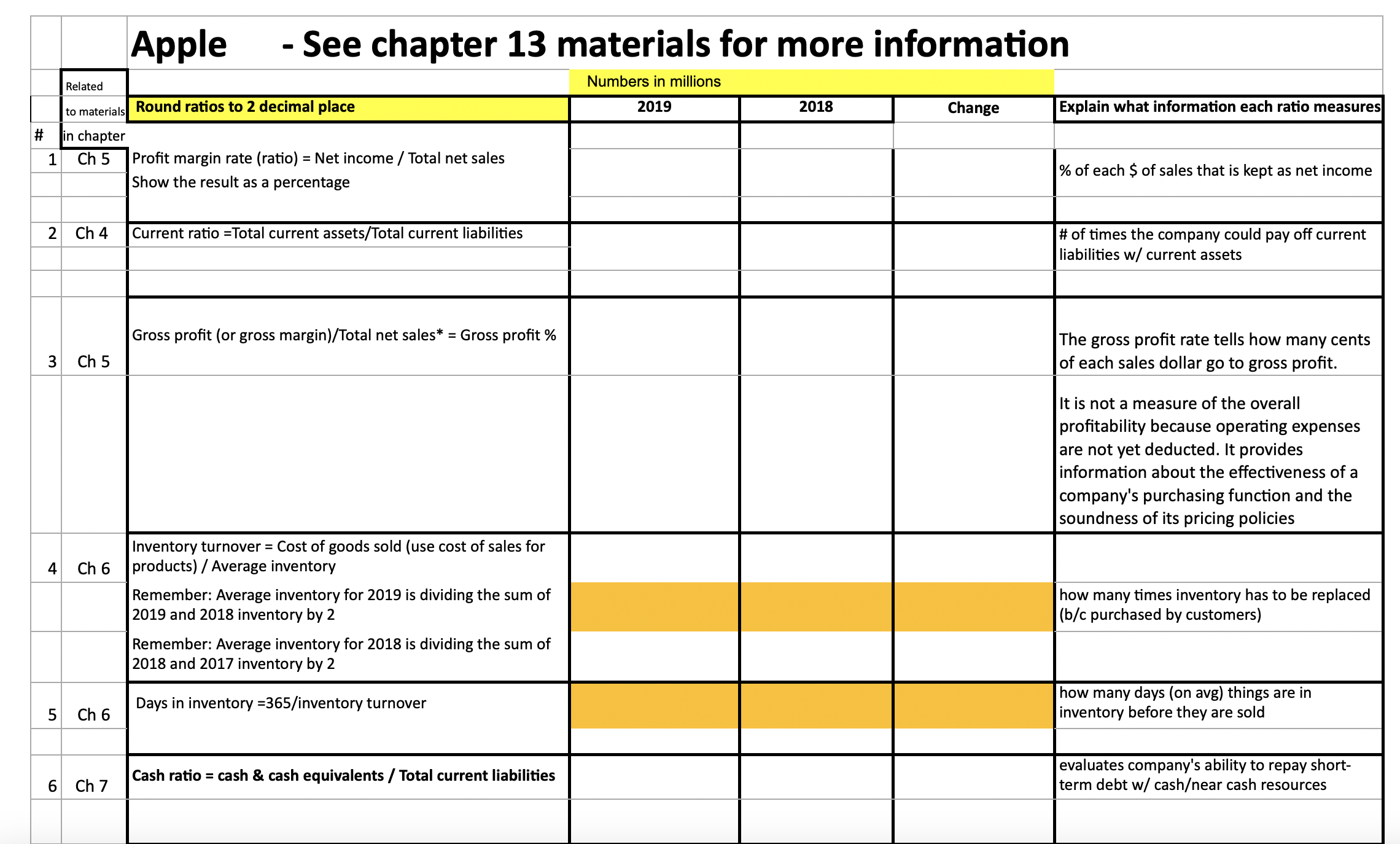
Apple - See chapter 13 materials for more information Related Numbers in millions to materials Round ratios to 2 decimal place 2019 2018 Change Explain what information each ratio measures n chapter 1 Ch 5 Profit margin rate (ratio) = Net income / Total net sales % of each $ of sales that is kept as net income Show the result as a percentage 2 Ch 4 Current ratio =Total current assets/Total current liabilities # of times the company could pay off current liabilities w/ current assets Gross profit (or gross margin)/Total net sales* = Gross profit % The gross profit rate tells how many cents 3 Ch 5 of each sales dollar go to gross profit. It is not a measure of the overall profitability because operating expenses are not yet deducted. It provides information about the effectiveness of a company's purchasing function and the soundness of its pricing policies nventory turnover = Cost of goods sold (use cost of sales for 4 Ch 6 products) / Average inventory Remember: Average inventory for 2019 is dividing the sum of how many times inventory has to be replaced 2019 and 2018 inventory by 2 (b/c purchased by customers) Remember: Average inventory for 2018 is dividing the sum of 2018 and 2017 inventory by 2 how many days (on avg) things are in 5 Ch 6 Days in inventory =365/inventory turnover inventory before they are sold Cash ratio = cash & cash equivalents / Total current liabilities evaluates company's ability to repay short- 6 Ch 7 term debt w/ cashear cash resourcesCash ratio = cash & cash equivalents / Total current liabilities evaluates company's ability to repay short- 6 Ch 7 term debt w/ cashear cash resources 7 Ch 8 Accounts Receivable turnover = Total net sales/Average A/R how many times in the yr they're collecting cash from the customers that owe money Average collection period in Days = 365/A/R turnover avg # of days it takes business to collect & 8 Ch 8 convert A/R into cash how effectently company uses its assets to 9 Ch 9 Asset turnover = Total Revenue / Average total assets generate sales how much the assets are financed by Debt ratio =Total liabilities / Total asset 10 Ch 10 borrowing (don't really own it) 11 Earnings per share (EPS)-Basic For EPS # see Income Statement - it has already been income-dividends / number of outstanding calculated and disclosed at the bottom of income statement shares --> way to put money made into Ch 11 (called statement of operations) perspective * Total Revenue for public companies is the same as net salesApple - See chapter 13 materials for more information Related Numbers in millions to materials Round ratios to 2 decimal place 2019 2018 Change Explain what information each ratio measures in chapter Ch 5 Profit margin rate (ratio) = Net income / Total net sales 0.00% Show the result as a percentage 2 Ch 4 Current ratio =Total current assets/Total current liabilities Gross profit (or gross margin)/Total net sales* = Gross profit % The gross profit rate tells how many cents 3 Ch 5 of each sales dollar go to gross profit It is not a measure of the overall profitability because operating expenses 0.00% are not yet deducted. It provides information about the effectiveness of a company's purchasing function and the soundness of its pricing policies Inventory turnover = Cost of goods sold (use cost of sales for Ch 6 products) / Average inventory Remember: Average inventory for 2019 is dividing the sum of 2019 and 2018 inventory by 2 Remember: Average inventory for 2018 is dividing the sum of 2018 and 2017 inventory by 2 5 Ch 6 Days in inventory =365/inventory turnover 6 Ch 7 Cash ratio = cash & cash equivalents / Total current liabilities Ch 8 Accounts Receivable turnover = Total net sales/Average A/R 8 Ch 8 Average collection period in Days = 365/A/R turnover 9 Ch 9 Asset turnover = Total Revenue / Average total assets 10 Ch 10 Debt ratio =Total liabilities / Total asset 11 Earnings per share (EPS)-Basic For EPS # see Income Statement - it has already been calculated and disclosed at the bottom of income statement (called Ch 11 statement of operations) * Total Revenue for public companies is the same as net sales

Step by Step Solution

There are 3 Steps involved in it

1 Expert Approved Answer
Step: 1 Unlock blur-text-image

Question Has Been Solved by an Expert!

Get step-by-step solutions from verified subject matter experts

Step: 2 Unlock
Step: 3 Unlock

Students Have Also Explored These Related Finance Questions!