







Question: Hi, I need help understanding this problem please. Thank you for your time. 2. Consider the following Bayesian game. Nature chooses the type o of
Hi, I need help understanding this problem please. Thank you for your time.
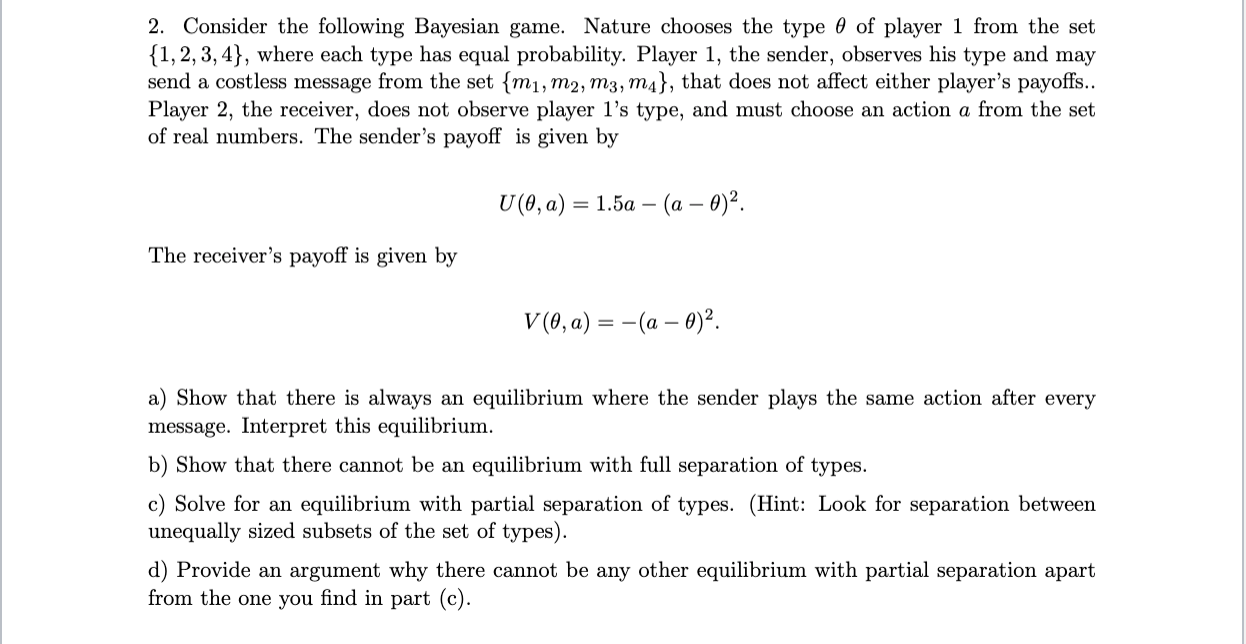
2. Consider the following Bayesian game. Nature chooses the type o of player 1 from the set {1,2,3,4}, where each type has equal probability. Player 1, the sender, observes his type and may send a costless message from the set {m1, M2, M3, m4}, that does not affect either player's payoffs.. Player 2, the receiver, does not observe player l's type, and must choose an action a from the set of real numbers. The sender's payoff is given by U(0,a) = 1.5a (a 6)2. The receiver's payoff is given by V(0,a) = -(a 0) a) Show that there is always an equilibrium where the sender plays the same action after every message. Interpret this equilibrium. b) Show that there cannot be an equilibrium with full separation of types. c) Solve for an equilibrium with partial separation of types. (Hint: Look for separation between unequally sized subsets of the set of types). d) Provide an argument why there cannot be any other equilibrium with partial separation apart from the one you find in part (c). 2. Consider the following Bayesian game. Nature chooses the type o of player 1 from the set {1,2,3,4}, where each type has equal probability. Player 1, the sender, observes his type and may send a costless message from the set {m1, M2, M3, m4}, that does not affect either player's payoffs.. Player 2, the receiver, does not observe player l's type, and must choose an action a from the set of real numbers. The sender's payoff is given by U(0,a) = 1.5a (a 6)2. The receiver's payoff is given by V(0,a) = -(a 0) a) Show that there is always an equilibrium where the sender plays the same action after every message. Interpret this equilibrium. b) Show that there cannot be an equilibrium with full separation of types. c) Solve for an equilibrium with partial separation of types. (Hint: Look for separation between unequally sized subsets of the set of types). d) Provide an argument why there cannot be any other equilibrium with partial separation apart from the one you find in part (c)
Step by Step Solution
There are 3 Steps involved in it

Get step-by-step solutions from verified subject matter experts
 Study Help