


Question: Hi I need help with #45-63, all true and false, if its false can you please give short explanation. % In Erereises 4564. deremrine whether

Hi I need help with #45-63, all true and false, if its false can you please give short explanation.
Hi I need help with #45-63, all true and false,Hi I need help with #45-63, all true and false,
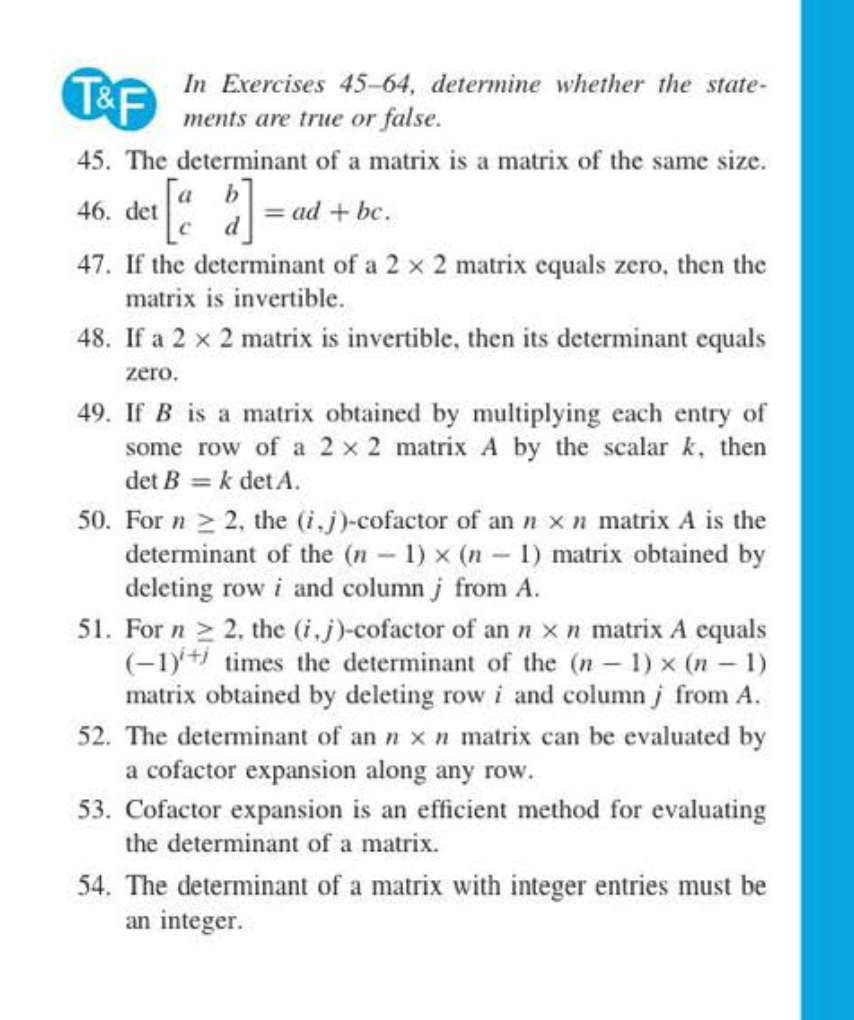
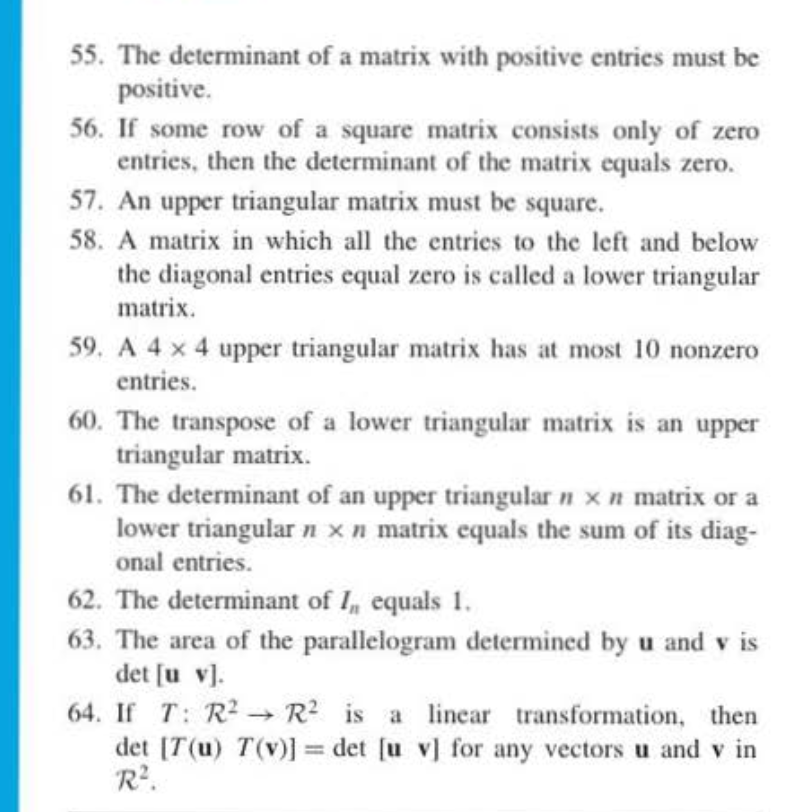
% In Erereises 4564. deremrine whether the state- 45. 46. 47. 48. 49. 50. 51. 52. 53. meals are true or false. The determinant of a matrix is a matrix of the same size. det [\" b] = ad + be. e d If the determinant of a 2 x 2 matrix equals zero. then the matrix is invertible. If a 2 x 2 matrix is invertible. then its determinant equals zero. If B is a matrix obtained by multiplying each entry of some row of a 2 x 2 matrix A by the scalar k, then at 3 = k detA. For n 3 2. the (i,j}-eofactor of an n x n matrix A is the determinant of the (n l) x (n 1) matrix obtained by deleting row i and column j from A. For n 2 2. the (i,j)neofactor of an n x n matrix A equals (1)'\" times the determinant of the (n l) x (n 1) matrix obtained by deleting row i and column j from A. The determinant of an n x in matrix can be evaluated by a eofaetor expansion along any row. Cofactor expansion is an efcient method for evaluating the determinant of a matrix. The determinant of a matrix with integer entries must be an integer. 55. The determinant of a matrix with positive entries must be positive. 56. If some row of a square matrix consists only of zero entries, then the determinant of the matrix equals zero. 57. An upper triangular matrix must be square. 58. A matrix in which all the entries to the left and below the diagonal entries equal zero is called a lower triangular matrix. 59. A 4 x 4 upper triangular matrix has at most 10 nonzero entries. 60. The transpose of a lower triangular matrix is an upper triangular matrix. 61. The determinant of an upper triangular n x / matrix or a lower triangular n x n matrix equals the sum of its diag- onal entries. 62. The determinant of 1,, equals 1. 63. The area of the parallelogram determined by u and v is det [u v]. 64. If T: R2 - R2 is a linear transformation, then det [T(u) T(v)] = det [u v] for any vectors u and v in R2

Step by Step Solution

There are 3 Steps involved in it

1 Expert Approved Answer
Step: 1 Unlock blur-text-image

Question Has Been Solved by an Expert!

Get step-by-step solutions from verified subject matter experts

Step: 2 Unlock
Step: 3 Unlock

Students Have Also Explored These Related Mathematics Questions!