







Question: Hi, I need help with Question #5 all a,b,c, and d. Also part C of Q#3 Exercises 1 The data in the table are simulated
Hi, I need help with Question #5 all a,b,c, and d. Also part C of Q#3
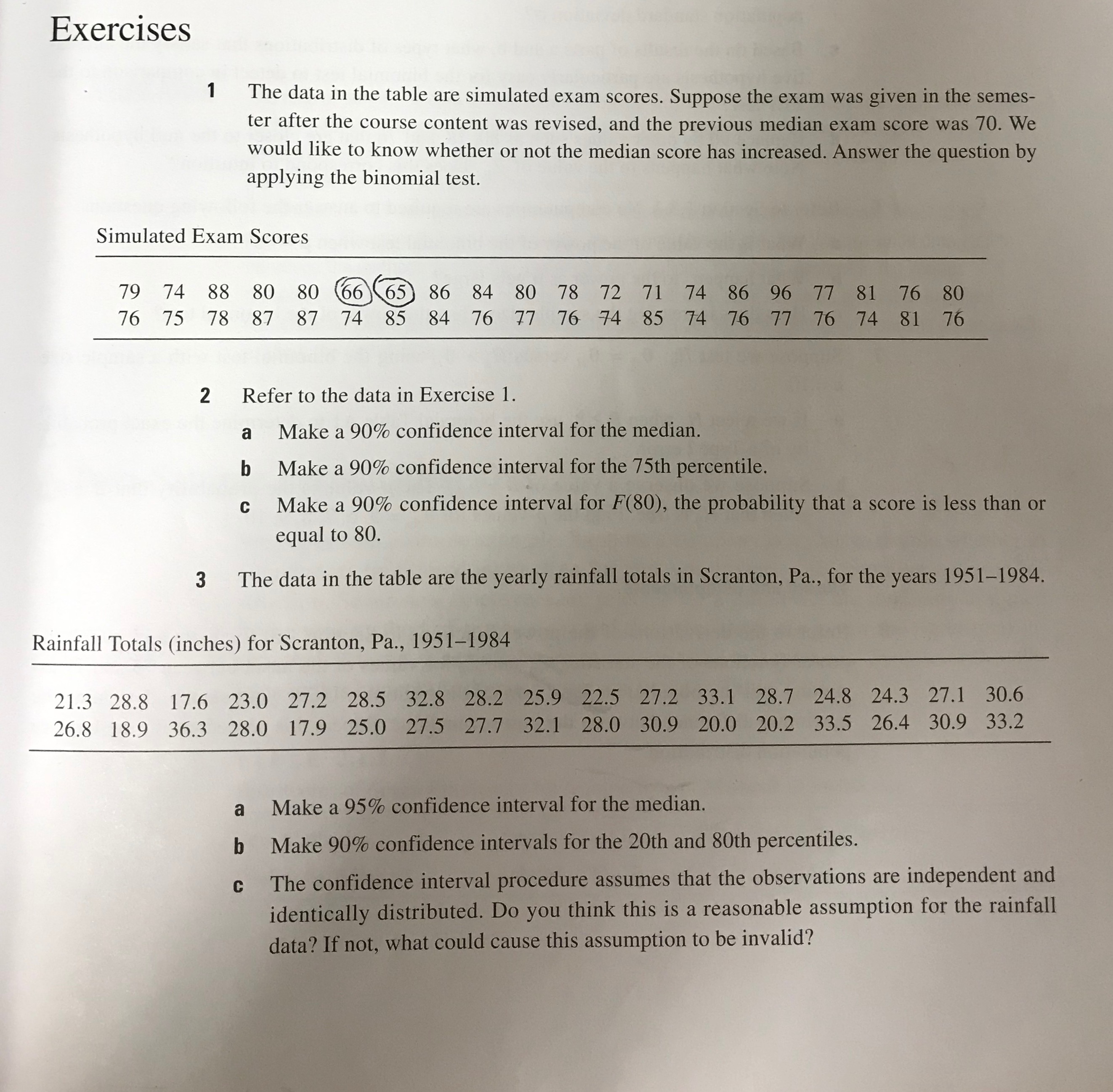
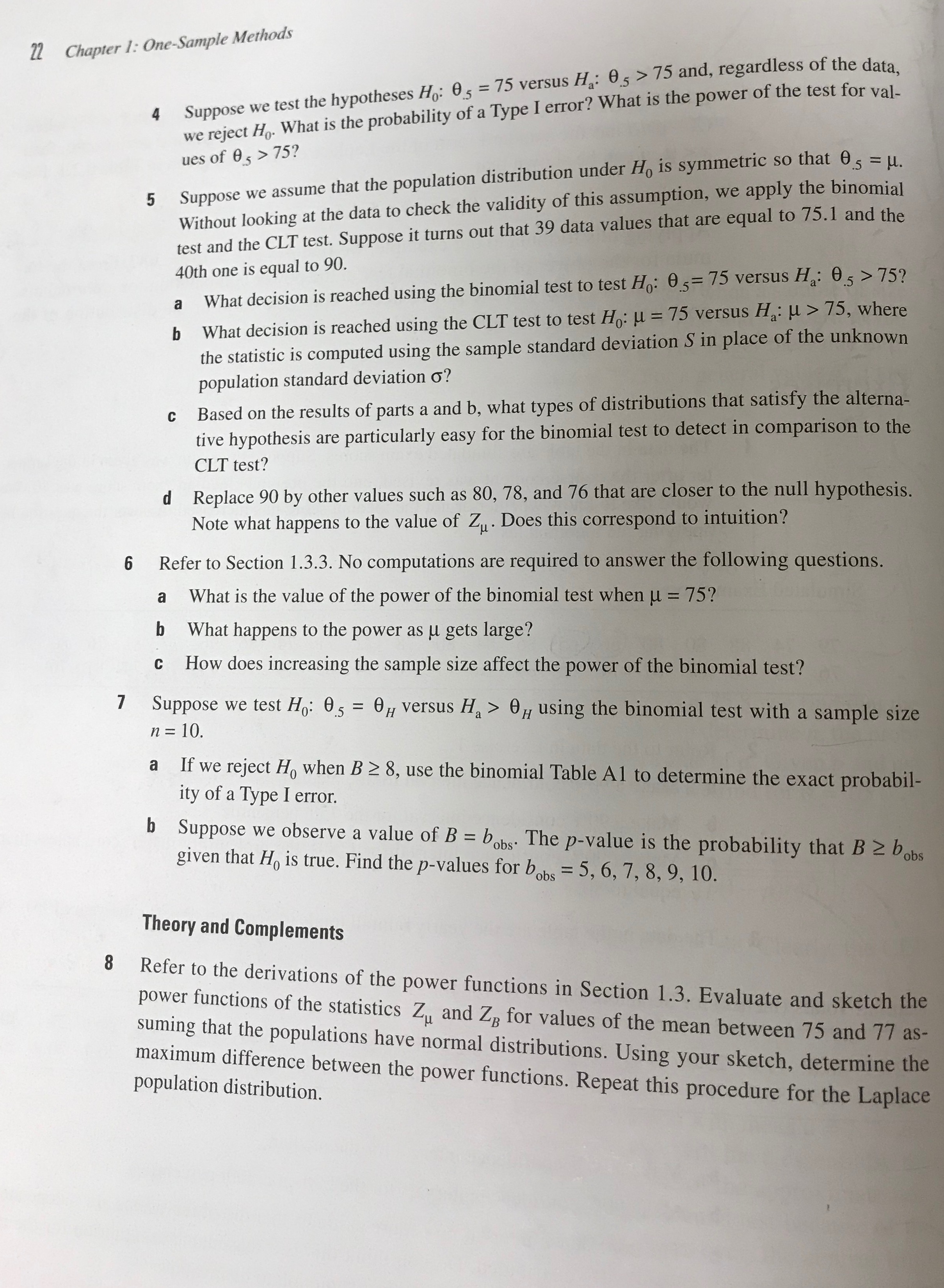
Exercises 1 The data in the table are simulated exam scores. Suppose the exam was given in the semes- ter after the course content was revised, and the previous median exam score was 70. We would like to know whether or not the median score has increased. Answer the question by applying the binomial test. Simulated Exam Scores 79 74 88 80 80 66 65 86 84 80 78 72 71 74 86 96 77 81 76 80 76 75 78 87 87 74 85 84 76 77 76 74 85 74 76 77 76 74 81 76 2 Refer to the data in Exercise 1. a Make a 90% confidence interval for the median. b Make a 90% confidence interval for the 75th percentile. c Make a 90% confidence interval for F(80), the probability that a score is less than or equal to 80. 3 The data in the table are the yearly rainfall totals in Scranton, Pa., for the years 1951-1984. Rainfall Totals (inches) for Scranton, Pa., 1951-1984 21.3 28.8 17.6 23.0 27.2 28.5 32.8 28.2 25.9 22.5 27.2 33.1 28.7 24.8 24.3 27.1 30.6 26.8 18.9 36.3 28.0 17.9 25.0 27.5 27.7 32.1 28.0 30.9 20.0 20.2 33.5 26.4 30.9 33.2 a Make a 95% confidence interval for the median. b Make 90% confidence intervals for the 20th and 80th percentiles. C The confidence interval procedure assumes that the observations are independent and identically distributed. Do you think this is a reasonable assumption for the rainfall data? If not, what could cause this assumption to be invalid?22 Chapter 1: One-Sample Methods 4 Suppose we test the hypotheses Ho: 05 = 75 versus Ha: 0.5 > 75 and, regardless of the data, we reject Ho. What is the probability of a Type I error? What is the power of the test for val- ues of 05 > 75? 5 Suppose we assume that the population distribution under Ho is symmetric so that 0 5 = u. Without looking at the data to check the validity of this assumption, we apply the binomial test and the CLT test. Suppose it turns out that 39 data values that are equal to 75.1 and the 40th one is equal to 90. a What decision is reached using the binomial test to test Ho: 0.= 75 versus Ha: 0.5 > 75? What decision is reached using the CLT test to test Ho: u = 75 versus Ha: u > 75, where the statistic is computed using the sample standard deviation S in place of the unknown population standard deviation o? C Based on the results of parts a and b, what types of distributions that satisfy the alterna- tive hypothesis are particularly easy for the binomial test to detect in comparison to the CLT test? Replace 90 by other values such as 80, 78, and 76 that are closer to the null hypothesis. Note what happens to the value of Zu . Does this correspond to intuition? 6 Refer to Section 1.3.3. No computations are required to answer the following questions. a What is the value of the power of the binomial test when u = 75? b What happens to the power as uu gets large? c How does increasing the sample size affect the power of the binomial test? 7 Suppose we test Ho: 05 = 0# versus Ha > OH using the binomial test with a sample size n = 10. a If we reject Ho when B 2 8, use the binomial Table Al to determine the exact probabil- ity of a Type I error. b Suppose we observe a value of B = bobs. The p-value is the probability that B Z bobs given that Ho is true. Find the p-values for bobs = 5, 6, 7, 8, 9, 10. Theory and Complements 8 Refer to the derivations of the power functions in Section 1.3. Evaluate and sketch the power functions of the statistics Zy and ZB for values of the mean between 75 and 77 as- suming that the populations have normal distributions. Using your sketch, determine the maximum difference between the power functions. Repeat this procedure for the Laplace population distribution
Step by Step Solution
There are 3 Steps involved in it

Get step-by-step solutions from verified subject matter experts
 Study Help