







Question: Hi I need help writing a short method in java in relation to data structures and algorithms. We are aiming for O(n): so a single
Hi I need help writing a short method in java in relation to data structures and algorithms. We are aiming for O(n): so a single for-loop. I have started working on it, but cannot seem to figure it out. Any help would be greatly appreciated, and please include comments so that i may understand. Please find the criteria as well as my code so far down below:
public class SmarterArray {
// data
private int[] data;
private int elements;
public static long before;
public static long after;
// constructor method, returns nothing
public SmarterArray()
{
data = new int[4]; // as the size goes up, the sort takes longer
elements = 0;
}
// method which doubles the size of an array, does not return anything
public void DoubleSize()
{
int[] tmp = new int[2 * data.length];
// move the existing values/data
for (int i = 0; i
{
// moving into tmp array
tmp[i]=data[i];
}
// have original array point to new/temp. one
data = tmp;
}
// this methods adds to the end of an array
public void add(int val)
{
if(elements >= data.length)
{
DoubleSize();
}
data[elements] = val;
elements++;
}
// this method prints the array values
public void print()
{
// prints only valid data
for(int i = 0; i
{
System.out.print(data[i] + " ");
}
System.out.println();
}
// find min, and return index
public int min()
{
// make an assumption that min is 1st element
int loc = 0;
// compare against the remainder
for(int i = 1; i
{
// change the previous assumption if necessary
if(data[i]
{
loc = i;
}
}
// return the location
return loc;
}
// find max, and return its index
public int max()
{
// make an assumption that min is the first element
int loc = 0;
// compare against the remainder
for(int i = 1; i
{
// change assumption if necessary
if(data[i] > data[loc])
{
loc = i;
}
}
// return location
return loc;
}
// this method gets a value given an index
public int get(int loc)
{
return data[loc];
}
// set a value, given an index
public void set(int loc, int value)
{
data[loc]= value;
}
// this method sorts the data in array in ascending order
public void sort()
{
// creating a temp. array that is the same size as the original array (data)
int[] tmp2 = new int[data.length];
// transferring data to temp. array using a for loop
for(int i = 0;i
{
int loc = this.min();
tmp2[i] = this.get(loc);
data[loc] = this.get(this.max())+1;
}
// make original array point to new/temporary array
data = tmp2;
}
public void insert(int val)
{
// step 1: if the array is full, increase its size
if(elements >= data.length)
{
DoubleSize();
}
for(int i = 0; i
{
}
// step 5: increment the variable 'elements'
elements++;
}
// main method
public static void main(String[] args)
{
SmarterArray smarter = new SmarterArray();
// adding in numbers to sort
smarter.add(15);
smarter.add(6);
smarter.add(7);
smarter.add(9);
smarter.add(-4);
smarter.print();
//sorting our data
smarter.sort();
smarter.print();
// inserting more values into our array, while maintaining the ordered sort
smarter.insert(8); // insert in between
smarter.print(); // prints -4 6 7 8 9 15
smarter.insert(-9); // insert at the beginning
smarter.print(); // prints -9 -4 6 7 8 9 15
smarter.insert(19); // insert at the end
smarter.print(); // prints -9 -4 6 7 8 9 15 19
}
}
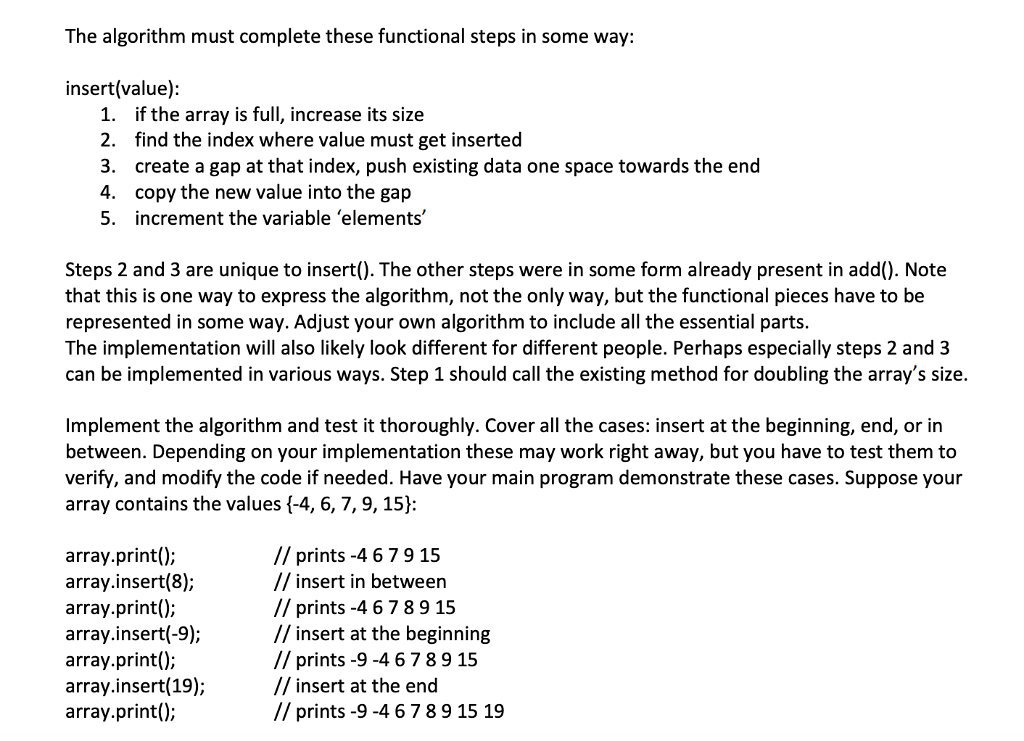
The algorithm must complete these functional steps in some way: insert(value) 1. 2. 3. 4. 5. if the array is full, increase its size find the index where value must get inserted create a gap at that index, push existing data one space towards the end copy the new value into the gap increment the variable 'elements' Steps 2 and 3 are unique to insert(). The other steps were in some form already present in add(). Note that this is one way to express the algorithm, not the only way, but the functional pieces have to be represented in some way. Adjust your own algorithm to include all the essential parts. The implementation will also likely look different for different people. Perhaps especially steps 2 and 3 can be implemented in various ways. Step 1 should call the existing method for doubling the array's size. Implement the algorithm and test it thoroughly. Cover all the cases: insert at the beginning, end, or in between. Depending on your implementation these may work right away, but you have to test them to verify, and modify the code if needed. Have your main program demonstrate these cases. Suppose your array contains the values f-4, 6, 7, 9,15]: array.print(); array.insert(8); array.print(); array.insert(-9); array.print() array.insert(19); array.print(); // prints -467915 // insert in between // prints -4 678915 //insert at the beginning // prints -9-4678915 // insert at the end // prints -9-4 6789 15 19
Step by Step Solution
There are 3 Steps involved in it

Get step-by-step solutions from verified subject matter experts
 Study Help