







Question: Hi, I would like to get help with this problem. Thank you in advance. A company is considering two mutually exclusive expansion plans. Plan A
Hi, I would like to get help with this problem. Thank you in advance.
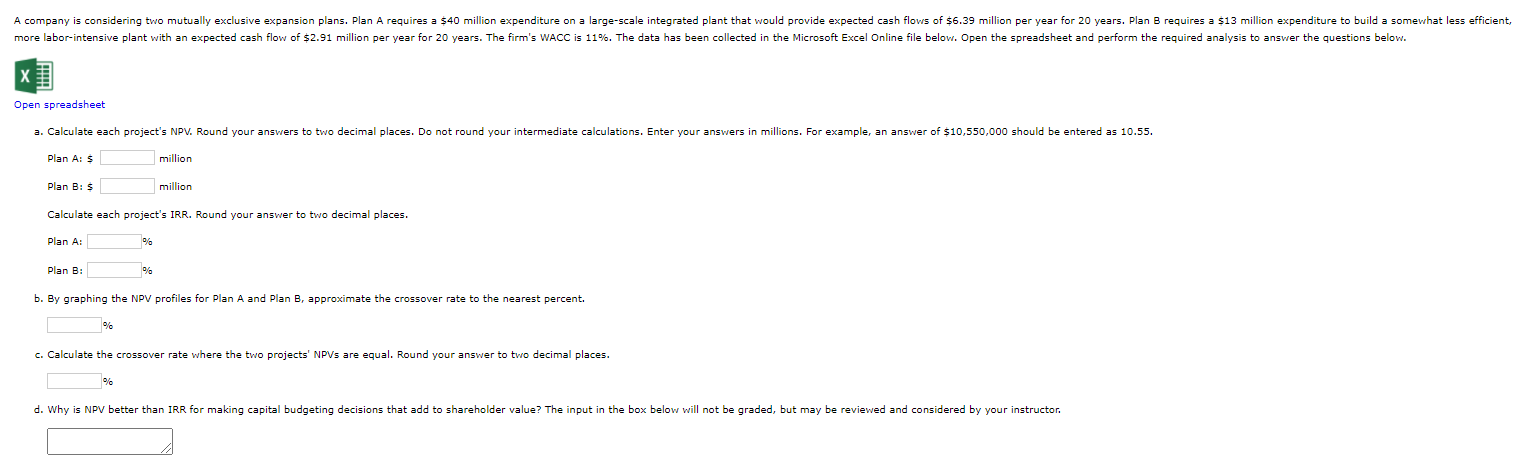
A company is considering two mutually exclusive expansion plans. Plan A requires a $40 million expenditure on a large-scale integrated plant that would provide expected cash flows of $6.39 million per year for 20 years. Plan B requires a $13 million expenditure to build a somewhat less efficient, more labor-intensive plant with an expected cash flow of $2.91 million per year for 20 years. The firm's WACC is 11%. The data has been collected the Microsoft Excel Online file below. Open the spreadsheet and perform the required analysis to answer the questions below. Open spreadsheet a. Calculate each project's NPV. Round your answers to two decimal places. Do not round your intermediate calculations. Enter your answers in millions. For example, an answer of $10,550,000 should be entered as 10.55. Plan A: S million Plan B: $ million Calculate each project's IRR. Round your answer to two decimal places. Plan A: % Plan B % b. By graphing the NPV profiles for Plan and Plan B, approximate the crossover rate to the nearest percent. % c. Calculate the crossover rate where the two projects' NPVs are equal. Round your answer to two decimal places. d. Why is NPV better than IRR for making capital budgeting decisions that add to shareholder value? The input in the box below will not be graded, but may be reviewed and considered by your instructor. A company is considering two mutually exclusive expansion plans. Plan A requires a $40 million expenditure on a large-scale integrated plant that would provide expected cash flows of $6.39 million per year for 20 years. Plan B requires a $13 million expenditure to build a somewhat less efficient, more labor-intensive plant with an expected cash flow of $2.91 million per year for 20 years. The firm's WACC is 11%. The data has been collected the Microsoft Excel Online file below. Open the spreadsheet and perform the required analysis to answer the questions below. Open spreadsheet a. Calculate each project's NPV. Round your answers to two decimal places. Do not round your intermediate calculations. Enter your answers in millions. For example, an answer of $10,550,000 should be entered as 10.55. Plan A: S million Plan B: $ million Calculate each project's IRR. Round your answer to two decimal places. Plan A: % Plan B % b. By graphing the NPV profiles for Plan and Plan B, approximate the crossover rate to the nearest percent. % c. Calculate the crossover rate where the two projects' NPVs are equal. Round your answer to two decimal places. d. Why is NPV better than IRR for making capital budgeting decisions that add to shareholder value? The input in the box below will not be graded, but may be reviewed and considered by your instructor
Step by Step Solution
There are 3 Steps involved in it

Get step-by-step solutions from verified subject matter experts
 Study Help