



Question: Hi, I'm not sure how to procede with this question. Since theres two cases that make recursive calls, How do we use the substitution method.
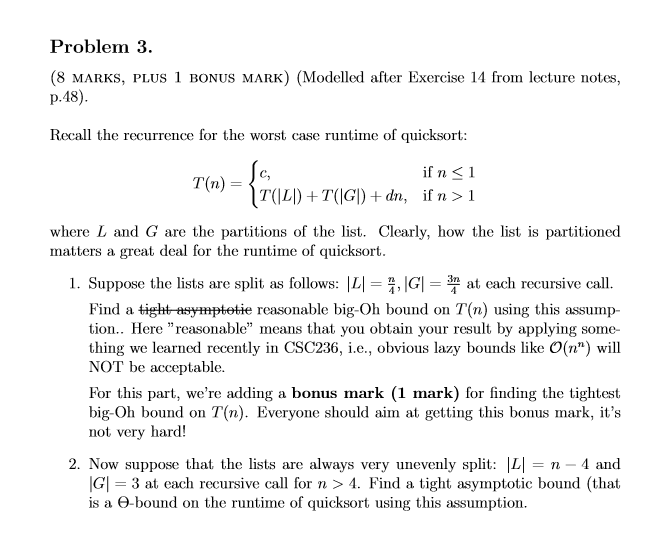
Hi, I'm not sure how to procede with this question. Since theres two cases that make recursive calls, How do we use the substitution method. Can I get a hint?
Problem 3 (8 MARKS, PLUS 1 BONUS MARK) (Modelled after Exercise 14 frorn lecture notes. p.48) Recall the recurrence for the worst case runtime of quicksort if n 1 where L and G are the partitions of the list. Clearly, how the list is partitioned matters a great deal for the runtime of quicksort i. Suppose the lists are split as follows: IL- G-4 at each recursive call Find a tight asymptetie reasonable big-Oh bound on T(n) using this assump- tion.. Here "reasonable" means that you obtain your result by applying some- thing we learned recently in CSC236, i.e., obvious lazy bounds like O(n") will NOT be acceptable. For this part, we're adding a bonus mark (1 mark) for finding the tightest big-Oh bound on T(n). Everyone should ai at getting this bonus mark, it's not very hard! 2. Now suppose that the lists are always very unevenly split: |L n 4 and G 3 at each recursive call for n > 4. Find a tight asymptotic bound (that is a -bound on the runtime of quicksort using this assumption
Step by Step Solution
There are 3 Steps involved in it

Get step-by-step solutions from verified subject matter experts