







Question: Hi, I'm posting this again because I didn't get answer from the first one. I know this a lot to read. PLEASE I really need
Hi, I'm posting this again because I didn't get answer from the first one. I know this a lot to read. PLEASE I really need your help with this one. I need to report these topics on powerpoint and I don't know what to put on my presentation. Can you please help me? Today is the dealine. I'm begging you guys. Please help me.
HOSPITALITY PRINCIPLE: PURSUE PERFECTION RELENTLESSLY
The critical challenge for hospitality managers seeking this information is to identify and implement the methods that best measure the quality of the experience from the guests point of view was the experience is occurring. Measurements taken after the experience may be too late to enable recovery from failure, though they may be useful in improving the service experience for the future. The guest determines the quality and value of the service experience. Consequently, an acceptable experience for one guest might be a wow experience for another and totally unacceptable to a third. The subjective nature of the quality and value of a guest experience makes identifying and implementing the appropriate measurements particularly difficult. One key to creating a flawless guest experience is that the organization must know what errors are being made, what failures are occurring. If you dontknowits broken, you can hardly fix it. Consequently, monitoring and measuring the quality of the guest experience with an eye out for flaws or failures is a crucial part of the hospitality organizations responsibility. Satisfied guests come back, and dissatisfied guests go elsewhere. The best time to find out about possible service failures is before the guest ever arrives. The best mistake is one that never happens because the organization planned thoroughly to ensure that each part of the experience is flawless. But no matter how well the management planned the meal, scheduled the convention, or designed the hotel lobby, mistakes will happen. The organization wants to have measures in place to identify the mistakes as soon as possiblecertainly before the guest leaves the service setting, while the information is still fresh in the guests mind. Finding out about failure on the spot gives the organization the opportunity to recover. The worst time to learn of a service failure is after the guest has departed because the opportunity to fix it is substantially decreased once the guest has left the premises. The most effective tool for ensuring quality is through planning to ensure that anything that might go wrong is anticipated and fail safed to the extent humanly possible.
TECHNIQUES AND METHODS FOR ASSESSING SERVICE QUALITY
Process Strategies
Process strategies include various ways in which organizations can avoid failing their guests by monitoring the delivery while it is taking place, while it is in process. A process strategy is a means of comparing what is happening against what is supposed to happen, usually, but not always, expressed as a measurable service standard. Sometimes process strategies are the experience and training that managers and employees have in delivering the high-quality service experience that organizations want their customers to have. The idea behind process strategies is to design monitoring mechanisms into the delivery system to find and fix failures before they affect the quality of the guest experience.
For example, a supervisor can monitor telephone calls, a server can check the food order against what is served, or a machine can control the frying time of French fries to get them perfect every time
The advantage of process strategies is that they can catch errors before or as they occur, enabling prevention or immediate correction before the errors impact guest satisfaction beyond repair. Of course, organizations need to devote the resources to create and maintain the error-prevention system, and that has costs.
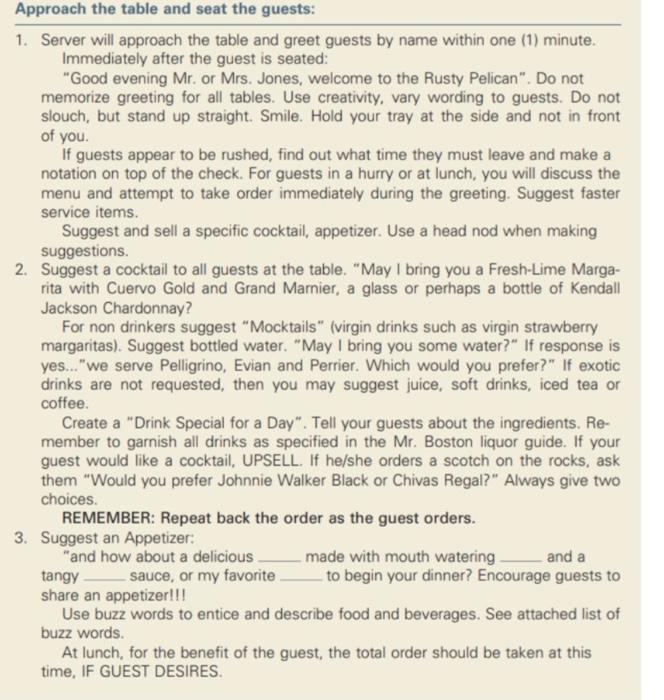
For example, Hard Rock Cafe, hires an additional person to stand at the end of the food preparation line to match the order against the food on the plate to be served, to catch discrepancies before the guest ever sees the order. Even though the traditional job description for wait staff includes this checking responsibility, the additional person reduces the possibility of error even further. Service standards that can be applied while the service is in process provide employees with objective measures against which to monitor their own job performance while they are doing it. Specifying the maximum number of times the phone can ring before it is picked up is an example. Other process-related measurements that allow the organization to minimize errors or catch them while the guest experience is underway include the number of times a server should revisit a table during the meal, or the number of people who can stand in line before the manager adds extra personnel to the check-in.
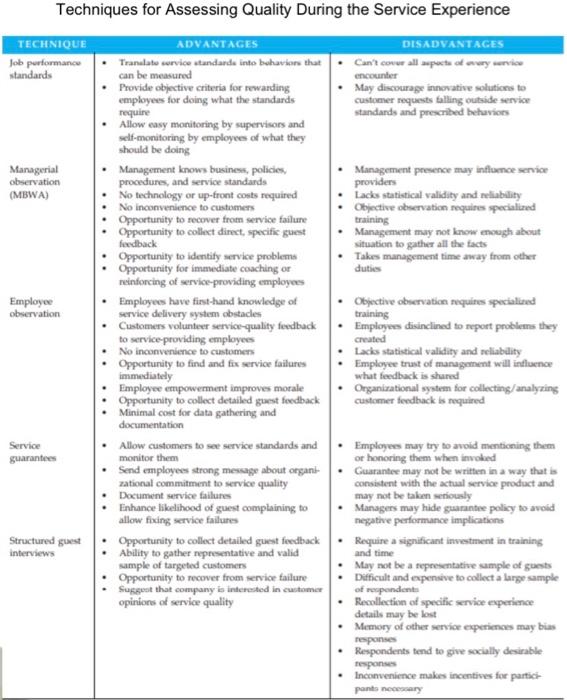
Continually checking the performance of organizational members against preestablished service standards while the service experience is in process is an excellent way to ensure a successful experience. Two other in-process methods of assessing the service quality of the experience while it is happening are managerial observation, sometimes called management by walking around (MBWA), and employee observation and inquiry. If managers or employees ask a guest how is it? or see someone unhappy, they might be able to identify and fix a service failure immediately. Some standards of performance are embodied in organizational service guarantees, so organizations will want to keep the terms of these guarantees in mind while providing service. After providing the service experience to the guests but before they have left the premises, the organization may want to solicit their opinions about whether their expectations have been met.
The methods designed to assess quality while service is being provided are intended to ensure the success of individual service experiences. Also important for long-run organizational success is having methods in place for collecting data directly from guests after their experience, to identify the areas needing improvement to satisfy regular guests and attract new ones. Among these methods are comment cards; toll-free 800 numbers; e-mail, telephone, and Web surveys using various techniques; and guest focus groups. Mystery shopping is an additional widely used approach for gathering data about the quality of a service experience.
The various methods differ in cost, accuracy, degree of guest inconvenience, and at what point in the guest experience they are used. Measuring service quality can have many organizational benefits, but as usual, the benefits must be balanced against the costs of obtaining them. The organization must balance the information needed and the research expertise required to gather and interpret the information against the available funds. As a rule, the more accurate and precise the data, the more expensive it is to acquire.
MEASURES OF SERVICE QUALITY
Managers of outstanding hospitality organizations try to develop measures for every part of the guest experience so that they can monitor where they are meeting or failing to meet their own definition of quality service. These measures are critical to ensure that the service is delivered to the customer as it should be.
Some standards are built directly into the design of the service system. For example, a restaurant bar is designed to contain sufficient beer capacity and wine storage space to meet forecasted demand. Some standards are for employee use in anticipating guests coming in the door. To use the restaurant again as an example, if the restaurant has reliable predictions of how many customers come in on the different days of the week, those predictions can be used as a basis or standard for the number of salads that should be preprepared, the number of tables that should be pre-set, and the amount of silverware that should be rolled into napkins. If the prediction is correct and the standards for these aspects of the service are met, a service failure should not occur. A final group of standards is used after the guests have arrived and while the service is taking place, such as maximum number of minutes before greeting and number of visits to the table during the meal. Poka-yokes such as those described previously can be used to prevent failures in some of these activities. Other examples of how performance standards can prevent failures might include annual hours of training required of service personnel, number of computer terminals to be purchased to serve anticipated demand, and number of banquet tables to be set up or other facilities to be available when the organization can reasonably predict requirements before the service experience ever begins.
Table below provides a summary of the methods and techniques available to hospitality organizations for monitoring and assessing the quality of the service experience while it is being delivered. They all depend on careful planning to set service standards, careful training to prepare the employees to meet those standards, and rewards for employees when the guest experience meets or exceeds the set standards.
Service Standards at the Rusty Pelican
Step by Step Solution
There are 3 Steps involved in it

Get step-by-step solutions from verified subject matter experts
 Study Help