







Question: Hi, please answer from the pages from book below please:) Question 1 : a) What are the two main initiatives of the WTO? explain b)
Hi, please answer from the pages from book below please:) 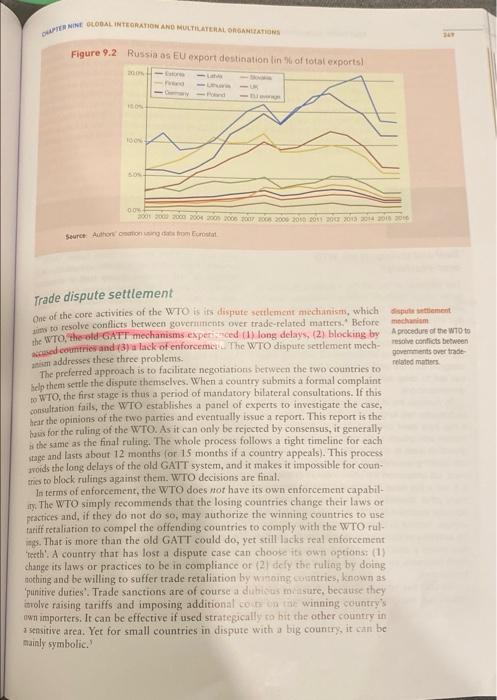
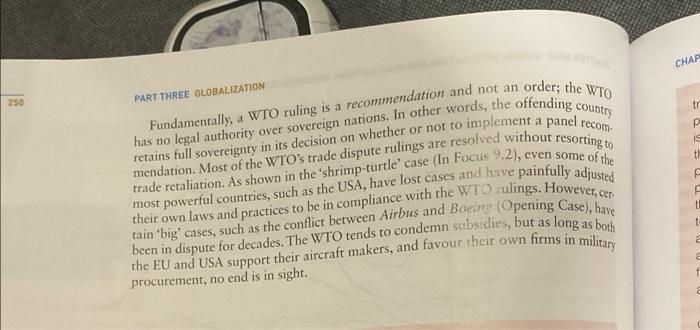
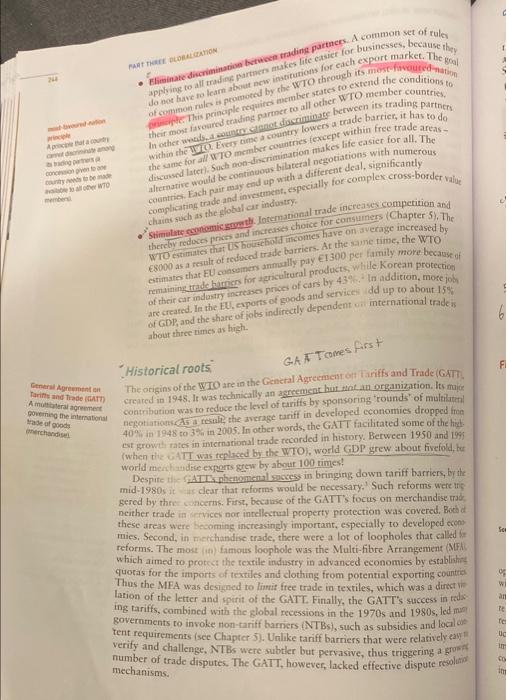
245 ONUTER NINE OLOBAL INTEORATION AND MULTILATERAL ORGANIZATIONS Shen companies such as Boeing and Airbus have a disagreement about the rules of the game, how do they sort out their differences? What if even their two or more on ments dont agree? There must be some place where countries can discuss their dit es, resolve their conflicts and agree on common rules, In setting common rules mailateral organizations have attained a central role in setting rules and in helping multe ori resolve disputes between countries. The word 'multilateral here indicates that they are Organicons set up by used on an agreement between many countries, as opposed to bilateral agreements several colaborating ween two countries. In the area of international trade, the World Trade Organiza counts cion (WTO) is designed to resolve trade disputes, while the International Monetary non agreements such as the EU (Chapter 8) and ASEAN facilitate international busi Fund (IMF) is the guardian of the global monetary system. At a regional level, integra mess within regions of the world. Other institutions, such as tree trade areas, are based on bilateral agreements between countries or groups of countries. For businesses, the question is how these supra-national institutions affect the institutional frameworks under which they operate. Specifically, how do changes in the rules of the game via global and regional economic integration, as emphasized by he institution-based view, enable firms to better develop and leverage their capabili- bes, as highlighted by the resource-based view? This chapter first introduces multilateral institutions of international trade and monetary systems and then discusses regional and bilateral economic integration. The debates and extensions section extends the discussion to other areas of inter national policy coordination: economic development, climate change and financial actor regulation. The rules of the game that nation states have agreed on for their conomic interactions are becoming more and more complex, which makes this chapter possibly the most challenging to study - yet also the most important for Innderstanding some of the controversies related to globalization. THE MULTILATERAL TRADE SYSTEM Benefits of global integration by trade Recall from Chapters 5 and 6 that, theoretically, there are economic gains when firms from different countries freely trade and invest. However, in the 1920s and 1930s, virtually all governments imposed protectionist policies through tariffs and quo- LEARNING OBJECTIVE tas, trying to protect domestic industries. Collectively, these beggar-thy-neighbour 1 Explain the multi- policies triggered retaliation that further restricted trade, which worsened the Great lateral institutions Depression and eventually contributed to World War II. In the late 1940s, the world of the global trade community, mindful of the mercant was during the 1930s, initiated several system and the current challenges developments aimed at fostering in ind political integration, including the foundation of the United Nation non of the Bretton Woods institutions IMF and World Bank) and the reement on Tariffs and Trade (GATT) - the predecessor of the World ization (WHO World Trade Organization The WTO is the main multilateral organization establishing rules for interna (WTO) itional trade and resolving trade-related conflicts between nations. The WTO aims to The organization underpinning the Handle disputes constructively. The WTO's dispute resolution mechanism multilateral trading system (discussed later in this chapter) has become the preferred mechanism to settle since 2005 disputes over issues such as, arguably, unfair tariffs, quotas or subsidies. Since 1995, over 550 disputes have been brought to the WTO, and in most cases the rulings of the WTO have been complied with by responding countries.! Notwithstanding a small number of long-standing conflicts, such as the fight between Airbus and Boeing (Opening Case), this is a good track record, a . uit WTO RT TE DORELATION medicin trading partners. A common set of rules applying to al trading press makes liteetser for businesses, because they do not have to learn about new institutions for cach export market. The goal of common rules promoted by the WTO through its most da This principle regismember states to extend the conditions to In other wabinet inte between its trading partners the most famoured trading partner to all other WTO member countries, within the reseantry lowers a trade barrier, it has to do the same for all member countries except within free trade areas discussed later). Such non-discrimination makes bite casier for all. The alternative would be continous bilateral negotiations with numerous countries. Each pair may end up with a different deal, significantly complicating trade and investment, especially for complex cross-border van chains such as the global car industry, Stimate comic Inremonal trade increases competition and thereby nedoces prices and increases choice for consumers (Chapter 5). The WTO estimates that I household comes have on average increased by E8000 as a result of reduced trade barriers. At the same time, the WTO estimates that EU comensammly pay e 1300 per family more because remainingradibus forricultural products, while Korean protection are created. In the EU. exports of goods and services dd up to about 15% of their car industry into praces of cars by 437. In addition, motejobs about three times as high. of GDP, and the share of jobs indirectly dependent on international trade GAAT comes first FI General Agre Tatra ATT Aliment governing them to rate of merchandise Historical roots The origins of the WTO are in the General Agreement ont lariffs and Trade (GATT created in 1945. It was technically an agreement but an organization. Its mais contribution was to reduce the level of tariffs by sponsoring 'rounds of multilateral negotiation. As a result, the average tariff in developed economies dropped from 40% in 1948 to 3% in 2005. In other words, the GATT facilitated some of the high est growth rates in international trade recorded in history. Between 1950 and 1995 (when the GATT was replaced by the WTO), world GDP grew about fivefold, but world merchandise experts grew by about 100 times! Despite t-GAT phenomenal access in bringing down tariff barriers, by the mid-1980s it clear that reforms would be necessary. Such reforms were tri sered by the concerns. First, because of the GATTS focus on merchandise trade neither trade in services por intellectual property protection was covered. Both these areas were becoming increasingly important, especially to developed econ mies. Second, in merchandise trade, there were a lot of loopholes that called reforms. The most (in) famous loophole was the Multi-fibre Arrangement (MFR which aimed to protect the textile industry in advanced economies by establishing quotas for the imports of textiles and clothing from potential exporting countries Thus the MFA was designed to limit free trade in textiles, which was a direct lation of the letter and spirit of the GATT. Finally, the GATT's success in teda ing tariffs, combined with the global recessions in the 1970s and 1980s, led mom governments to invoke non-tariff barriers (NTBs), such as subsidies and local com Tent requirements (see Chapter 5). Unlike tariff barriers that were relatively caw verity and challenge, NTBs were subtler but pervasive, thus triggering a grown number of trade disputes. The GATT, however, lacked effective dispute resolutio So 0 an RRRES CO mechanisms. im 14 PENNE OLOBAL INTEGRATION AND MULTILATERAL ORGANIZATIONS The WTO Wits created to address the lack ot enforcement mechanisms within GAZZI romed the GATT from treaty serviced by hoc secara into meded international Organization, headquartered in Geneva, Switzerland Schindly broader than the GATT, the WTO las Fuel Agar trade in Service AS AWID ghetto An umbrella agreement, called the Agreement Establishing the WTO. An agreement governing the international trade of goods, still using the si de as the General Agreement on Tariffs and Trade (GATT). Hence the GATT continues to live as part of the new organization An agreement governing the international trade of services, the General Agreement on Trade in Services (GATS). The GATS aims to open up markets in service industries such as insurance, telecommunications, tourism and transportation, which requires member countries to liberalize these traditionally tightly controlled sectors to let foreign companies compete 1. An agreement governing intellectual property rights, the Trade Related Aspects of Intellectual Property Rights (TRIS). This agreement establishes tules regarding intellectual property rights used in international trade, which were a particular concern to MNEs in developed countries wishing to exploit their copyrights, patents, trademarks and geographic names. It was not popular among developing countries that now faced more payments for, for example, urgently needed medicines first developed by Western MNES 5. The Trade Dispute Settlement Mechanism, which allows for the WTO to adjudicate trade disputes between countries (discussed next). b. Trade policy reviews, which enable the WTO and other member countries to peer review a country's trade policy Tapet och ( AWTON tech grupety night Figure 9.1 Six main areas of the WTO Umbrella ante O Three main are ar Barvede oporty GATA Connict resolution CG Rottam Transparency Prade news Serce World Trade Organization 2000. Understanding the WTO ip 221. Geneva: WTO To the disappointment of developing countries, the WTO did not require devel- oped countries to open up their agricultural sectors. Overall, the WTO has a far wider scope, incorporating trade in services, intellectual property dispute settlement ind peer review of policy. The WTO does not, however, cover all aspects of trade Initted regulation Nation countries continue to develop their own standards with mspect to, for example, the environment. Thus, exporters need to adapt their prod wts and services to local rules. Only if regulation is unduly discriminating against importers, the WTO might get involved. These limitations also imply that countries continue to maintain border controls, not only to collect tariffs but also to ensure sports meet their regulatory requirements OUR NE OLDAL INTEGRATION AND MULTILATERAL ORGANIZATIONS 14 Figure 9.2 Russia as EU export destination line of total exports 18 100 004 00000000000000 Source Author amorom Trade dispute settlement One of the core activities of the WTO is its dispute settlement mechanisms, which supstatement is to resolve conflicts between governments over trade-related matters. Before mechanism the WTO, the old GRTT mechanisms experienced (1) long delays, (2) blocking by Aprocedure of the WTO to resolve confits between used come and a lack of enforceme. The WTO dispute settlement mech- government over trade him addresses these three problems. related matters The preferred approach is to facilitate negotiations between the two countries to help them settle the dispute themselves. When a country submits a formal complaint to WTO, the first stage is thus a period of mandatory bilateral consultations. If this consultation fails, the WTO establishes a panel of experts to investigate the case, hear the opinions of the two parties and eventually issue a report. This report is the bases for the ruling of the WTO. As it can only be rejected by consensus, it generally the same as the final ruling. The whole process follows a tight timeline for cach stage and lasts about 12 months for 15 months if a country appeals). This process avoids the long delays of the old GATT system, and it makes it impossible for coun tries to block rulings against them. WTO decisions are final In terms of enforcement, the WTO does nor have its own enforcement capabil aty. The WTO simply recommends that the losing countries change their laws or practices and if they do not do so, may authorize the winning countries to use tariff retaliation to compel the offending countries to comply with the WTO rul s. That is more than the old GATT could do, yet still lacks real enforcement Teeth'. A country that has lost a dispute case can choose its own options: (1) change its laws or practices to be in compliance or (2) defy the ruling by doing tothing and be willing to suffer trade retaliation by winning coaties, known as punitive duties. Trade sanctions are of course a dubious modisure, because they trolve raising tariffs and imposing additional con winning country's own importers. It can be effective if used strategically to hit the other country in sensitive area. Yet for small countries in dispute with a big country, it can be mainly symbolic. CHAR 250 country tr PART THREE GLOBALIZATION Fundamentally, a WTO ruling is a recommendation and not an order; the WTO has no legal authority over sovereign nations. In other words, the offending is m = mendation. Most of the WTO's trade dispute rulings are resolved without resorting to trade retaliation. As shown in the 'shrimp-turtle case (In Focus 9.2), even some of the their own laws and practices to be in compliance with the WTO culings. However, cer- most powerful countries, such as the USA, have lost cases and have painfully adjusted tain 'big' cases, such as the conflict between Airbus and Boeing (Opening Case), have been in dispute for decades. The WTO tends to condemn subsidies, but as long as both the EU and USA support their aircraft makers, and favour their own firms in military procurement, no end is in sight. 1 Question 1 : 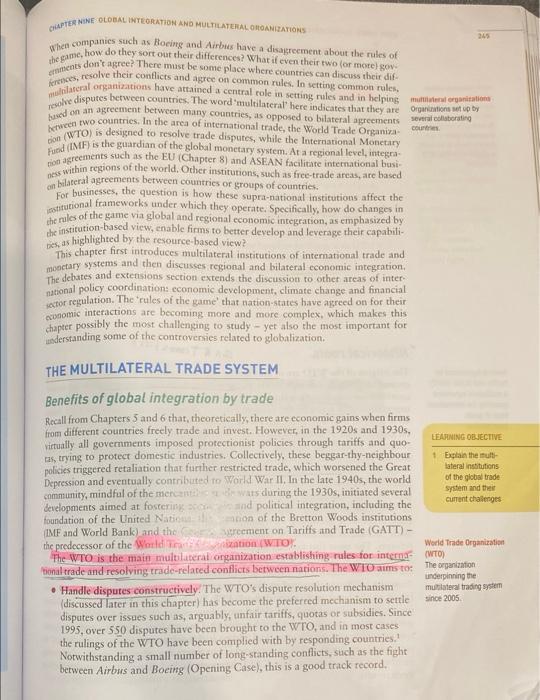
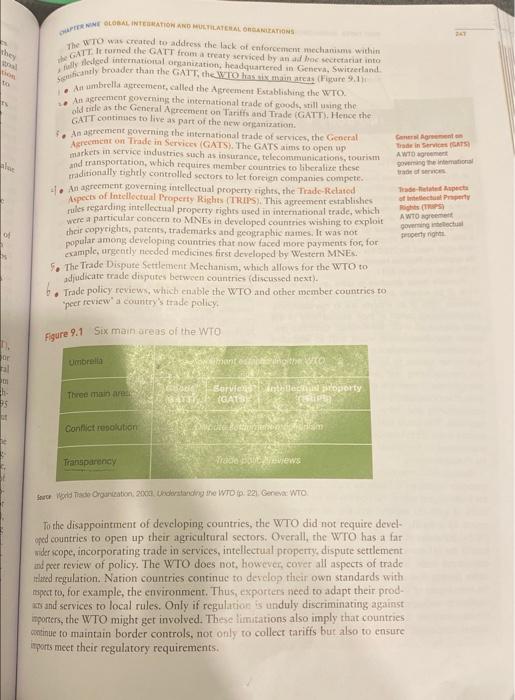
a) What are the two main initiatives of the WTO? explain
b) Discuss the WTO enforcement capabilities?
c) What is the WTO stance on subsidies? explain.
Step by Step Solution
There are 3 Steps involved in it
1 Expert Approved Answer
Step: 1 Unlock

Question Has Been Solved by an Expert!
Get step-by-step solutions from verified subject matter experts
Step: 2 Unlock
Step: 3 Unlock
 Study Help