







Question: Hi , Please could you answer parts d , e and f of the below question and explain and expand all working so that it
Hi
Please could you answer parts de and f of the below question and explain and expand all working so that it is clearly visable in step by step format and the steps explained where necessary for further clarification.
Thankyou in advance for your help.
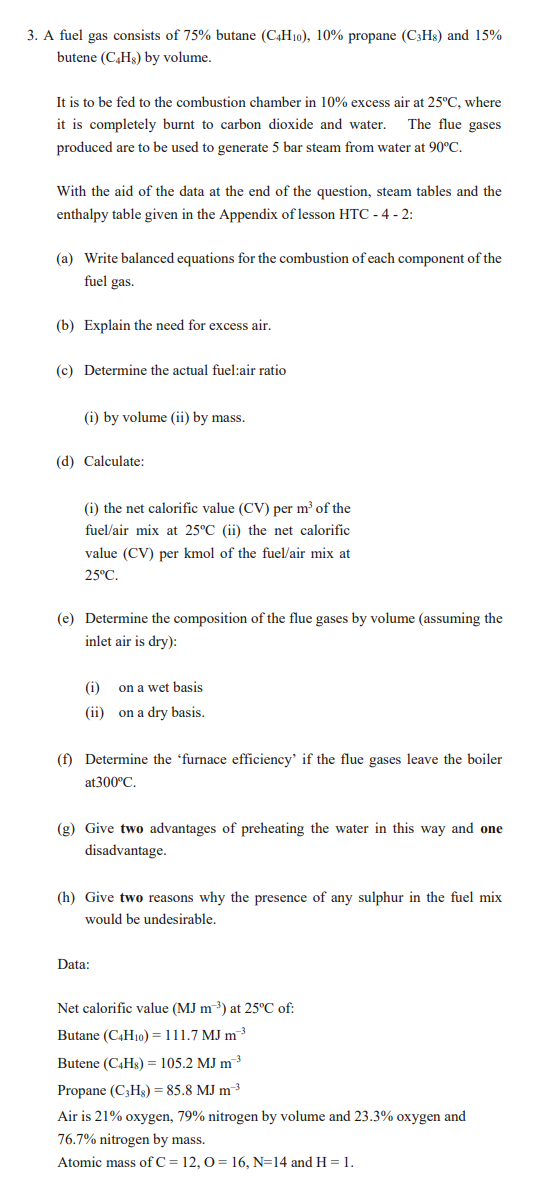
A fuel gas consists of butane propane and
butene by volume.
It is to be fed to the combustion chamber in excess air at where
it is completely burnt to carbon dioxide and water. The flue gases
produced are to be used to generate bar steam from water at
With the aid of the data at the end of the question, steam tables and the
enthalpy table given in the Appendix of lesson HTC :
a Write balanced equations for the combustion of each component of the
fuel gas.
b Explain the need for excess air.
c Determine the actual fuel:air ratio
i by volume ii by mass.
d Calculate:
i the net calorific value per of the
fuelair mix at ii the net calorific
value CV per kmol of the fuelair mix at
e Determine the composition of the flue gases by volume assuming the
inlet air is dry:
i on a wet basis
ii on a dry basis.
f Determine the 'furnace efficiency' if the flue gases leave the boiler
at
g Give two advantages of preheating the water in this way and one
disadvantage.
h Give two reasons why the presence of any sulphur in the fuel mix
would be undesirable.
Data:
Net calorific value at of:
Butane
Butene
Propane
Air is oxygen, nitrogen by volume and oxygen and
nitrogen by mass.
Atomic mass of and
Step by Step Solution
There are 3 Steps involved in it
1 Expert Approved Answer
Step: 1 Unlock

Question Has Been Solved by an Expert!
Get step-by-step solutions from verified subject matter experts
Step: 2 Unlock
Step: 3 Unlock
 Study Help