







Question: Hi. Please help me to solve this question with correct answer. Skip if you don't know the answer. if you solve this correctly i will
Hi. Please help me to solve this question with correct answer. Skip if you don't know the answer. if you solve this correctly i will upvote you. Don't spam!!!!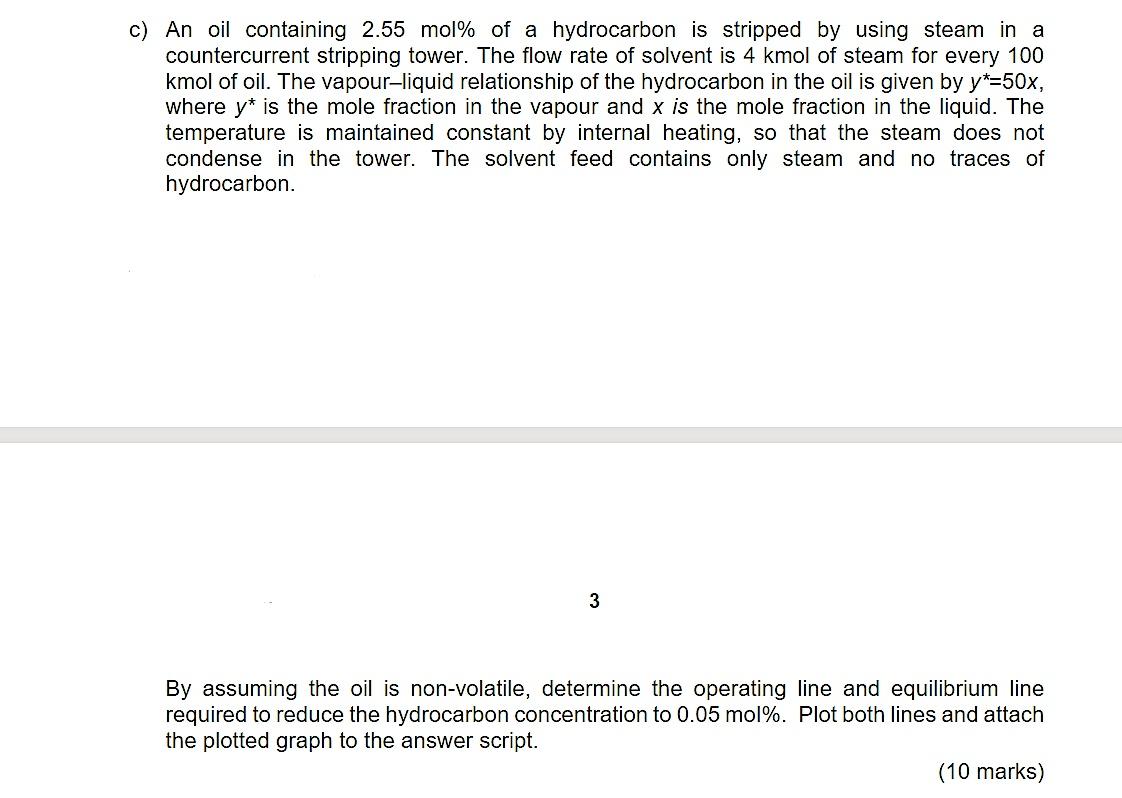 Hi. Please help me to solve this question correctly. I will upvote you if you help me to solve this correctly. Skip if you don't know!!!! Don't spam.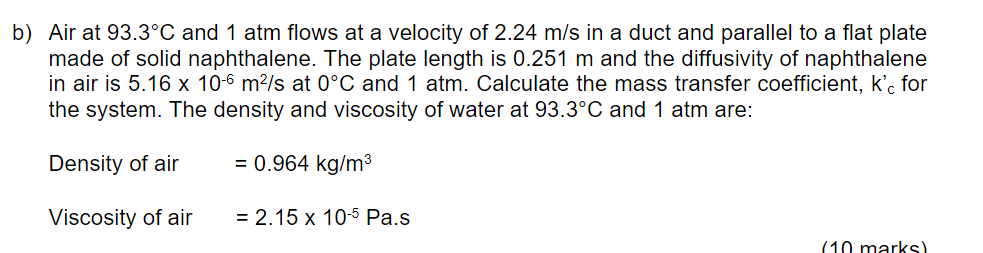
c) An oil containing 2.55 mol% of a hydrocarbon is stripped by using steam in a countercurrent stripping tower. The flow rate of solvent is 4 kmol of steam for every 100 kmol of oil. The vapour-liquid relationship of the hydrocarbon in the oil is given by y*=50x, where y* is the mole fraction in the vapour and x is the mole fraction in the liquid. The temperature is maintained constant by internal heating, so that the steam does not condense in the tower. The solvent feed contains only steam and no traces of hydrocarbon. 3 By assuming the oil is non-volatile, determine the operating line and equilibrium line required to reduce the hydrocarbon concentration to 0.05 mol%. Plot both lines and attach the plotted graph to the answer script. (10 marks) b) Air at 93.3C and 1 atm flows at a velocity of 2.24 m/s in a duct and parallel to a flat plate made of solid naphthalene. The plate length is 0.251 m and the diffusivity of naphthalene in air is 5.16 x 10⁻⁶ m/s at 0C and 1 atm. Calculate the mass transfer coefficient, k'c for the system. The density and viscosity of water at 93.3C and 1 atm are: Density of air = 0.964 kg/m3 Viscosity of air = 2.15 x 10⁻⁵ Pa.s (10 marks)
Step by Step Solution
There are 3 Steps involved in it

Get step-by-step solutions from verified subject matter experts
 Study Help