







Question: Hi, question is from Compurer Science Logic, please answer part (b) only: In the following, we wil be looking at properties of sequences of characters
Hi, question is from Compurer Science Logic, please answer part (b) only:
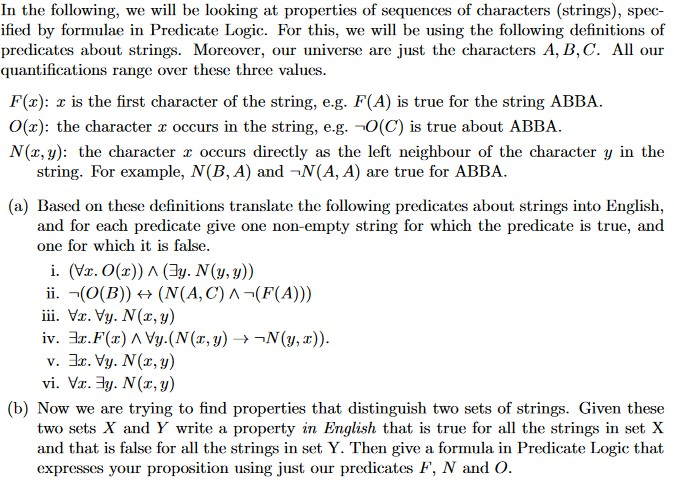
In the following, we wil be looking at properties of sequences of characters (strings), spec ified by formulae in Predicate Logic. For this, we will be using the following definitions of predicates about strings. Moreover, our universe are just the characters A, B,C. All our quantifications range over these three values F(x): r is the first character of the string, e.g. F(A) is true for the string ABBA O(x): the character x occurs in the string, e.g. -O(C) is true about ABBA N(x, y): the character r occurs directly as the left neighbour of the character y in the string. For example, N(B,A) and MA, A) are true for ABBA (a) Based on these definitions translate the following predicates about strings into English, and for each predicate give one non-empty string for which the predicate is true, and one for which it is false (b) Now we are trying to find properties that distinguish two sets of strings. Given these two sets X and Y write a property in English that is true for all the strings in set X and that is false for all the strings in set Y. Then give a formula in Predicate Logic that expresses your proposition using just our predicates F, N and O
Step by Step Solution
There are 3 Steps involved in it

Get step-by-step solutions from verified subject matter experts
 Study Help