







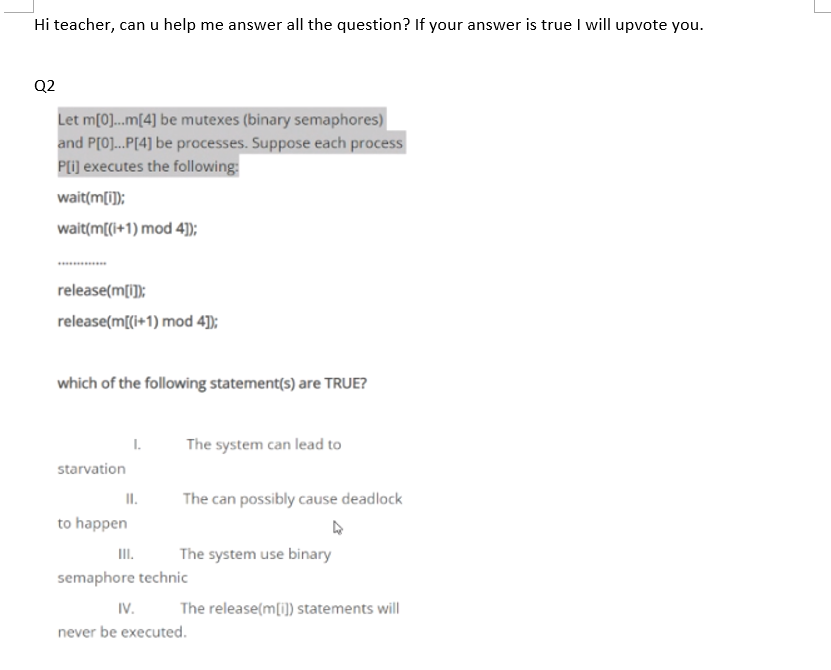
Question: Hi teacher, can u help me answer all the question? If your answer is true I will upvote you. Q2 Let m[O)...m[4] be mutexes (binary
![your answer is true I will upvote you. Q2 Let m[O)...m[4] be](https://dsd5zvtm8ll6.cloudfront.net/si.experts.images/questions/2024/09/66f31bc0309d7_38366f31bbfc72fd.jpg)
![mutexes (binary semaphores) and P[O...P[4] be processes. Suppose each process P[i] executes](https://dsd5zvtm8ll6.cloudfront.net/si.experts.images/questions/2024/09/66f31bc0d4753_38466f31bc053fcc.jpg)
![the following: wait(m[i]); wait(m[(i+1) mod 4]); release(m[i; release(m[(i+1) mod 4]); which of](https://dsd5zvtm8ll6.cloudfront.net/si.experts.images/questions/2024/09/66f31bc1c3543_38566f31bc131f96.jpg)
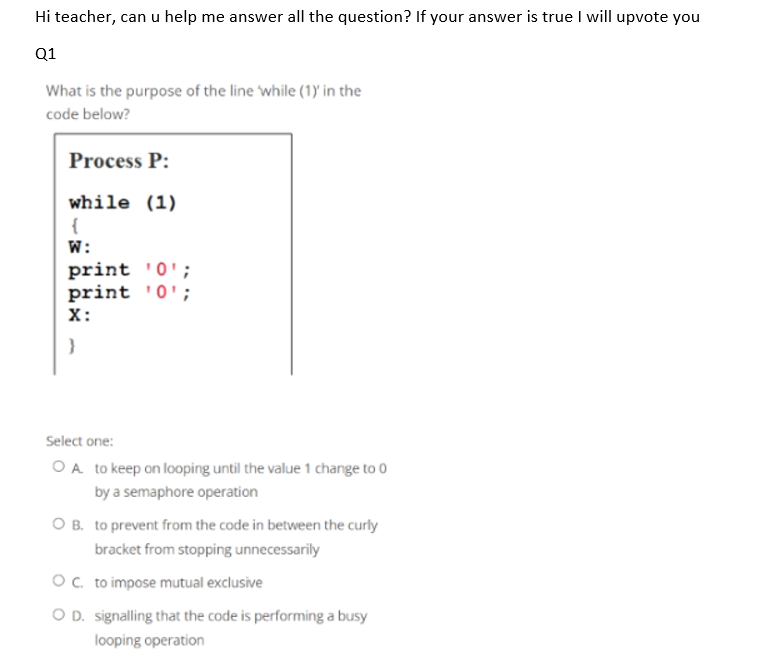
Hi teacher, can u help me answer all the question? If your answer is true I will upvote you. Q2 Let m[O)...m[4] be mutexes (binary semaphores) and P[O...P[4] be processes. Suppose each process P[i] executes the following: wait(m[i]); wait(m[(i+1) mod 4]); release(m[i; release(m[(i+1) mod 4]); which of the following statement(s) are TRUE? 1. The system can lead to starvation II. The can possibly cause deadlock to happen III. The system use binary semaphore technic IV. The release(m[l) statements will never be executed. Select one: O A II and III only OB. None are TRUE. OC I and IV only OD. II, III and IV only OE. I and I only Q3 Let m[O]...m[4] be mutexes (binary semaphores) and P[O....P[4] be processes. Suppose each process P[i] executes the following: wait(m[i]); wait(m[(i+1) mod 4); release(m[i]); release(m[(i+1) mod 4]); What is the effect of putting the mod 4 operation? Select one: O A It will create the effect of a loop. O B. It will keep the value of the semaphore to be less or equal to 4 OC It ensured that only the 5 semaphores will be accessed. OD. It will increase the value of 1(1++1); Q4 What is the effect of the cobegin and coned statement in the following code? var a, b, c, d, e, f, g : semaphore; begin cobegin begin si; V(a); V(b) end; begin P(a); 52; V(c); V(d) end; begin P(b); 33; V(e) end; begin P(c); P(): S4 end; begin P(d); P(); P(g): 55 end begin $6; V(); V(g) end; coend end; Select one: O A It allows for all concurrent execution of the statements S1, S2 and 53. OB. It ensures mutual exclusion is imposed. OC It ensures that the statements in between them is executed in order OD. It functions like a loop which executes statements 51.52 and 53 forever. Hi teacher, can u help me answer all the question? If your answer is true I will upvote you Q1 What is the purpose of the line while (1) in the code below? Process P: while (1) { W: print '0'; print '0'; X: } Select one: O A. to keep on looping until the value 1 change to o by a semaphore operation O B. to prevent from the code in between the curly bracket from stopping unnecessarily OC to impose mutual exclusive OD. signalling that the code is performing a busy looping operation
Step by Step Solution
There are 3 Steps involved in it

Get step-by-step solutions from verified subject matter experts
 Study Help