







Question: Hi, the correct answer is given in red which helps you to explain . please explain the formula then the rest of the questions thanks
Hi, the correct answer is given in red which helps you to explain . please explain the formula then the rest of the questions thanks a lot!
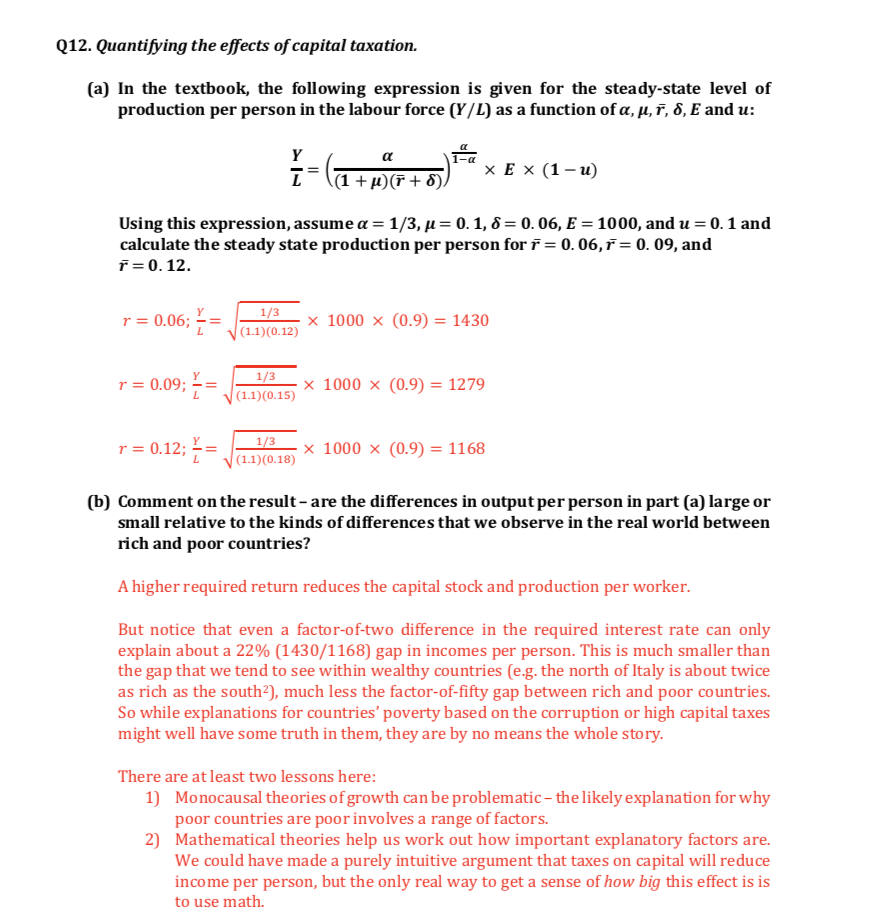
Q12. Quantifying the effects of capital taxation. (a) In the textbook, the following expression is given for the steady-state level of production per person in the labour force (Y/L) as a function of a, u, r, 8, E and u: I = (71 +1 ) (+ +8 ) a I -a X E x (1-u) Using this expression, assume a = 1/3, # = 0. 1, 8 = 0. 06, E = 1000, and u = 0. 1 and calculate the steady state production per person for F = 0. 06, r = 0. 09, and F = 0. 12. r = 0.06; - = 1/3 x 1000 x (0.9) = 1430 (1.1) (0.12) r = 0.09; -= 1/3 (1.1) (0.15) x 1000 x (0.9) = 1279 r = 0.12; -= 1/3 (1.1)(0.18) x 1000 x (0.9) = 1168 (b) Comment on the result - are the differences in output per person in part (a) large or small relative to the kinds of differences that we observe in the real world between rich and poor countries? A higher required return reduces the capital stock and production per worker. But notice that even a factor-of-two difference in the required interest rate can only explain about a 22% (1430/1168) gap in incomes per person. This is much smaller than the gap that we tend to see within wealthy countries (e.g. the north of Italy is about twice as rich as the south?), much less the factor-of-fifty gap between rich and poor countries. So while explanations for countries' poverty based on the corruption or high capital taxes might well have some truth in them, they are by no means the whole story. There are at least two lessons here: 1) Monocausal theories of growth can be problematic- the likely explanation for why poor countries are poor involves a range of factors. 2) Mathematical theories help us work out how important explanatory factors are. We could have made a purely intuitive argument that taxes on capital will reduce income per person, but the only real way to get a sense of how big this effect is is to use math
Step by Step Solution
There are 3 Steps involved in it

Get step-by-step solutions from verified subject matter experts
 Study Help