







Question: Hi, the correct answer to the question is provided in red, please dont reproduce the answer as i am struggling to understand the answer, but
Hi, the correct answer to the question is provided in red, please dont reproduce the answer as i am struggling to understand the answer, but explanations in step by step, please dont worry about the unhelpful , i will vote for helpful if its good enough . Thanks
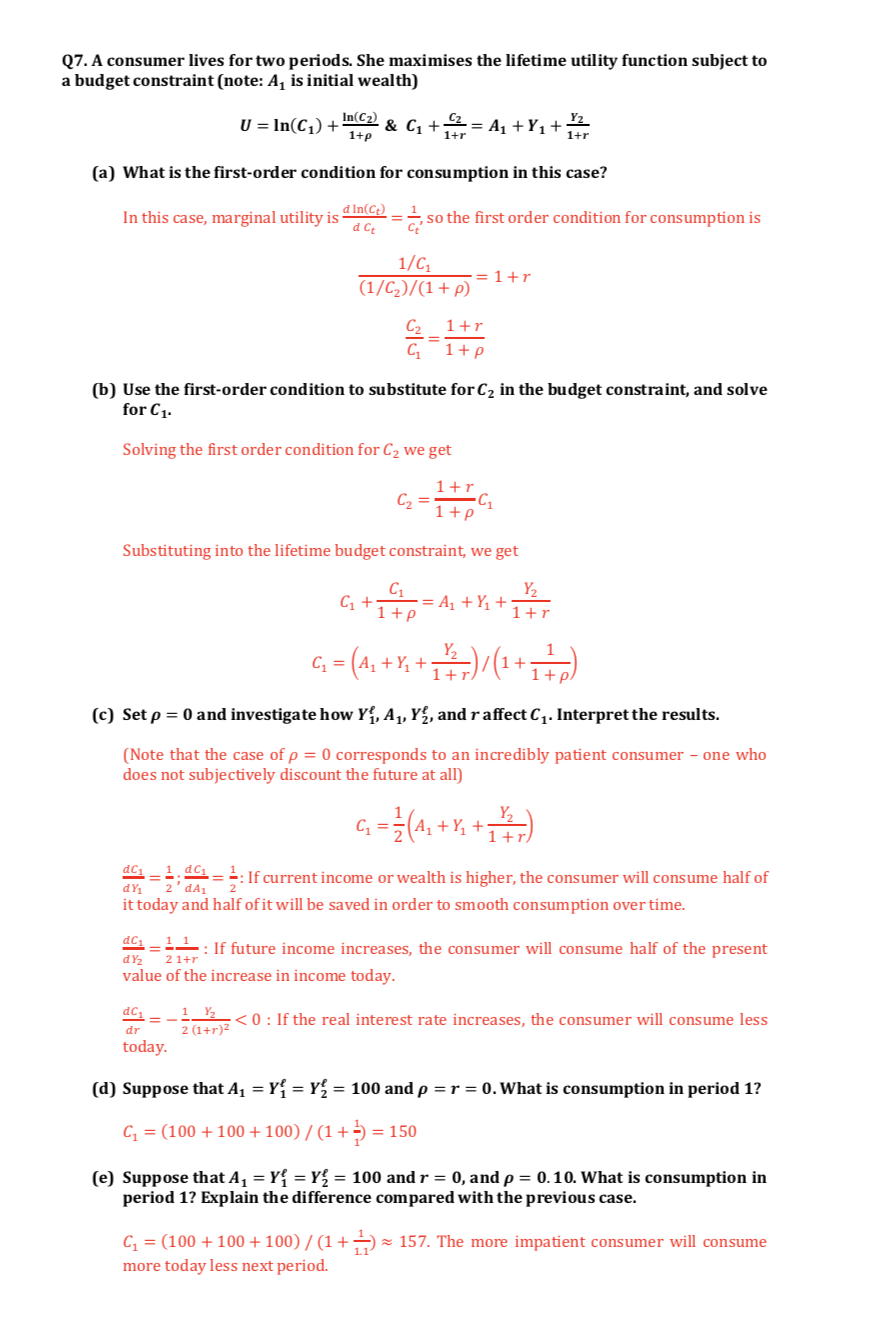
Q7. A consumer lives for two periods. She maximises the lifetime utility function subject to a budget constraint (note: A, is initial wealth) U = In(C1) + 14p & C1+12= 147 = A1 + Y1+ #2 (a) What is the first-order condition for consumption in this case? In this case, marginal utility is = , so the first order condition for consumption is 1/C (1/C2)/(1 + p) -=1+r Cz 1 +r C , = 1 + p (b) Use the first-order condition to substitute for C2 in the budget constraint, and solve for C1. Solving the first order condition for C2 we get 1+r -C1 C2 = 1 + p Substituting into the lifetime budget constraint, we get C1# 1 + p (1 = A1 + Y + Itr C1 = (A , + + 27) / ( 1 + 14 ) (c) Set p = 0 and investigate how Yi, A,, Y, and r affect C. Interpret the results. (Note that the case of p = 0 corresponds to an incredibly patient consumer - one who does not subjectively discount the future at all) C1 = Z ( A, + 1 , + 147) 1 = 1, do1 = -: If current income or wealth is higher, the consumer will consume half of dy1 2' dAl it today and half of it will be saved in order to smooth consumption over time. dYz 2 1+r do1 = _! : If future income increases, the consumer will consume half of the present value of the increase in income today. dr 2 ( 1+r) 2
Step by Step Solution
There are 3 Steps involved in it

Get step-by-step solutions from verified subject matter experts
 Study Help