



Question: Hi there can anyone please help me with this, would really appreciate it!! 4. Let X be a random variable with cdf F and a
Hi there can anyone please help me with this, would really appreciate it!!
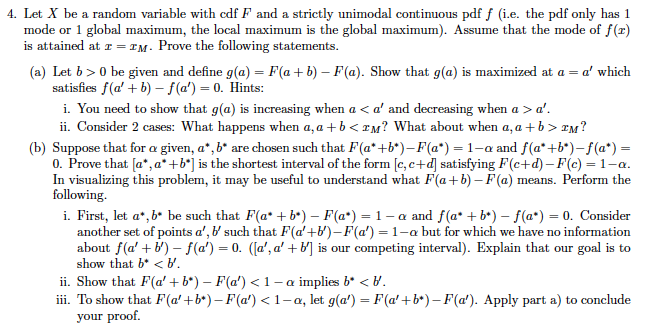
4. Let X be a random variable with cdf F and a strictly unimodal continuous pdf f (i.e. the pdf only has 1 mode or 1 global maximum, the local maximum is the global maximum). Assume that the mode of f (x) is attained at r = ry. Prove the following statements. (a) Let b > 0 be given and define g(a) = F(a + b) - F(a). Show that g(a) is maximized at a = a' which satisfies f(a' + b) - f(a') =0. Hints: i. You need to show that g(a) is increasing when a a'. ii. Consider 2 cases: What happens when a, a + b IM? (b) Suppose that for a given, a* , b' are chosen such that F(a* +b*)-F(a") = 1-a and f(a* +b')-f(a*) = 0. Prove that [a*, a* + b'] is the shortest interval of the form [c, c+d] satisfying F(c+d) -F(c) = 1-a. In visualizing this problem, it may be useful to understand what F(a + b) -F(a) means. Perform the following. i. First, let a*, b* be such that F(a* + b*) - F(a*) = 1 -a and f(a* + b*) - f(a") =0. Consider another set of points a', b' such that F(a'+b)-F(a') =1-a but for which we have no information about f(a' + b') - f(a') =0. ([a', a' + b'] is our competing interval). Explain that our goal is to show that b*
Step by Step Solution
There are 3 Steps involved in it

Get step-by-step solutions from verified subject matter experts