







Question: Hi there I really need help with this please all the directions are on the sheet. I will appreciate it please Laun in the Law
Hi there I really need help with this please all the directions are on the sheet. I will appreciate it please
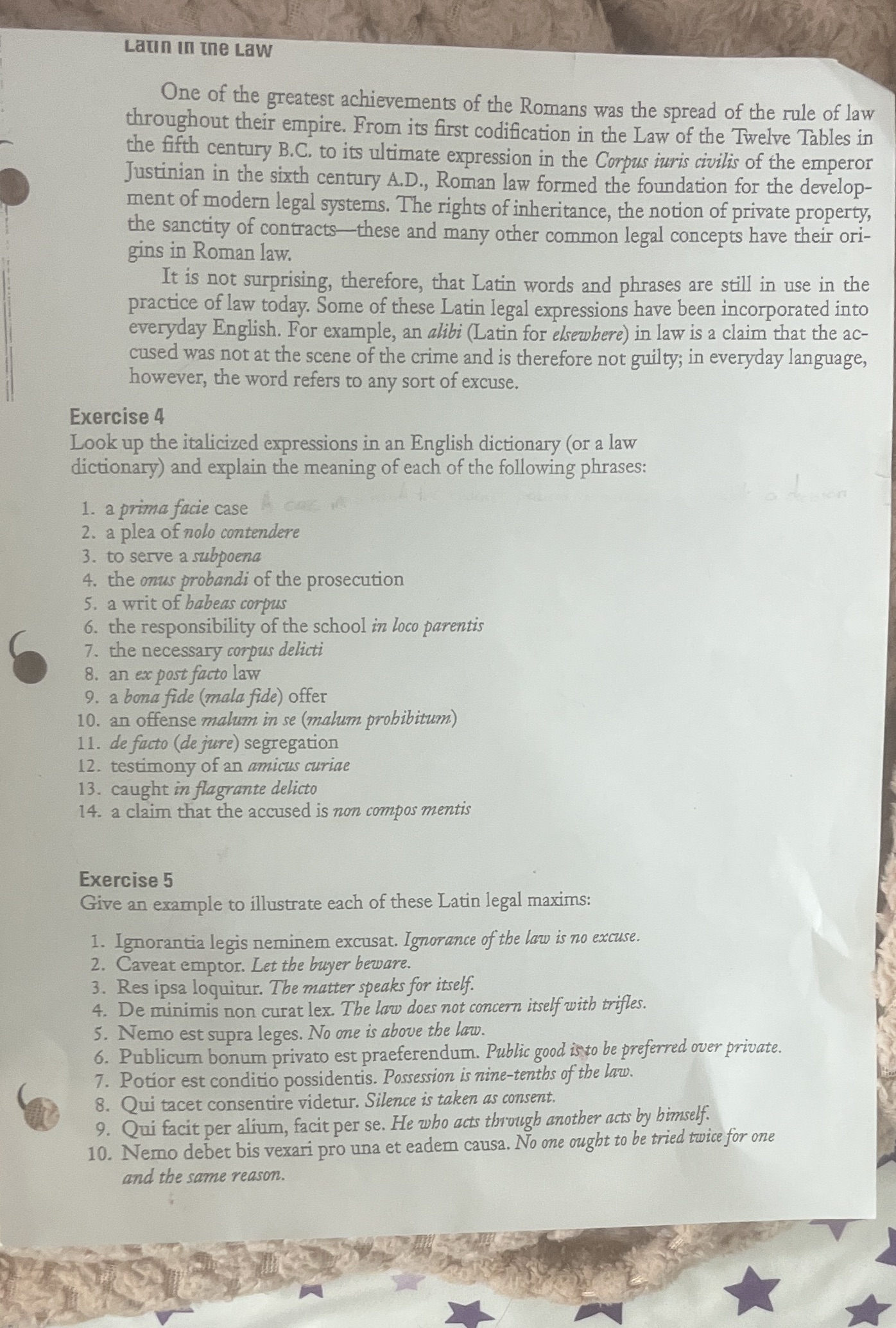
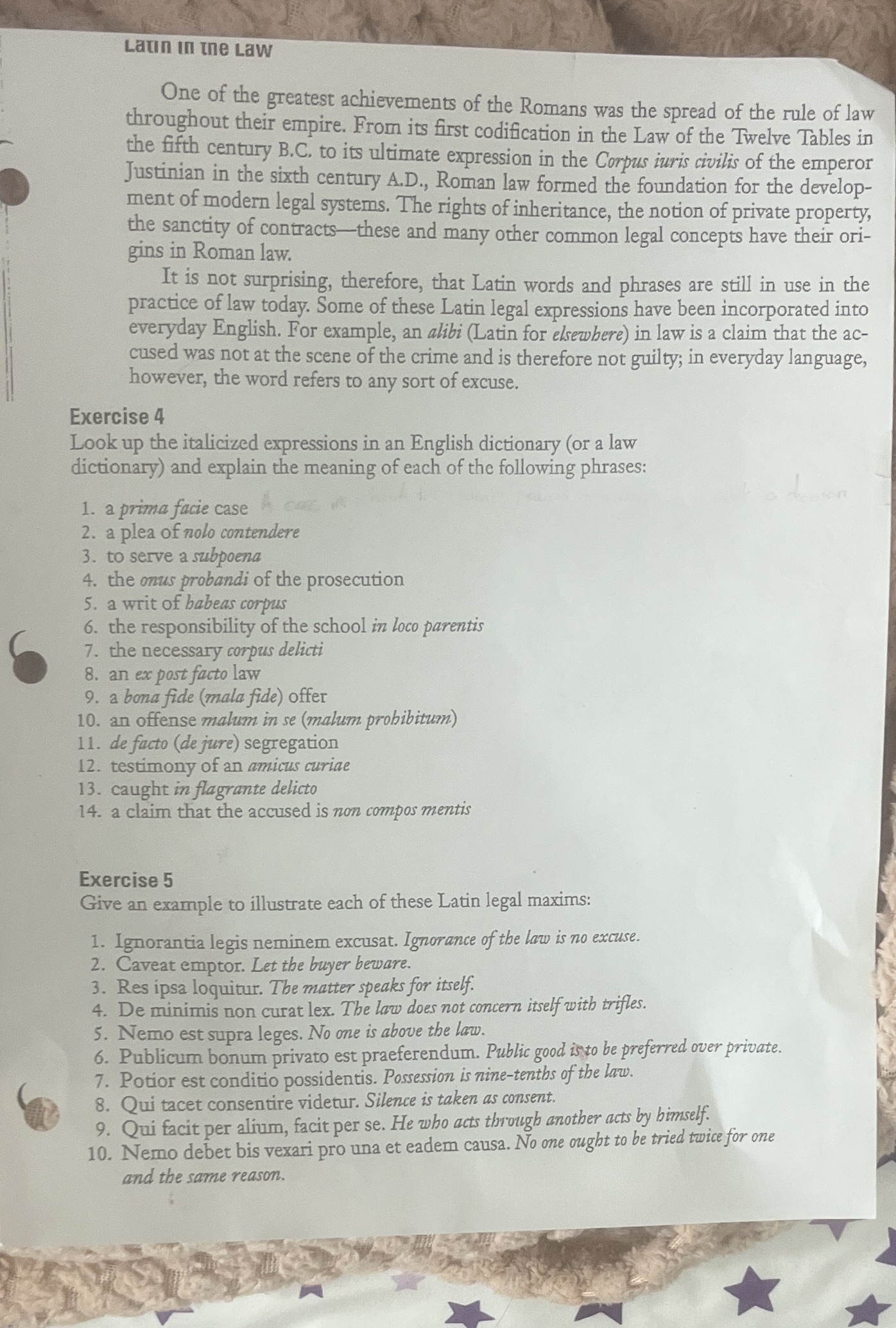
Laun in the Law One of the greatest achievements of the Romans was the spread of the rule of law throughout their empire. From its first codification in the Law of the Twelve Tables in the fifth century B.C. to its ultimate expression in the Corpus iuris civilis of the emperor Justinian in the sixth century A.D., Roman law formed the foundation for the develop- ment of modern legal systems. The rights of inheritance, the notion of private property, the sanctity of contracts-these and many other common legal concepts have their ori- gins in Roman law. It is not surprising, therefore, that Latin words and phrases are still in use in the practice of law today. Some of these Latin legal expressions have been incorporated into everyday English. For example, an alibi (Latin for elsewhere) in law is a claim that the ac- cused was not at the scene of the crime and is therefore not guilty; in everyday language, however, the word refers to any sort of excuse. Exercise 4 Look up the italicized expressions in an English dictionary (or a law dictionary) and explain the meaning of each of the following phrases: 1. a prima facie case 2. a plea of nolo contendere 3. to serve a subpoena 4. the onus probandi of the prosecution 5. a writ of habeas corpus 6. the responsibility of the school in loco parentis 7. the necessary corpus delicti 8. an ex post facto law 9. a bona fide (mala fide) offer 10. an offense malum in se (malum prohibitum) 11. de facto (de jure) segregation 12. testimony of an amicus curiae 13. caught in flagrante delicto 14. a claim that the accused is non compos mentis Exercise 5 Give an example to illustrate each of these Latin legal maxims: 1. Ignorantia legis neminem excusat. Ignorance of the law is no excuse. 2. Caveat emptor. Let the buyer beware. 3. Res ipsa loquitur. The matter speaks for itself. 4. De minimis non curat lex. The law does not concern itself with trifles. 5. Nemo est supra leges. No one is above the law. 6. Publicum bonum privato est praeferendum. Public good is to be preferred over private. 7. Potior est conditionossidentis. Possession is nine-tenths of the law. 8. Qui tacet consentire videtur. Silence is taken as consent. 9. Qui facit per alium, facit per se. He who acts through another acts by himself. 10. Nemo debet bis vexari pro una et eadem causa. No one ought to be tried twice for one and the same reason
Step by Step Solution
There are 3 Steps involved in it

Get step-by-step solutions from verified subject matter experts
 Study Help