



Question: Hi there! This is a case study. I have highlighted (in blue) the questions that need to be addressed on page-2. It will be helpful
Hi there! This is a case study. I have highlighted (in blue) the questions that need to be addressed on page-2. It will be helpful you I can actually get all the questions answered (and not merely receive definions in the name of an answer, pls). Word limit: 1500- 2000 words. Thanks in advance! 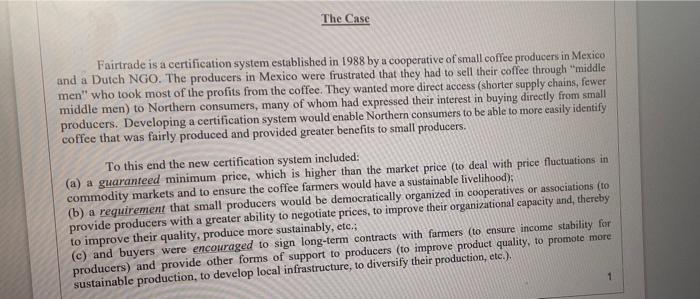
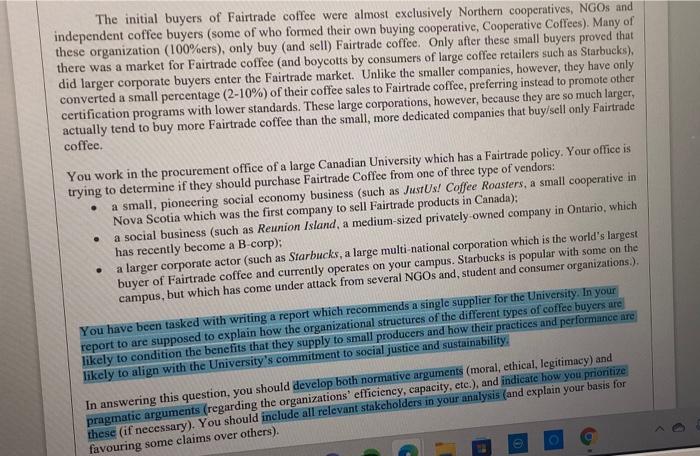
The Case Fairtrade is a certification system established in 1988 by a cooperative of small coffee producers in Mexico and a Dutch NGO. The producers in Mexico were frustrated that they had to sell their coffee through "middle men" who took most of the profits from the coffee. They wanted more direct access (shorter supply chains, fewer middle men) to Northern consumers, many of whom had expressed their interest in buying directly from small producers. Developing a certification system would enable Northern consumers to be able to more easily identify coffee that was fairly produced and provided greater benefits to small producers. To this end the new certification system included: (a) a guaranteed minimum price, which is higher than the market price (to deal with price fluctuations in commodity markets and to ensure the coffee farmers would have a sustainable livelihood); (b) a requirement that small producers would be democratically organized in cooperatives or associations (to provide producers with a greater ability to negotiate prices, to improve their organizational capacity and thereby to improve their quality, produce more sustainably, etc.; (c) and buyers were encouraged to sign long-term contracts with farmers to ensure income stability for producers) and provide other forms of support to producers (to improve product quality, to promote more sustainable production, to develop local infrastructure, to diversify their production, etc.). 1 The initial buyers of Fairtrade coffee were almost exclusively Northern cooperatives, NGOs and independent coffee buyers (some of who formed their own buying cooperative, Cooperative Coffees). Many of these organization (100%ers), only buy and sell) Fairtrade coffee. Only after these small buyers proved that there was a market for Fairtrade coffee and boycotts by consumers of large coffee retailers such as Starbucks), did larger corporate buyers enter the Fairtrade market. Unlike the smaller companies, however, they have only converted a small percentage (2-10%) of their coffee sales to Fairtrade coffee, preferring instead to promote other certification programs with lower standards. These large corporations, however, because they are so much larger, actually tend to buy more Fairtrade coffee than the small, more dedicated companies that buy sell only Fairtrade coffee. . You work in the procurement office of a large Canadian University which has a Fairtrade policy. Your office is trying to determine if they should purchase Fairtrade Coffee from one of three type of vendors: a small, pioneering social economy business (such as JustUs! Coffee Roasters, a small cooperative in Nova Scotia which was the first company to sell Fairtrade products in Canada): a social business (such as Reunion Island, a medium-sized privately owned company in Ontario, which has recently become a B-corp): a larger corporate actor (such as Starbucks, a large multi-national corporation which is the world's largest buyer of Fairtrade coffee and currently operates on your campus. Starbucks is popular with some on the campus, but which has come under attack from several NGOs and student and consumer organizations.). You have been tasked with writing a report which recommends a single supplier for the University. In your report to are supposed to explain how the organizational structures of the different types of coffee buyers are likely to condition the benefits that they supply to small producers and how their practices and performance are likely to align with the University's commitment to social justice and sustainability In answering this question, you should develop both normative arguments (moral, ethical, legitimacy) and pragmatic arguments (regarding the organizations' efficiency, capacity, etc.), and indicate how you prioritize these (if necessary). You should include all relevant stakeholders in your analysis and explain your basis for favouring some claims over others) Step by Step Solution
There are 3 Steps involved in it
1 Expert Approved Answer
Step: 1 Unlock

Question Has Been Solved by an Expert!
Get step-by-step solutions from verified subject matter experts
Step: 2 Unlock
Step: 3 Unlock