


Question: Hi, This is a task on pricing in Black-Scholes. Can someone help me with the following: 1. The interest rate, given at 2%, is semi-annually

Hi,

This is a task on pricing in Black-Scholes. Can someone help me with the following:

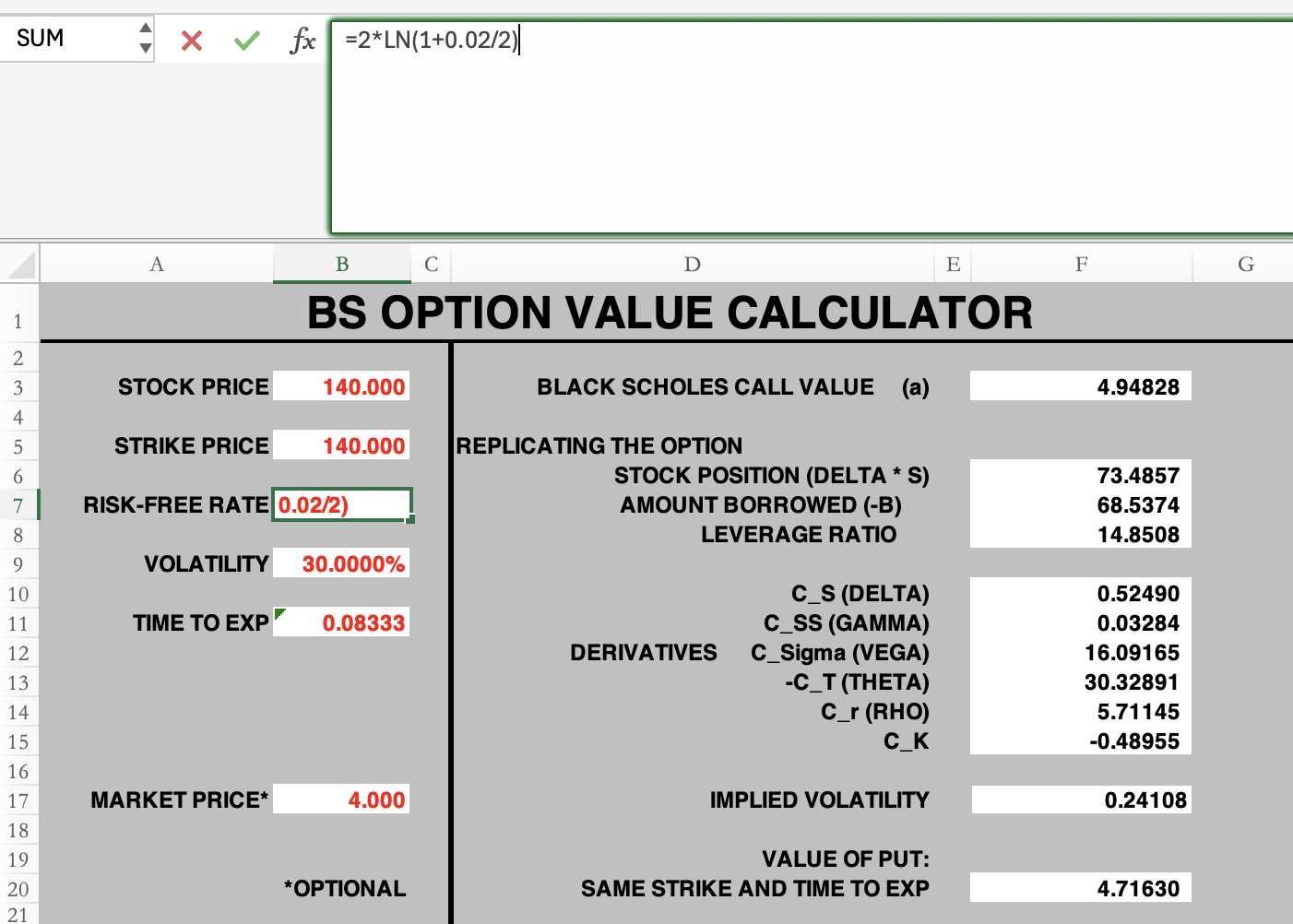
1. The interest rate, given at 2%, is semi-annually continuously compounded. It is stated earlier in the task that it must be semi-annual. However, I do not understand why my teacher derives it as: 2 * LN ( 1 + r / 2). Can you please explain this?

2. Can someone explain me the difference between T, t, and T-t, and which cases we use it to compound the interest rate? I assume that T = 1/12 and t = 1, with T-t being the difference. Why don't we compound using this? I have seen some cases, where we do, and now we dont?
Hi, This is a task on pricing in Black-Scholes.Hi, This is a task on pricing in Black-Scholes.
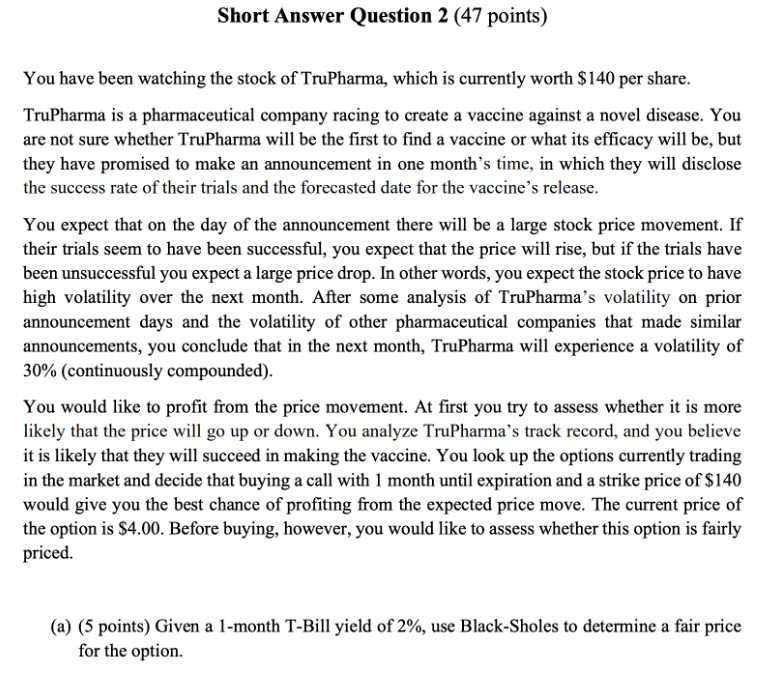
Short Answer Question 2 (47 points) You have been watching the stock of TruPharma, which is currently worth $140 per share. TruPharma is a pharmaceutical company racing to create a vaccine against a novel disease. You are not sure whether TruPharma will be the first to find a vaccine or what its efficacy will be, but they have promised to make an announcement in one month's time, in which they will disclose the success rate of their trials and the forecasted date for the vaccine's release. You expect that on the day of the announcement there will be a large stock price movement. If their trials seem to have been successful, you expect that the price will rise, but if the trials have been unsuccessful you expect a large price drop. In other words, you expect the stock price to have high volatility over the next month. After some analysis of TruPharma's volatility on prior announcement days and the volatility of other pharmaceutical companies that made similar announcements, you conclude that in the next month, TruPharma will experience a volatility of 30% (continuously compounded). You would like to profit from the price movement. At first you try to assess whether it is more likely that the price will go up or down. You analyze TruPharma's track record, and you believe it is likely that they will succeed in making the vaccine. You look up the options currently trading in the market and decide that buying a call with 1 month until expiration and a strike price of $140 would give you the best chance of profiting from the expected price move. The current price of the option is $4.00. Before buying, however, you would like to assess whether this option is fairly priced. (a) (5 points) Given a 1-month T-Bill yield of 2%, use Black-Sholes to determine a fair price for the option. SUM X V fx =2*LN(1+0.02/2) A B C D E F G BS OPTION VALUE CALCULATOR STOCK PRICE 140.000 BLACK SCHOLES CALL VALUE (a) 4.94828 STRIKE PRICE 140.000 REPLICATING THE OPTION STOCK POSITION (DELTA * S) 73.4857 RISK-FREE RATE 0.02/2) AMOUNT BORROWED (-B) 68.5374 LEVERAGE RATIO 14.8508 VOLATILITY 30.0000% 10 C_S (DELTA) 0.52490 11 TIME TO EXP 0.08333 C_SS (GAMMA) 0.03284 12 DERIVATIVES C_Sigma (VEGA) 16.09165 13 -C_T (THETA) 30.32891 14 C_r (RHO) 5.71145 15 C_K -0.48955 16 17 MARKET PRICE* 4.000 IMPLIED VOLATILITY 0.24108 18 19 VALUE OF PUT: 20 *OPTIONAL SAME STRIKE AND TIME TO EXP 4.71630 21

Step by Step Solution

There are 3 Steps involved in it

1 Expert Approved Answer
Step: 1 Unlock blur-text-image

Question Has Been Solved by an Expert!

Get step-by-step solutions from verified subject matter experts

Step: 2 Unlock
Step: 3 Unlock

Students Have Also Explored These Related Finance Questions!