







Question: HI TUTOR, CAN YOU PLEASE PROVIDE ME THE SOLUTION FOR THE QUESTIONS OF PART 2 OF THE ATTACHMENT I ATTACHED HERE. THANK YOU IN ADVANCE
HI TUTOR,
CAN YOU PLEASE PROVIDE ME THE SOLUTION FOR THE QUESTIONS OF PART 2 OF THE ATTACHMENT I ATTACHED HERE.
THANK YOU IN ADVANCE AND SORRY FOR THE INCONVENIENCE.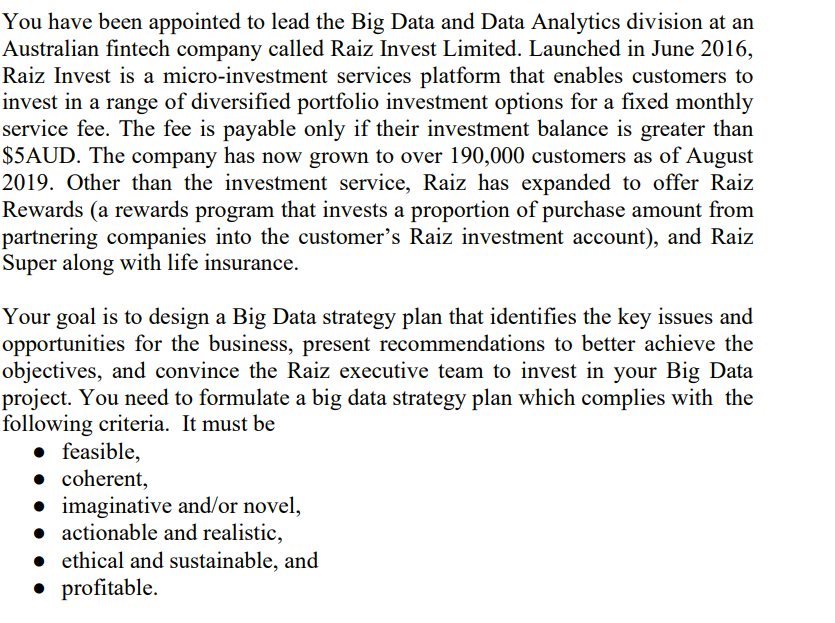
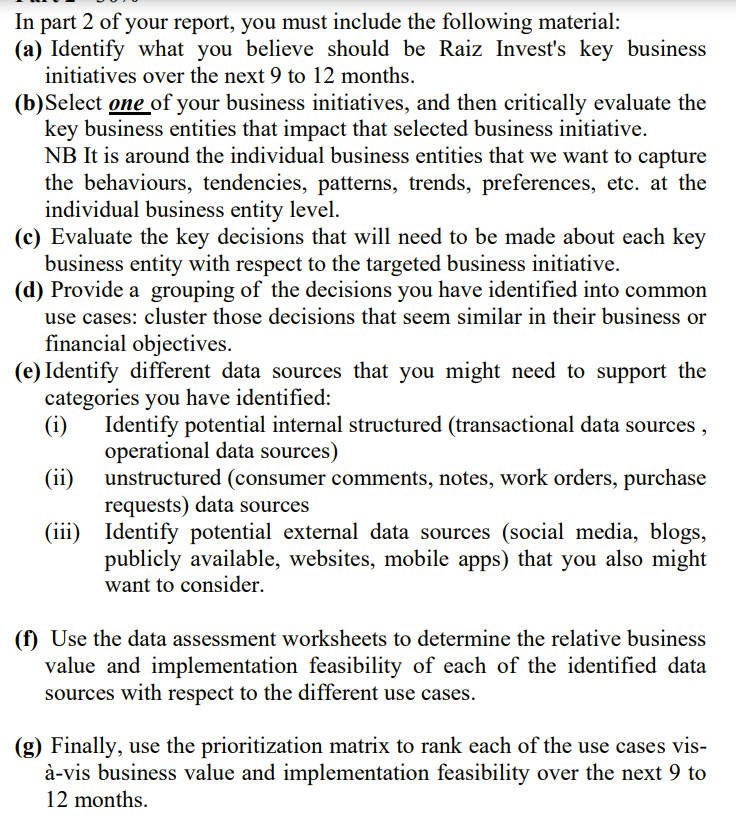
You have been appointed to lead the Big Data and Data Analytics division at an Australian fintech company called Raiz Invest Limited. Launched in June 2016, Raiz Invest is a micro-investment services platform that enables customers to invest in a range of diversified portfolio investment options for a fixed monthly service fee. The fee is payable only if their investment balance is greater than $5AUD. The company has now grown to over 190,000 customers as of August 2019. Other than the investment service, Raiz has expanded to offer Raiz Rewards (a rewards program that invests a proportion of purchase amount from partnering companies into the customer's Raiz investment account), and Raiz Super along with life insurance. Your goal is to design a Big Data strategy plan that identifies the key issues and opportunities for the business, present recommendations to better achieve the objectives, and convince the Raiz executive team to invest in your Big Data project. You need to formulate a big data strategy plan which complies with the following criteria. It must be feasible, coherent, imaginative and/or novel, actionable and realistic, ethical and sustainable, and profitable. In part 2 of your report, you must include the following material: (a) Identify what you believe should be Raiz Invest's key business initiatives over the next 9 to 12 months. (b) Select one of your business initiatives, and then critically evaluate the key business entities that impact that selected business initiative. NB It is around the individual business entities that we want to capture the behaviours, tendencies, patterns, trends, preferences, etc. at the individual business entity level. (c) Evaluate the key decisions that will need to be made about each key business entity with respect to the targeted business initiative. (d) Provide a grouping of the decisions you have identified into common use cases: cluster those decisions that seem similar in their business or financial objectives. (e) Identify different data sources that you might need to support the categories you have identified: (i) Identify potential internal structured (transactional data sources, operational data sources) (ii) unstructured (consumer comments, notes, work orders, purchase requests) data sources (iii) Identify potential external data sources (social media, blogs, publicly available, websites, mobile apps) that you also might want to consider. (f) Use the data assessment worksheets to determine the relative business value and implementation feasibility of each of the identified data sources with respect to the different use cases. (g) Finally, use the prioritization matrix to rank each of the use cases vis- -vis business value and implementation feasibility over the next 9 to 12 months
Step by Step Solution
There are 3 Steps involved in it

Get step-by-step solutions from verified subject matter experts
 Study Help