







Question: Hidden node problem 6. Consider a network of 5 nodes as shown below. The edges represent the range of transmission/reception for each node. Edges with
Hidden node problem
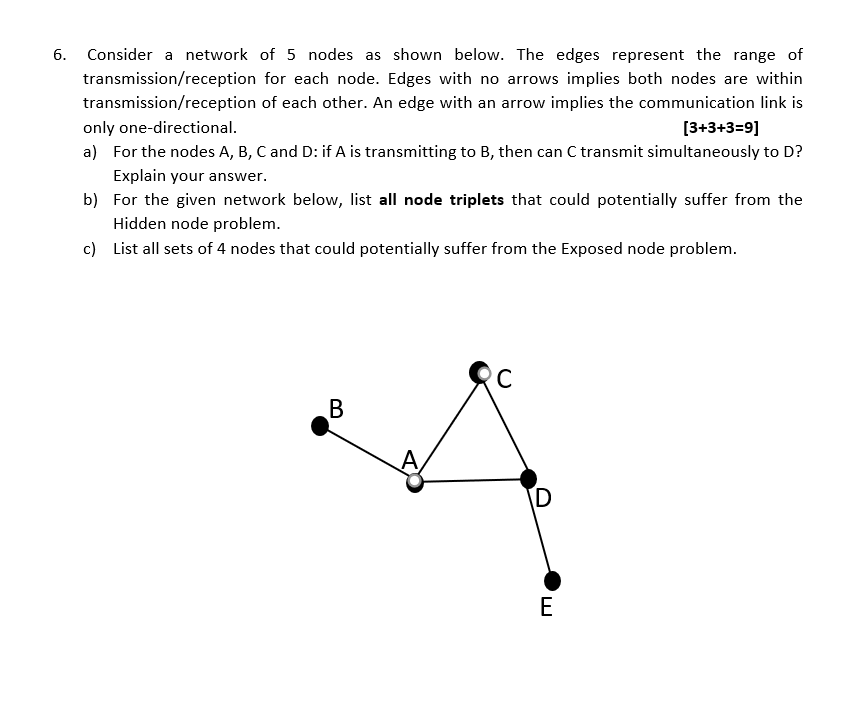
6. Consider a network of 5 nodes as shown below. The edges represent the range of transmission/reception for each node. Edges with no arrows implies both nodes are within transmission/reception of each other. An edge with an arrow implies the communication link is only one-directional. (3+3+3=9] a) For the nodes A, B, C and D: if A is transmitting to B, then can C transmit simultaneously to D? Explain your answer. b) For the given network below, list all node triplets that could potentially suffer from the Hidden node problem. c) List all sets of 4 nodes that could potentially suffer from the Exposed node problem. C B A ID E
Step by Step Solution
There are 3 Steps involved in it
1 Expert Approved Answer
Step: 1 Unlock

Question Has Been Solved by an Expert!
Get step-by-step solutions from verified subject matter experts
Step: 2 Unlock
Step: 3 Unlock
 Study Help