







Question: Hidden Surface Removal Assume that you are given a sequence of N convex polygons with (x,y,z) coordinates defined for each polygon vertex. Your goal is
Hidden Surface Removal
Assume that you are given a sequence of N convex polygons with (x,y,z) coordinates defined for each polygon vertex. Your goal is to create an image where only the visible portions of each polygon appear on the screen, and hidden surfaces are removed.
a) Describe how the z-buffer algorithm for hidden surface removal works.
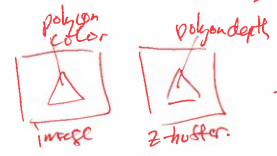
Basic idea is to store the depth of the polygon at each (x, y) location in a z-buffer array. Then when we display each polygon, we compare the polygon depth at (x, y) to z-buffer depth at (x, y).
If polygon depth is less than the z-buffer depth:
* Save polygon color
* Update z-buffer to polygon depth
No sorting of polygons is needed!
b) Describe how the painters algorithm for hidden surface removal works.
Basic idea is to draw polygons that are far away first, and then draw closer polygons on top of far polygons
c) Give one advantage of the z-buffer versus the painters algorithm.
d) Give one advantage of the painters versus the z-buffer algorithm.
Step by Step Solution
There are 3 Steps involved in it

Get step-by-step solutions from verified subject matter experts
 Study Help