







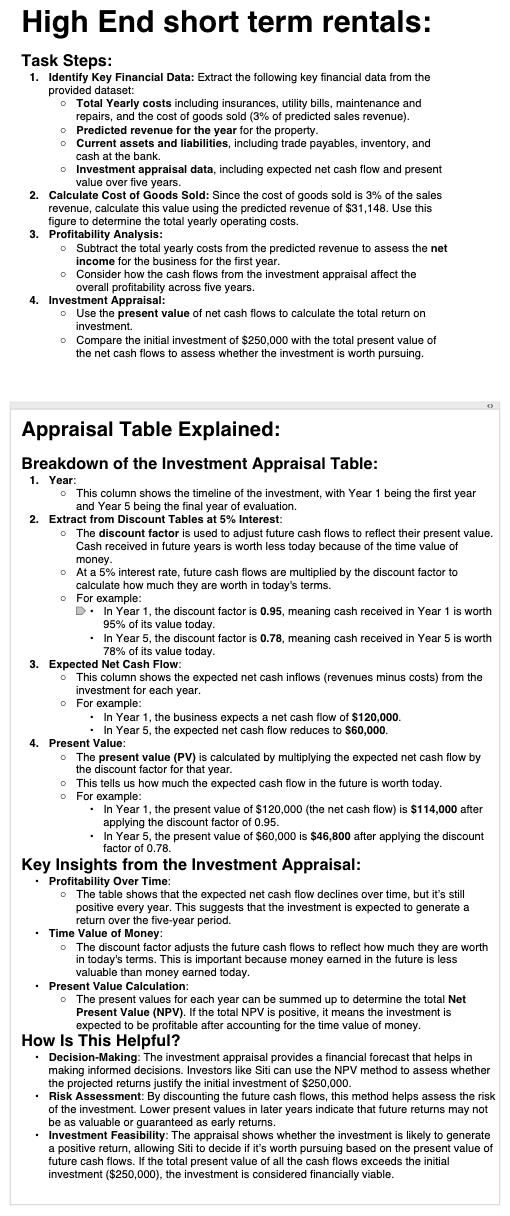
Question: High End short term rentals: Task Steps: Identify Key Financial Data: Extract the following key financial data from the provided dataset: Total Yearly costs including
High End short term rentals:
Task Steps:
Identify Key Financial Data: Extract the following key financial data from the
provided dataset:
Total Yearly costs including insurances, utility bills, maintenance and
repairs, and the cost of goods sold of predicted sales revenue
Predicted revenue for the year for the property.
Current assets and liabilities, including trade payables, inventory, and
cash at the bank.
Investment appraisal data, including expected net cash flow and present
value over five years.
Calculate Cost of Goods Sold: Since the cost of goods sold is of the sales
revenue, calculate this value using the predicted revenue of $ Use this
figure to determine the total yearly operating costs.
Profitability Analysis:
Subtract the total yearly costs from the predicted revenue to assess the net
income for the business for the first year.
Consider how the cash flows from the investment appraisal affect the
overall profitability across five years.
Investment Appraisal:
Use the present value of net cash flows to calculate the total return on
investment.
Compare the initial investment of $ with the total present value of
the net cash flows to assess whether the investment is worth pursuing.
Appraisal Table Explained:
Breakdown of the Investment Appraisal Table:
Year:
This column shows the timeline of the investment, with Year being the first year
and Year being the final year of evaluation.
Extract from Discount Tables at Interest:
The discount factor is used to adjust future cash flows to reflect their present value.
Cash received in future years is worth less today because of the time value of
money.
At a interest rate, future cash flows are multiplied by the discount factor to
calculate how much they are worth in today's terms.
For example:
D In Year the discount factor is meaning cash received in Year is worth
of its value today.
In Year the discount factor is meaning cash received in Year is worth
of its value today.
Expected Net Cash Flow:
This column shows the expected net cash inflows revenues minus costs from the
investment for each year.
For example:
In Year the business expects a net cash flow of $
In Year the expected net cash flow reduces to $
Present Value:
The present value PV is calculated by multiplying the expected net cash flow by
the discount factor for that year.
This tells us how much the expected cash flow in the future is worth today.
For example:
In Year the present value of $the net cash flow is $ after
applying the discount factor of
In Year the present value of $ is $ after applying the discount
factor of
Key Insights from the Investment Appraisal:
Profitability Over Time:
The table shows that the expected net cash flow declines over time, but it's still
positive every year. This suggests that the investment is expected to generate a
return over the fiveyear period.
Time Value of Money:
The discount factor adjusts the future cash flows to reflect how much they are worth
in today's terms. This is important because money earned in the future is less
valuable than money earned today.
Present Value Calculation:
The present values for each year can be summed up to determine the total Net
Present Value NPV If the total NPV is positive, it means the investment is
expected to be profitable after accounting for the time value of money.
How Is This Helpful?
DecisionMaking: The investment appraisal provides a financial forecast that helps in
making informed decisions. Investors like Siti can use the NPV method to assess whether
the projected returns justify the initial investment of $
Risk Assessment: By discounting the future cash flows, this method helps assess the risk
of the investment. Lower present values in later years indicate that future returns may not
be as valuable or guaranteed as early returns.
Investment Feasibility: The appraisal shows whether the investment is likely to generate
a positive return, allowing Siti to decide if it's worth pursuing based on the present value of
future cash flows. If the total present value of all the cash flows exceeds the initial
investment
$ the investment is considered financially viable.
High End short term rentals:
Task Steps:
Identify Key Financial Data: Extract the following key financial data from the
provided dataset:
Total Yearly costs including insurances, utility bills, maintenance
Step by Step Solution
There are 3 Steps involved in it
1 Expert Approved Answer
Step: 1 Unlock

Question Has Been Solved by an Expert!
Get step-by-step solutions from verified subject matter experts
Step: 2 Unlock
Step: 3 Unlock
 Study Help