







Question: Higher hinge height ( ? 4 ) : Unknown Take the acceleration due 1 0 gravity as 9 . 8 1 m s 2 and
Higher hinge height :
Unknown
Take the acceleration due gravity as and the density of water as
QUESTION
Determine the magnitude of the hydrostatic force to the nearest Newton due to depth of water
Report your answer in Newtons and use this rounded value in subsequent calculations.
The hydrostatic force N
QUESTION
Determine the magnitude of the hydrostatic force to the nearest Newton due to depth of water
Report your answer in Newtons and use this rounded value in subsequent calculations.
The hydrostatic force N
QUESTION C
Determine the magnitude of the resultant hydrostatic force to the nearest Newton acting on one gate.
Report your answer in Newons and use this rounded value in subsequent calculations.
QUESTION
Determine the height above the base of the gate of the resultant hydrostatic force to the nearest mm
Report your answer in and use this rounded value in subsequent calculations.
The height of the resultant force min
QUESTION
Determine the magnizude of the contact fonce to the nearest Newton acting between the gates.
Report your answer in Newons and use this rounded value in subsequent calculations.
The contact force
QUESTION
Determine the magnitude of the resultant reaction force to the nearesi Newton developed in the hinges of one gate.
Report your answer in Newtons and use this rounded value in subsequent calculations.
The force at the hinges of one gate
QUESTION
If the reaction force that develops in the top and botiom hinge is to be balanced, determine the height of the top hinge above the base of the gate.
Repor your answer in mm
The height of the top hinge in mim
YOUR PRQQRESS ON DUESTION
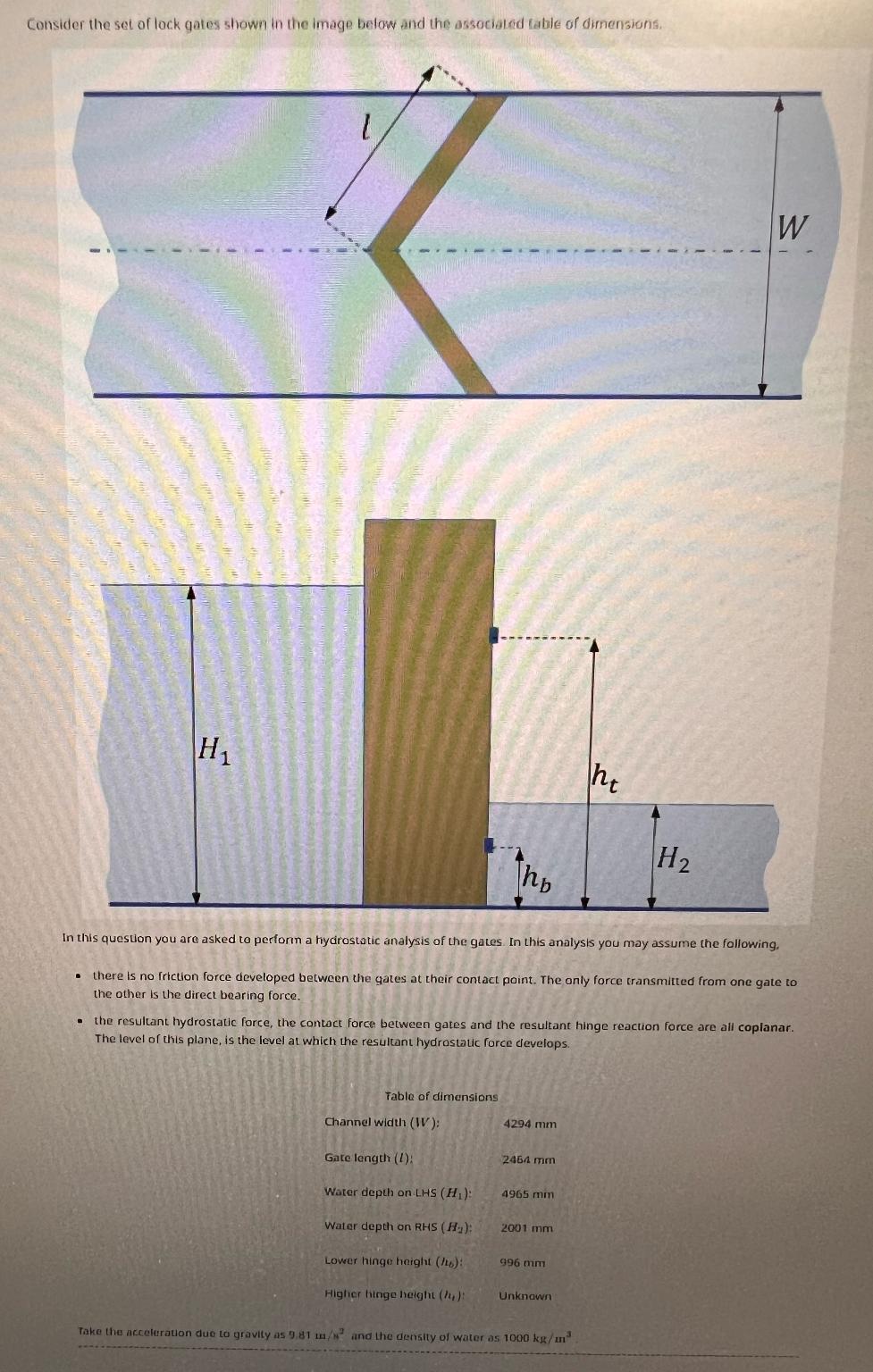
Consider the set of lock gates shown in the image below and the associaled table of dimensions.
In this question you are asked to perforn a hydrostatic analysis of the gates. In this analysis you may assume the following.
there is no friction force developed between the gates at their contact point. The only force transmitted from one gate to the other is the direct bearing force.
the resultant hydrostatic force, the contact force between gates and the resultant hinge reaction force are all coplanar. The level of this plane, is the level at which the resultant hydrostatic force develops.
Table of dimensions
Channel width IV:
tableGate length :
Step by Step Solution
There are 3 Steps involved in it
1 Expert Approved Answer
Step: 1 Unlock

Question Has Been Solved by an Expert!
Get step-by-step solutions from verified subject matter experts
Step: 2 Unlock
Step: 3 Unlock
 Study Help