







Question: Hint for question 1 To solve this problem, remember that you will first need to find how much money will be needed to have the
Hint for question 1
To solve this problem, remember that you will first need to find how much money will be needed to have the same buying power as the amount in the question. To do so, recall that inflation uses compound interest formula FV=PV(1+i)n where PV is what it costs to buy stuff today, FV is what it costs to buy the same stuff n years in the future, and i is the annual rate of inflation. You will then need to use the annuity equation FV = (PMT)(sn|i) where sn|i = [(1+i)n -1]/i to find the payments. Dont forget to adjust i and n in the annuity equations because it is not annual compounding. When adjusting remember i=(annual compound interest rate)/compounds per year and n=(number of years) times the number of compounds periods per year.
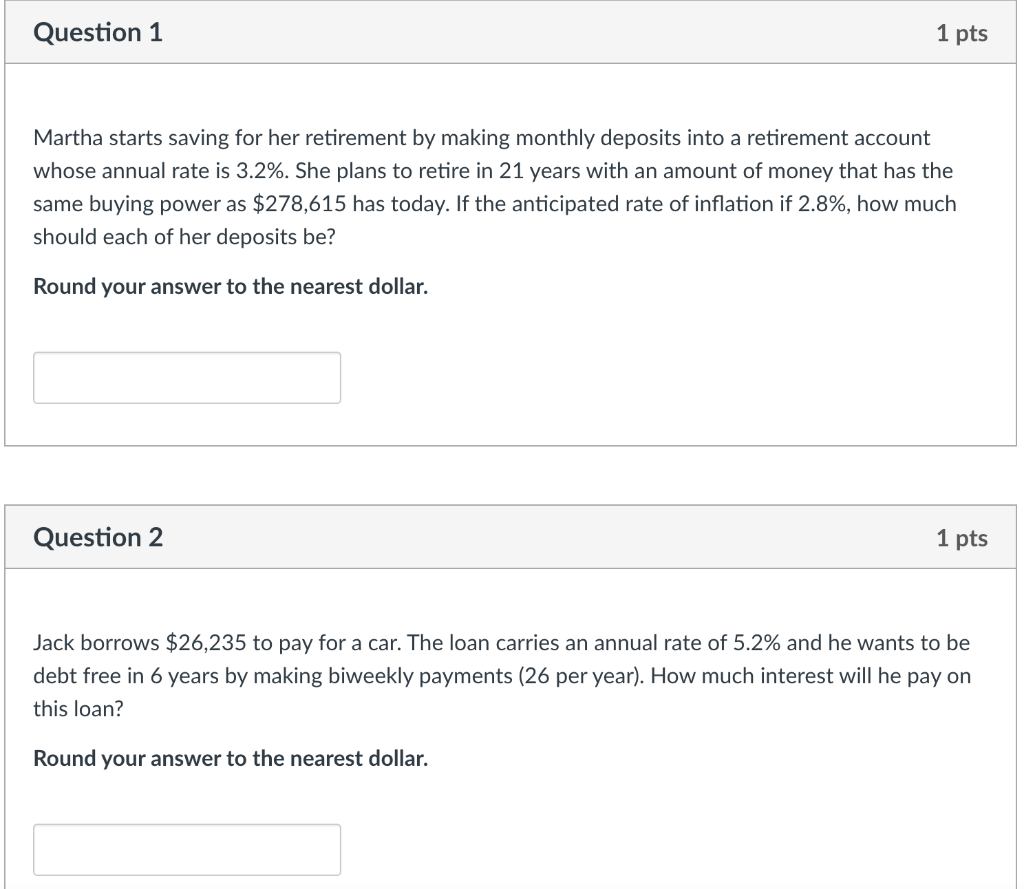
Question 1 1 pts Martha starts saving for her retirement by making monthly deposits into a retirement account whose annual rate is 3.2%. She plans to retire in 21 years with an amount of money that has the same buying power as $278,615 has today. If the anticipated rate of inflation if 2.8%, how much should each of her deposits be? Round your answer to the nearest dollar. Question 2 1 pts Jack borrows $26,235 to pay for a car. The loan carries an annual rate of 5.2% and he wants to be debt free in 6 years by making biweekly payments (26 per year). How much interest will he pay on this loan? Round your answer to the nearest dollar
Step by Step Solution
There are 3 Steps involved in it

Get step-by-step solutions from verified subject matter experts
 Study Help