







Question: Hint:Que This problem can be done with less than 1 5 0 variables and less than 1 1 0 constraints. PROBLEM DESCRIPTION NU Industries operates
Hint:Que
This problem can be done with less than variables and less than constraints.
PROBLEM DESCRIPTION
NU Industries operates two manufacturing plants that produce three products: Widgets, Gadgets, and Flugels. The finished products are shipped to the Distribution Center for final distribution to the customers. Five periods of production are to be scheduled.
According to the Sales Department, the production requirements that must be met due to contracts during the planning horizon are as follows:
Production Requirements:
Product Period Period Period Period Period
Widgets
Gadgets
Flugels
Advertisement Costs and Budget:
Also, the Marketing & Forecasting Department anticipates that NU Industries can cultivate additional demand within the distribution area through effective advertising. The M&F Department projects that each $ invested in advertising Widgets in a particular period creates additional demand for one Widget in the next period. The corresponding values for Gadgets and Flugels are $ and $ respectively. However, the total advertising budget is limited to $ for the entire planning horizon.
Profits:
Throughout the planning horizon, NU Industries will sell Widgets for $ Gadgets for $ and Flugels for $ The products can be manufactured at either of NU's Manufacturing Plants.
The Engineering Department has provided the following manufacturing and inventory data.
Plant A
The production requirements at Plant A are summarized below.
Production Requirements:
Each Widget requires pounds of Raw Material pounds of Raw Material and hours of Labor.
Each Gadget requires pounds of Raw Material and hours of Labor.
Each Flugel requires pounds of Raw Material pounds of Raw Material and hours of Labor.
Labor Costs and Budget:
Regular time labor availability is limited to hours in each period, but overtime can be scheduled in any amount if necessary. Labor costs during periods and are $hour for regular time and $hour for overtime. Labor costs are expected to rise by at the end of period
Inventory Storage Costs and Capacity:
The product inventory area can store a combined maximum of units, and inventory costs are as follows. It costs $ to store one Widget from one period to the next. The corresponding costs for Gadgets and Flugels are $ and $ respectively.
Plant B
The production requirements at Plant B are summarized below. Plant B is the more modern of the two facilities and can produce the products in a slightly more efficient manner.
Production Requirements:
Each Widget requires pounds of Raw Material pounds of Raw Material and hours of Labor.
Each Gadget requires pounds of Raw Material and hours of Labor.
Each Flugel requires pounds of Raw Material pounds of Raw Material and hours of Labor.
Labor Costs:
Regular time labor availability is limited to hours in each period, but overtime can be scheduled in any amount if necessary. Labor costs during periods and are $hour for regular time and $hour for overtime. Labor costs are expected to rise by at the end of period
Inventory Storage Costs:
The product inventory area can store a combined maximum of units, and inventory costs are as follows. It costs $ to store one Widget from one period to the next. The corresponding costs for Gadgets and Flugels are $ and $ respectively.
Raw Material Costs:
A maximum of tons of Raw Material and tons of Raw Material are available from a raw material vendor each period. Because of the proximity of the vendor to the plants, Raw Material delivered to Plant A costs $pound and Raw Material delivered to Plant A costs $pound The corresponding costs for Plant B are $pound for Raw Material and $pound for Raw Material Each plant only purchases raw material that can be used within a given period, since storage areas are limitedNote ton pounds
Transportation Costs:
There is an average transportation cost associated with the shipment of each unit of finished product from each plant to the Distribution Center. The cost depends on the product and the plant of origin. The unit shipping costs are given in the following table.
Product Plant A Plant B
Widgets $ $
Gadgets $ $
Flugels $ $
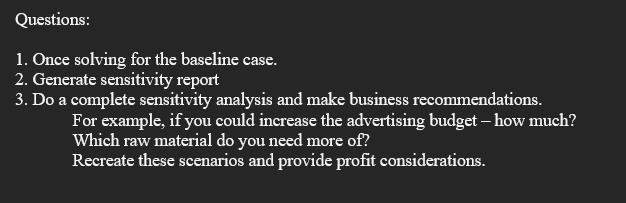
Demand in a given period must be satisfied by utilizing the units produced in that period or by using inventory from a previous period. The problem is to determine the marketing, production, distribution, inventory strategy that maximizes profit. Assume that there is no inventory at the start of the first period and there should be no inventory at the end of the planning horizon. All other plant overhead is assumedQuestions:
Once solving for the baseline case.
Generat
Step by Step Solution
There are 3 Steps involved in it
1 Expert Approved Answer
Step: 1 Unlock

Question Has Been Solved by an Expert!
Get step-by-step solutions from verified subject matter experts
Step: 2 Unlock
Step: 3 Unlock
 Study Help