







Question: Hints for Working on the Caih Flow Statement Cach flow Statements always agerecate (sum cp) all the inflows and Outhows of Cash flow durine a
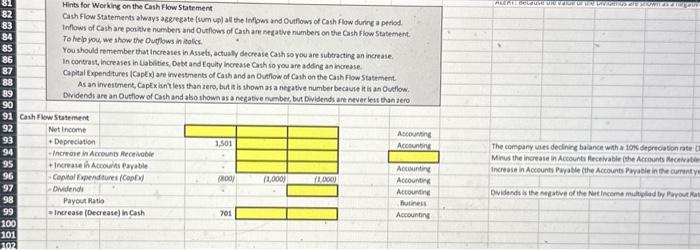
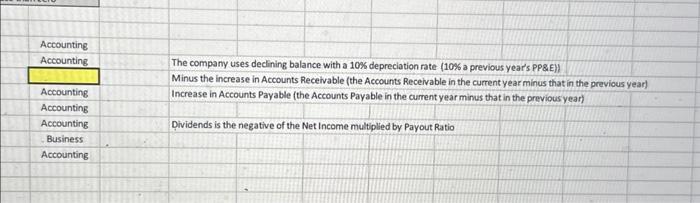
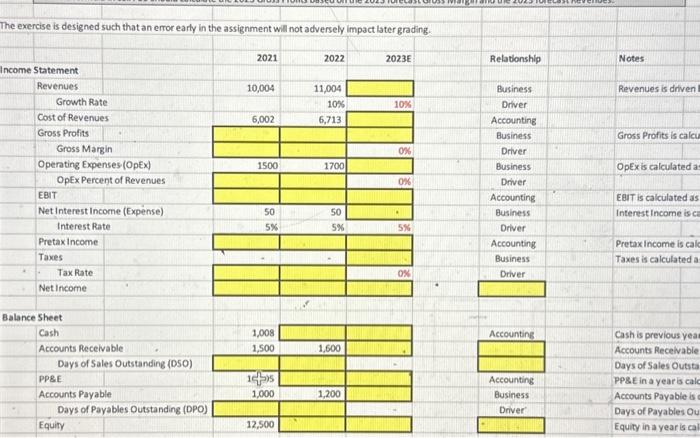
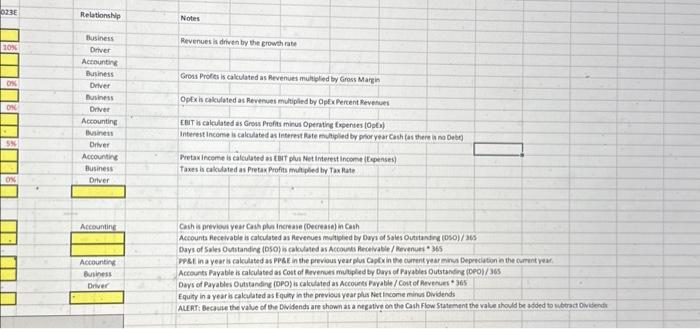
Hints for Working on the Caih Flow Statement Cach flow Statements always agerecate (sum cp) all the inflows and Outhows of Cash flow durine a petiod. inflows of Cash are poritive numbers and Outfoms of Cash are netatve numbers on the Cosh Flow Statement. To help you, we show the Ourlows in Rolics. You should remember that increases in Assets, actualy decrease Cols so you are subtracting an increase. In contrast, increases in Labities, Dete and Equity increase Cash so you are adding as incresse. As an irvestment, capt x antless than zero, but it is shown as a necative number becavis it is an outlow. Didendi are an Outtlow of Cash and abo shown as a nefabve number, but Dividends are never iest than zero The exercise is designed such that an error early in the assignment will not adversely impact later grading. \begin{tabular}{|l|l|} \hline Accounting & The company uses declining balance with a 10% depreciation rate (10\% a previous year's PPQE)) \\ \hline \begin{tabular}{|l|l} \hline Accounting & Minus the increase in Accounts Recelvable (the Accounts Receivable in the current year minus that in the previous year) \\ \hline Accounting & Increase in Accounts Payable (the Accounts Payable in the current year minus that in the previous year) \\ \hline Accounting & Dividends is the negative of the Net Income multiplied by Payout Ratio \\ \hline Accounting & \\ \hline Business & \\ \hline Accounting & \\ \hline \end{tabular} \end{tabular} Hints for Working on the Caih Flow Statement Cach flow Statements always agerecate (sum cp) all the inflows and Outhows of Cash flow durine a petiod. inflows of Cash are poritive numbers and Outfoms of Cash are netatve numbers on the Cosh Flow Statement. To help you, we show the Ourlows in Rolics. You should remember that increases in Assets, actualy decrease Cols so you are subtracting an increase. In contrast, increases in Labities, Dete and Equity increase Cash so you are adding as incresse. As an irvestment, capt x antless than zero, but it is shown as a necative number becavis it is an outlow. Didendi are an Outtlow of Cash and abo shown as a nefabve number, but Dividends are never iest than zero The exercise is designed such that an error early in the assignment will not adversely impact later grading. \begin{tabular}{|l|l|} \hline Accounting & The company uses declining balance with a 10% depreciation rate (10\% a previous year's PPQE)) \\ \hline \begin{tabular}{|l|l} \hline Accounting & Minus the increase in Accounts Recelvable (the Accounts Receivable in the current year minus that in the previous year) \\ \hline Accounting & Increase in Accounts Payable (the Accounts Payable in the current year minus that in the previous year) \\ \hline Accounting & Dividends is the negative of the Net Income multiplied by Payout Ratio \\ \hline Accounting & \\ \hline Business & \\ \hline Accounting & \\ \hline \end{tabular} \end{tabular}
Step by Step Solution
There are 3 Steps involved in it

Get step-by-step solutions from verified subject matter experts
 Study Help