



Question: Holliston Test Laboratories does heat testing (HT) and stress testing (ST) on materials and operates at capacity. Under its current simple costing system, Holliston aggregates
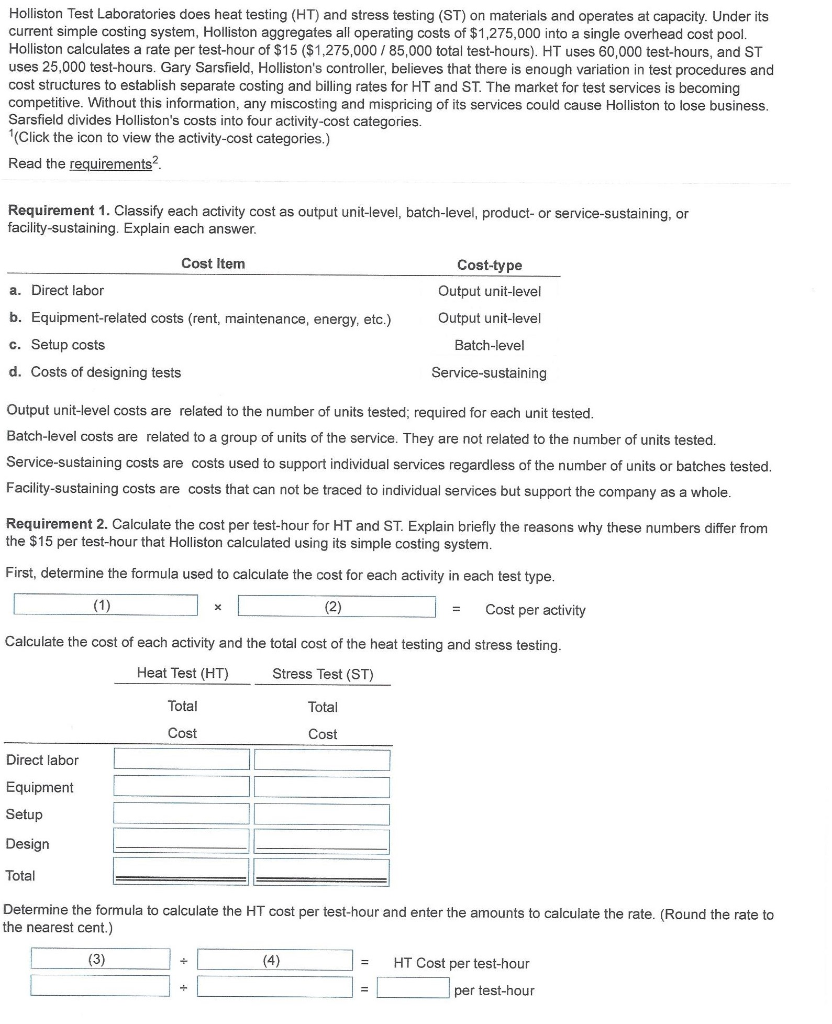
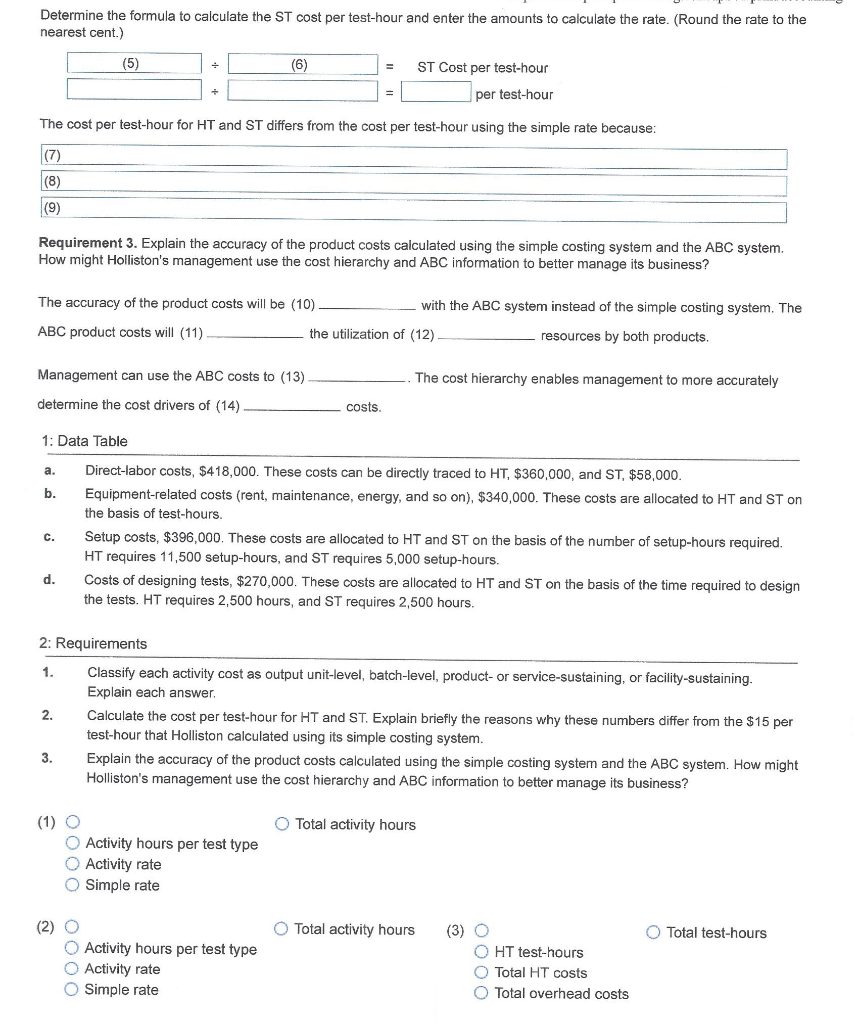
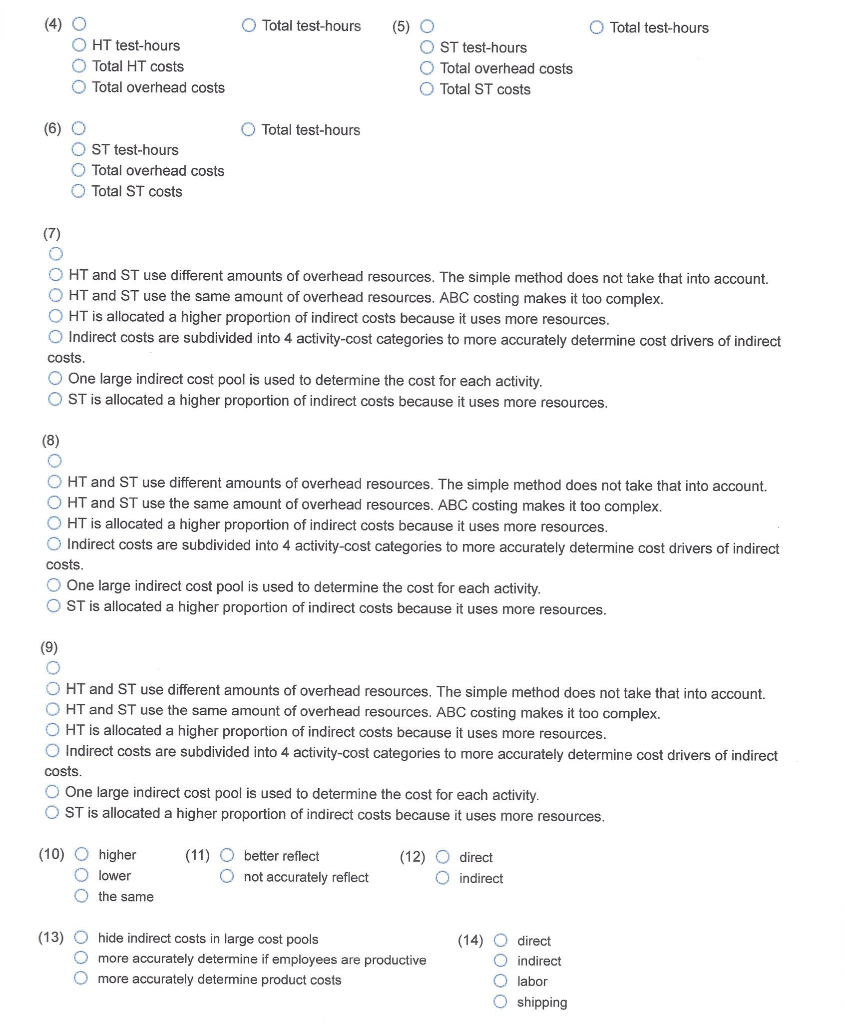
Holliston Test Laboratories does heat testing (HT) and stress testing (ST) on materials and operates at capacity. Under its current simple costing system, Holliston aggregates all operating costs of $1,275,000 into a single overhead cost pool. Holliston calculates a rate per test-hour of $15 ($1,275,000 / 85,000 total test-hours). HT uses 60,000 test-hours, and ST uses 25,000 test-hours. Gary Sarsfield, Holliston's controller, believes that there is enough variation in test procedures and cost structures to establish separate costing and billing rates for HT and ST. The market for test services is becoming competitive. Without this information, any miscosting and mispricing of its services could cause Holliston to lose business. Sarsfield divides Holliston's costs into four activity-cost categories. (Click the icon to view the activity-cost categories.) Read the requirements Requirement 1. Classify each activity cost as output unit-level, batch-level, product- or service-sustaining, or facility-sustaining. Explain each answer. Cost Item Cost-type Output unit-level a. Direct labor Output unit-level b. Equipment-related costs (rent, maintenance, energy, etc.) C. Setup costs Batch-level Service-sustaining d. Costs of designing tests Output unit-level costs are related to the number of units tested; required for each unit tested. Batch-level costs are related to a group of units of the service. They are not related to the number of units tested. Service-sustaining costs are costs used to support individual services regardless of the number of units or batches tested. Facility-sustaining costs are costs that can not be traced to individual services but support the company as a whole. Requirement 2. Calculate the cost per test-hour for HT and ST. Explain briefly the reasons why these numbers differ from the $15 per test-hour that Holliston calculated using its simple costing system. First, determine the formula used to calculate the cost for each activity in each test type. (1) X (2) Cost per activity Calculate the cost of each activity and the total cost of the heat testing and stress testing. Heat Test (HT) Stress Test (ST) Total Total Cost Cost Direct labor Equipment Setup Design Total Determine the formula to calculate the HT cost per test-hour and enter the amounts to calculate the rate. (Round the rate to the nearest cent.) (3) (4) HT Cost per test-hour + per test-hour Determine the formula to calculate the ST cost per test-hour and enter the amounts to calculate the rate. (Round the rate to the nearest cent.) (5) (6) ST Cost per test-hour per test-hour The cost per test-hour for HT and ST differs from the cost per test-hour using the simple rate because: (7) (8) (9) Requirement 3. Explain the accuracy of the product costs calculated using the simple costing system and the ABC system. How might Holliston's management use the cost hierarchy and ABC information to better manage its business? The accuracy of the product costs will be (10) with the ABC system instead of the simple costing system. The ABC product costs will (11) the utilization of (12) resources by both products, The cost hierarchy enables management to more accurately Management can use the ABC costs to (13) determine the cost drivers of (14) costs 1: Data Table a. b. c. Direct-labor costs, $418,000. These costs can be directly traced to HT, $360,000, and ST, $58,000 Equipment-related costs (rent, maintenance, energy, and so on), $340,000. These costs are allocated to HT and ST on the basis of test-hours. Setup costs, $396,000. These costs are allocated to HT and ST on the basis of the number of setup-hours required. HT requires 11,500 setup-hours, and ST requires 5,000 setup-hours. Costs of designing tests, $270,000. These costs are allocated to HT and ST on the basis of the time required to design the tests. HT requires 2,500 hours, and ST requires 2,500 hours. d. 2: Requirements 1. Classify each activity cost as output unit-level, batch-level, product or service-sustaining, or facility-sustaining. Explain each answer. 2. Calculate the cost per test-hour for HT and ST. Explain briefly the reasons why these numbers differ from the $15 per test-hour that Holliston calculated using its simple costing system. 3. Explain the accuracy of the product costs calculated using the simple costing system and the ABC system. How might Holliston's management use the cost hierarchy and ABC information to better manage its business? Total activity hours (1) O Activity hours per test type Activity rate Simple rate Total activity hours O Total test-hours (2) O Activity hours per test type O Activity rate O Simple rate (3) O O HT test-hours Total HT costs O Total overhead costs Total test-hours o Total test-hours (4) O O HT test-hours O Total HT costs Total overhead costs (5) O O ST test-hours Total overhead costs Total ST costs Total test-hours (6) O O ST test-hours Total overhead costs Total ST costs (7) O HT and ST use different amounts of overhead resources. The simple method does not take that into account. O HT and ST use the same amount of overhead resources. ABC costing makes it too complex. O HT is allocated a higher proportion of indirect costs because it uses more resources. O Indirect costs are subdivided into 4 activity-cost categories to more accurately determine cost drivers of indirect costs. One large indirect cost pool is used to determine the cost for each activity. OST is allocated a higher proportion of indirect costs because it uses more resources. (8) O HT and ST use different amounts of overhead resources. The simple method does not take that into account. O HT and ST use the same amount of overhead resources. ABC costing makes it too complex. O HT is allocated a higher proportion of indirect costs because it uses more resources. O Indirect costs are subdivided into 4 activity-cost categories to more accurately determine cost drivers of indirect costs. One large indirect cost pool is used to determine the cost for each activity. O ST is allocated a higher proportion of indirect costs because it uses more resources. (9) O HT and ST use different amounts of overhead resources. The simple method does not take that into account. O HT and ST use the same amount of overhead resources. ABC costing makes it too complex. O HT is allocated a higher proportion of indirect costs because it uses more resources. Indirect costs are subdivided into 4 activity-cost categories to more accurately determine cost drivers of indirect costs O One large indirect cost pool is used to determine the cost for each activity. O ST is allocated a higher proportion of indirect costs because it uses more resources, (10) O higher O lower O the same (11) O better reflect O not accurately reflect (12) O direct O indirect (13) (14) hide indirect costs in large cost pools O more accurately determine if employees are productive O more accurately determine product costs direct indirect O labor O shipping
Step by Step Solution
There are 3 Steps involved in it

Get step-by-step solutions from verified subject matter experts