







Question: Homework 0 5 - Data Mining and Text Mining CLO 5 . Assess the significance of mined frequent patterns, as well as the association rules
Homework Data Mining and Text Mining
CLO Assess the significance of mined frequent patterns, as well as the association rules derived from them by using rule and pattern assessment measures and employing algorithms to test for the statistical significance of rules and patterns. Evaluation
Homework directly aligns with the fifth course learning outcome CLO which focuses on assessing the significance of mined frequent patterns and association rules using rule evaluation measures and statistical thresholds. Through tasks such as identifying frequent itemsets, generating association rules, and calculating metrics like support and confidence, students evaluate the strength and significance of patterns derived from datasets. By employing algorithms such as Apriori, ECLAT, and FPGrowth, the homework ensures students not only understand the mechanics of mining frequent patterns but also critically assess their importance and applicability. This comprehensive approach allows students to demonstrate their ability to evaluate mined rules and patterns effectively, fulfilling the evaluation component of CLO Homework Data Mining and Text Mining
Question points: Apply the Apriori algorithm to generate frequent itemsets and association rules. Show your calculations for each step clearly.
Consider the following transaction dataset:
Generate Frequent Itemsets:
Use the Apriori algorithm with a minimum support count of
List all frequent itemsets, itemsets, and itemsets.
Generate Association Rules:
Using the frequent itemsets generated above, generate all association rules with a minimum confidence of
For each rule, calculate the support, confidence, and lift.
Answer the following questions:
Which item is most frequently purchased?
Are there any strong associations confidence between items? If yes, describe them. Homework Data Mining and Text Mining
Question points: Apply the ECLAT algorithm to generate frequent itemsets based on a given transaction dataset. Represent the vertical format clearly in your solution. Show stepbystep intersections for itemsets and itemsets.
Consider the following transaction dataset:
Generate Frequent Itemsets:
Use the ECLAT algorithm with a minimum support count of
Represent the dataset in vertical format list of transaction IDs for each item
Use the intersection of transaction IDs to generate:
Frequent itemsets
Frequent itemsets
Frequent itemsets
Answer the following questions:
Which item has the highest frequency support
Are there any itemsets with the given minimum support? Homework Data Mining and Text Mining
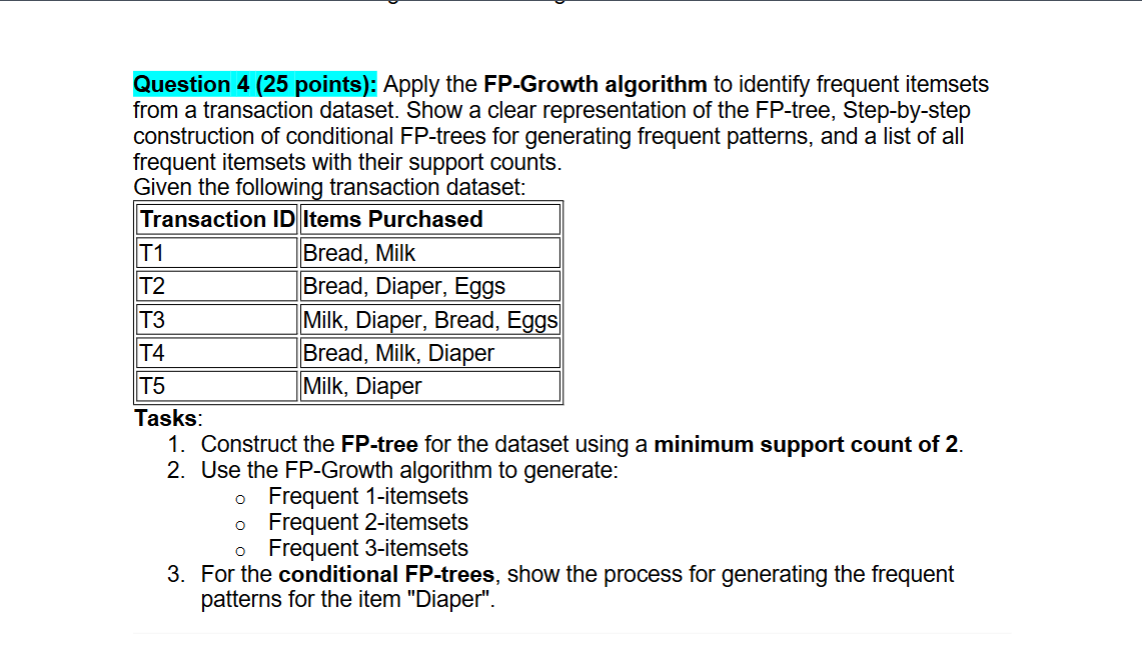
Question points: Apply the FPGrowth algorithm to identify frequent itemsets from a transaction dataset. Show a clear representation of the FPtree, for the dataset using a minimum support count of Stepbystep construction of conditional FPtrees for generating frequent patterns, and a list of all frequent itemsets with their support counts.
Given the following transaction dataset: Question points: Apply the FPGrowth algorithm to identify frequent itemsets from a transaction dataset. Show a clear representation of the FPtree, Stepbystep construction of conditional FPtrees for generating frequent patterns, and a list of all frequent itemsets with their support counts.
Given the following transaction dataset:
Tasks:
Construct the FPtree for the dataset using a minimum support count of
Use the FPGrowth algorithm to generate:
Frequent itemsets
Frequent itemsets
Frequent itemsets
For the conditional FPtrees, show the process for generating the frequent patterns for the item "Diaper".
Step by Step Solution
There are 3 Steps involved in it
1 Expert Approved Answer
Step: 1 Unlock

Question Has Been Solved by an Expert!
Get step-by-step solutions from verified subject matter experts
Step: 2 Unlock
Step: 3 Unlock
 Study Help