



Question: Homework 1 Astronomy 100 Dr. Warner D E:W n m r1 1 2 2 The goal of this homework is to help you synthesize and
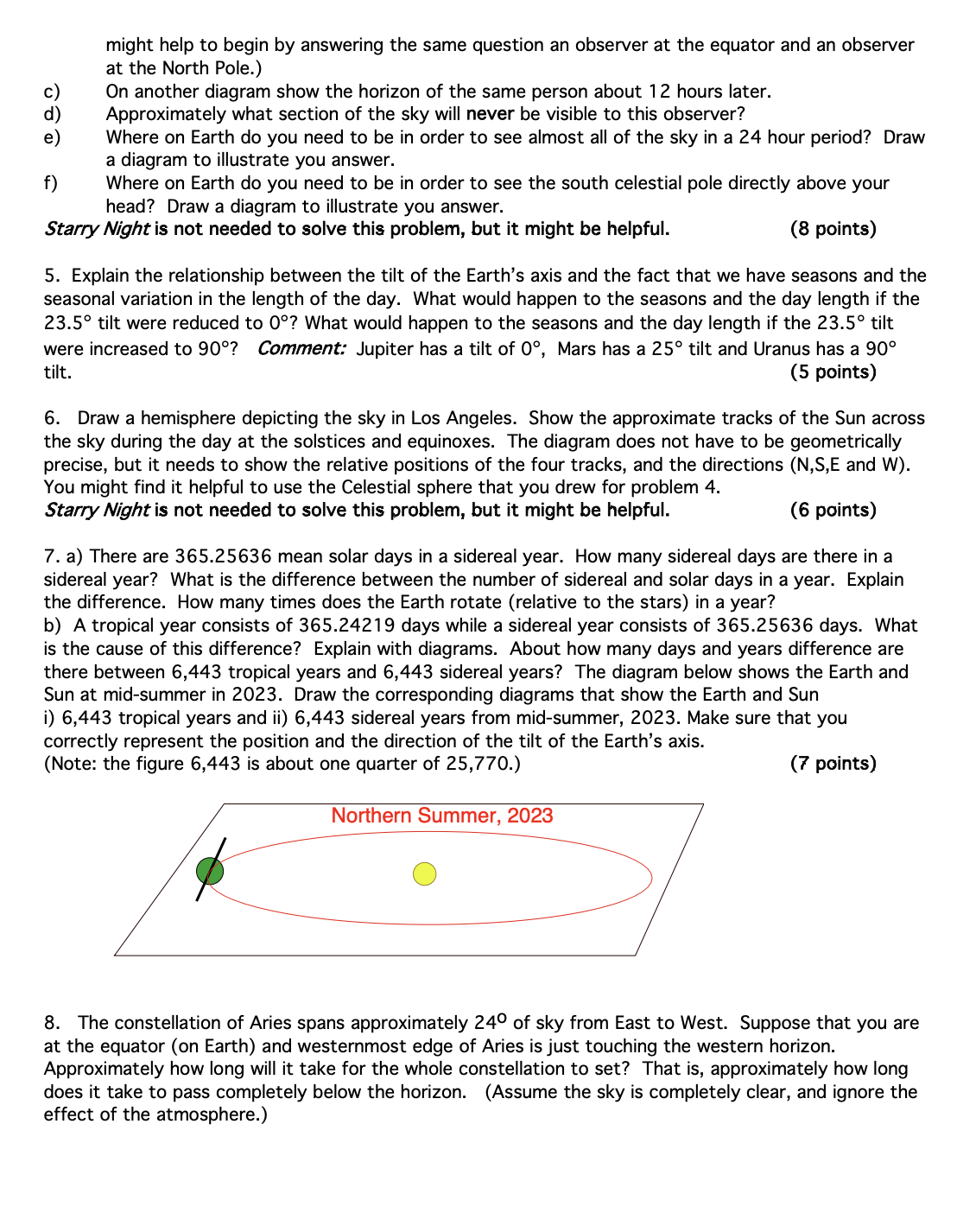
Homework 1 Astronomy 100 Dr. Warner D E:W n m r1 \"1 2 2 The goal of this homework is to help you synthesize and use many of the concepts we discussed in class and help you prepare for the midterm. Many of the exercises are valuable practice and will help you develop facility and understanding. Even though you do not have to do all the problems, I urge you to think about all of them and use the answer set (when l have posted it) to help you in review for the midterm. This homework is not comprehensive in its coverage, but will hopefully prove helpful. This homework contains both mathematical and descriptive problems, and the available points total a little over 100. However, to allow for the diverse backgrounds of the students in this course, you only need to get 50 points to gain a perfect score. You may attempt, and submit more than 50 points worth of problems, and you will not be penalized, except that if your score exceeds 50, then it will be set equal to 50. Please make sure that you give a $9.11 explanation of your answers. Answers that consist of two or three words will not receive full credit. Most of your explanations would almost certainly benefit if you drew diagrams. Where a calculation is involved, you w show your working. Before you do this homework please read the comments on page 4 of the syllabus concerning acceptable and unacceptable levels of collaboration. 1. What is the Problem of Induction and with which philosopher is the statement of the problem most directly associated? Karl Popper gave answer to this issue and this now lies at the heart of the scientific method. What was that answer? How does the every-day meaning of the word \"theory\" differ from the way we use the word theory in science? How does science evaluate theories? Modification of a hypothesis is a perfectly acceptable part of science and almost any theory can be modified to explain new data. How is this process of modification limited in science? (6 points) 2. The distance from Earth to Jupiter is currently about 4.417 A.U. What is this distance in (i) kilometers, (ii) light-years (iii) light-seconds? What is the total elapsed time for a signal to travel from Earth the Juno probe, currently in orbit around Jupiter, and then for the scientists at JPL to receive Juno's response? (4 points) 3. The Sun has a diameter of about 1,391,400 km and an average distance from Earth of 1 .496 x 108 km. a) What is the average angular size of the Sun, in arcminutes, as seen from the Earth (don't worry about the small variations in the distance from the Earth to the Sun)? b) The Moon has a diameter of 3,474 km and at closest approach to the Earth (perigee), the Earth-Moon distance is approximately 360,000 km. The largest Earth-Moon distance (at apogee) is about 406,000 km. What is the angular size of the Moon, in arcminutes, as seen from the Earth at perigee and at apogee? c) Explain why this is relevant to the kind of solar eclipse one might experience. (In performing these calculations you should keep it simple by neglecting the size of the Earth and your position on the surface.) (6 points) 4. Draw the Celestial Sphere, showing the north and south celestial poles, the celestial equator and the ecliptic. Show the position of the Sun in (northern) summer and (northern) winter. In the center of your sphere draw the Earth, showing someone standing at approximately the latitude of Los Angeles (34 degrees north). a) Draw the horizon of this person, showing the half of the sky she can see. b) At what angle is the north celestial pole above her horizon? (To understand this question it might help to begin by answering the same question an observer at the equator and an observer at the North Pole.) c) On another diagram show the horizon of the same person about 12 hours later. d) Approximately what section of the sky will never be visible to this observer? e) Where on Earth do you need to be in order to see almost all of the sky in a 24 hour period? Draw a diagram to illustrate you answer. f) Where on Earth do you need to be in order to see the south celestial pole directly above your head? Draw a diagram to illustrate you answer. Starry M'ght is not needed to solve this problem, but it might be helpful. (8 points) 5. Explain the relationship between the tilt of the Earth's axis and the fact that we have seasons and the seasonal variation in the length of the day. What would happen to the seasons and the day length if the 23.5 tilt were reduced to 0? What would happen to the seasons and the day length if the 23.5 tilt were increased to 90? Comment: Jupiter has a tilt of 0, Mars has a 25 tilt and Uranus has a 90 tilt. (5 points) 6. Draw a hemisphere depicting the sky in Los Angeles. Show the approximate tracks of the Sun across the sky during the day at the solstices and equinoxes. The diagram does not have to be geometrically precise, but it needs to show the relative positions of the four tracks, and the directions (N,S,E and W). You might find it helpful to use the Celestial sphere that you drew for problem 4. Stany Night is not needed to solve this problem, but it might be helpful. (6 points) 7. a) There are 365.25636 mean solar days in a sidereal year. How many sidereal days are there in a sidereal year? What is the difference between the number of sidereal and solar days in a year. Explain the difference. How many times does the Earth rotate (relative to the stars) in a year? b) A tropical year consists of 365.24219 days while a sidereal year consists of 36525636 days. What is the cause of this difference? Explain with diagrams. About how many days and years difference are there between 6,443 tropical years and 6,443 sidereal years? The diagram below shows the Earth and Sun at mid-summer in 2023. Draw the corresponding diagrams that show the Earth and Sun i) 6,443 tropical years and ii) 6,443 sidereal years from mid-summer, 2023. Make sure that you correctly represent the position and the direction of the tilt of the Earth's axis. (Note: the figure 6,443 is abOut one quarter of 25,770.) (2 points) Northern Summer, 2023 8. The constellation of Aries spans approximately 240 of sky from East to West. Suppose that you are at the equator (on Earth) and westernmost edge of Aries is just touching the western horizon. Approximately how long will it take for the whole constellation to set? That is, approximately how long does it take to pass completely below the horizon. (Assume the sky is completely clear, and ignore the effect of the atmosphere.) b) On September 13th at 1:00 am you look towards the eastern horizon and see the star, Betelgeuse, (u-Orionis) rising. At approximately what time will Betelgeuse rise one week later on September 20th (4 points) 9. How would the sidereal and solar days change if the Earth orbited the Sun exactly as it does now and the Earth's rate of rotation was exactly the same as it is now, but was in the opposite direction? (3 points) 10. The time for the Moon to complete one orbit around the Earth (the sidereal period) is 27.322 days but the time for the Moon to go through one complete set of phases (the synodic period) is 29.53 days. Explain why there is a difference of about two days in these periods (4 points) 1 1. What is the right ascension of the Sun at the winter solstice? What is the right ascension of a star that is crossing the meridian at midnight at the time of the summer solstice? (4 points) 12. What is the phase of the Moon if it: a) rising at 3 am, b) crosses your local meridian at 3 pm, c) sets at 9 pm? d) At what time does the full moon rise? e) At what time does the last quarter moon set? f) At what time does the first quarter moon cross your local meridian? (6 points) 1 3. Some observers on a distant planet note that a given star is at their zenith. Simultaneously, other observers on that planet see the same star 18" away from the zenith. The observers are separated from each other by 600 miles. What is the circumference of their planet? (4 points) 14. i) Why isn't there a solar eclipse every new moon, and a lunar eclipse every full moon. What would have to change for this to occur? (ii) Draw a diagram showing the Earth, the Moon, and shadows during (a) a total solar eclipse, (b) a total lunar eclipse, (c) a partial lunar eclipse, (d) an annular eclipse. What are the phases of the Moon in each of these situations? (8 points) 1 5. a) If people on Earth saw a total solar eclipse, how would this event present itself to an astronaut on the Moon? b) Seen from the Moon, the Earth has phases analogous to those of the Moon seen from here. How is the phase of the Moon seen from Earth, when the lunar observers have (i) \"Full Earth\" on the Moon? (ii) \"First Quarter Earth\" (i.e. half-earth between \"New Earth\" and \"Full Earth\")? (5 points) 1 6. Comet Tempel-Tuttle has an orbital period of 33.22 years about the Sun. Use Kepler's Laws to calculate its average distance (in A.U.) from the Sun. The eccentricity of its elliptical orbit is e=0.9055. What is its distance from the Sun at perihelion and aphelion (closest approach and furthest away)? (5 points) 17. What is prograde and retrograde motion of planets? When does an outer planet exhibit the most pronounced retrograde motion: At opposition or conjunction? Explain. (4 points) 18. Explain (with diagrams) how Galileo's observations of Venus showed that Venus must orbit the Sun. Why is it critical in the argument to note that Venus is always fairly close to the Sun in the sky? (4 points) 51'3ng Night Pmbiems: Start up Starry Might. Go to the \"Options\" or \"View\" and \"Hide daylight.\" Give yourself a very flat horizon by going to the \"Options\" and under \"Local Horizon\" and choose \"Flat.\" Make sure that the Location is set to Los Angeles (use \"Viewing Location\" under the \"Options Menu\"). Finally, Make sure that \"Auto Manage Daylight Saving\" is turned off and turn off Daylight saving: You can do this under the date and time menu. This sets the time to local time without daylight saving. Set the \"Time Flow Rate\" box to 1 minute. 19. Go to the \"Options\" menu and select \"Constellations,\" and turn on the Stick Figures of the constellations. Face North and look at the stars near the North Celestial Pole. Run the time fonivard for 24 hours using a time-step of 1 minute. Look for circumpolar stars (ones that do not go below the horizon) Find and identify by name four such bright stars, choose one star in each of four distinct constellations. (Double-clicking on a star will pop up an info panel that will identify the star.) (4 points) 20. Set the date and time to September 28'\
Step by Step Solution
There are 3 Steps involved in it

Get step-by-step solutions from verified subject matter experts