Question: Homework 1: Throw Back the Little Ones (With and Without Replacement) In Sampling Seniors, you completed each poll before returning the objects to the bag.
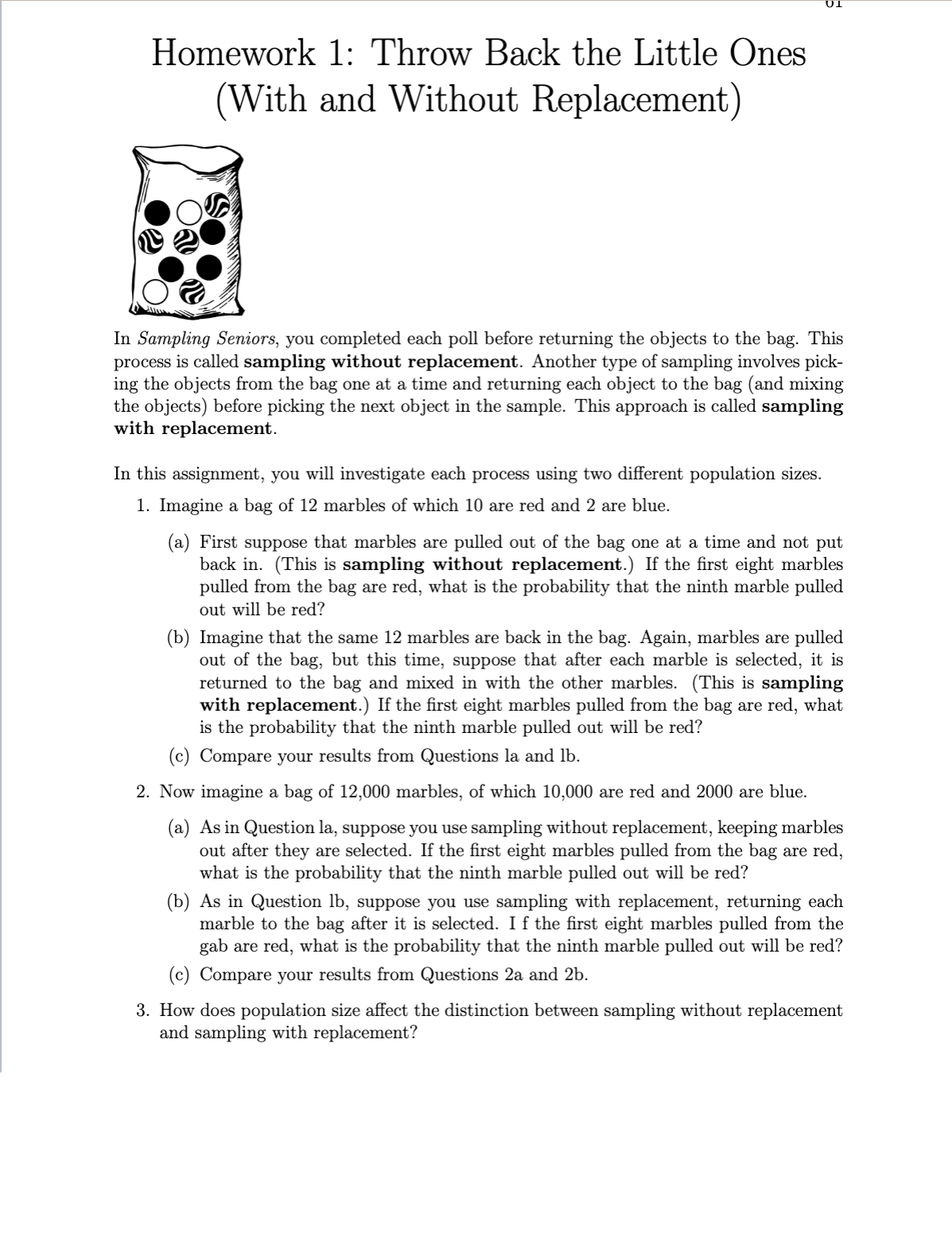
Homework 1: Throw Back the Little Ones (With and Without Replacement) In Sampling Seniors, you completed each poll before returning the objects to the bag. This process is called sampling without replacement. Another type of sampling involves pick- ing the objects from the bag one at a. time and returning each object to the bag (and mixing the objects) before picking the next object in the sample. This approach is called sampling with replacement. In this assignment, you will investigate each process using two different population sizes. 1. Imagine a bag of 12 marbles of which 10 are red and 2 are blue. (a) First suppose that marbles are pulled out of the bag one at a time and not put back in. (This is sampling without replacement.) If the rst eight marbles pulled from the bag are red, what is the probability that the ninth marble pulled out will be red? (b) Imagine that the same 12 marbles are back in the bag. Again, marbles are pulled out of the bag, but this time, suppose that after each marble is selected, it is returned to the bag and mixed in with the other marbles (This is sampling with replacement.) If the rst eight marbles pulled from the bag are red, what is the probability that the ninth marble pulled out will be red? (c) Compare your results from Questions la and lb. 2. Now imagine a bag of 12,000 marbles, of which 10,000 are red and 2000 are blue. (a) As in Question la, suppose you use sampling without replacement, keeping marbles out after they are selected. If the rst eight marbles pulled from the bag are red, what is the probability that the ninth marble pulled out will be red? (b) As in Question lb, suppose you use sampling with replacement, returning each marble to the bag after it is selected. I f the rst eight marbles pulled from the gab are red, what is the probability that the ninth marble pulled out will be red? (c) Compare your results from Questions 2a and 2b. 3. How does population size affect the distinction between sampling without replacement and sampling with replacement? 62 CHAPTER 3. THE POLLSTER'S DILEMMA Homework 2: Pizza Combinations Jonathan delivers pizza several evenings a week. He doesn't get paid very much, but he does get a free pizza for dinner every night he works. He gets bored with the same old kind of pizza every night, and in fact he likes variety. The pizza shops he works for has ve different toppings that he likes - pineapple, sausage, mushrooms, onions, and anchovies. 1. If Jonathan always has exactly two of these ve toppings on his pizza, how many nights can he work without repeating a combination? Explain your answer. 2. Now Jonathan's sister Johanna has come to work there as well. She likes the same toppings as her brother, but she always wants to get exactly three of the ve toppings on her pizzas. How many nights can she work without repeating a combination? Explain your answer. 3. How does the answer to Question 1 relate to the answer to Question 2? Explain why this relationship holds
Step by Step Solution
There are 3 Steps involved in it
1 Expert Approved Answer
Step: 1 Unlock
Question Has Been Solved by an Expert!
Get step-by-step solutions from verified subject matter experts
Step: 2 Unlock
Step: 3 Unlock
Students Have Also Explored These Related Mathematics Questions!