







Question: Homework 2 Please read through all questions before starting work 1) Consider a Silicon atom. Draw the lewis dot diagram of a neutral silicon atom,
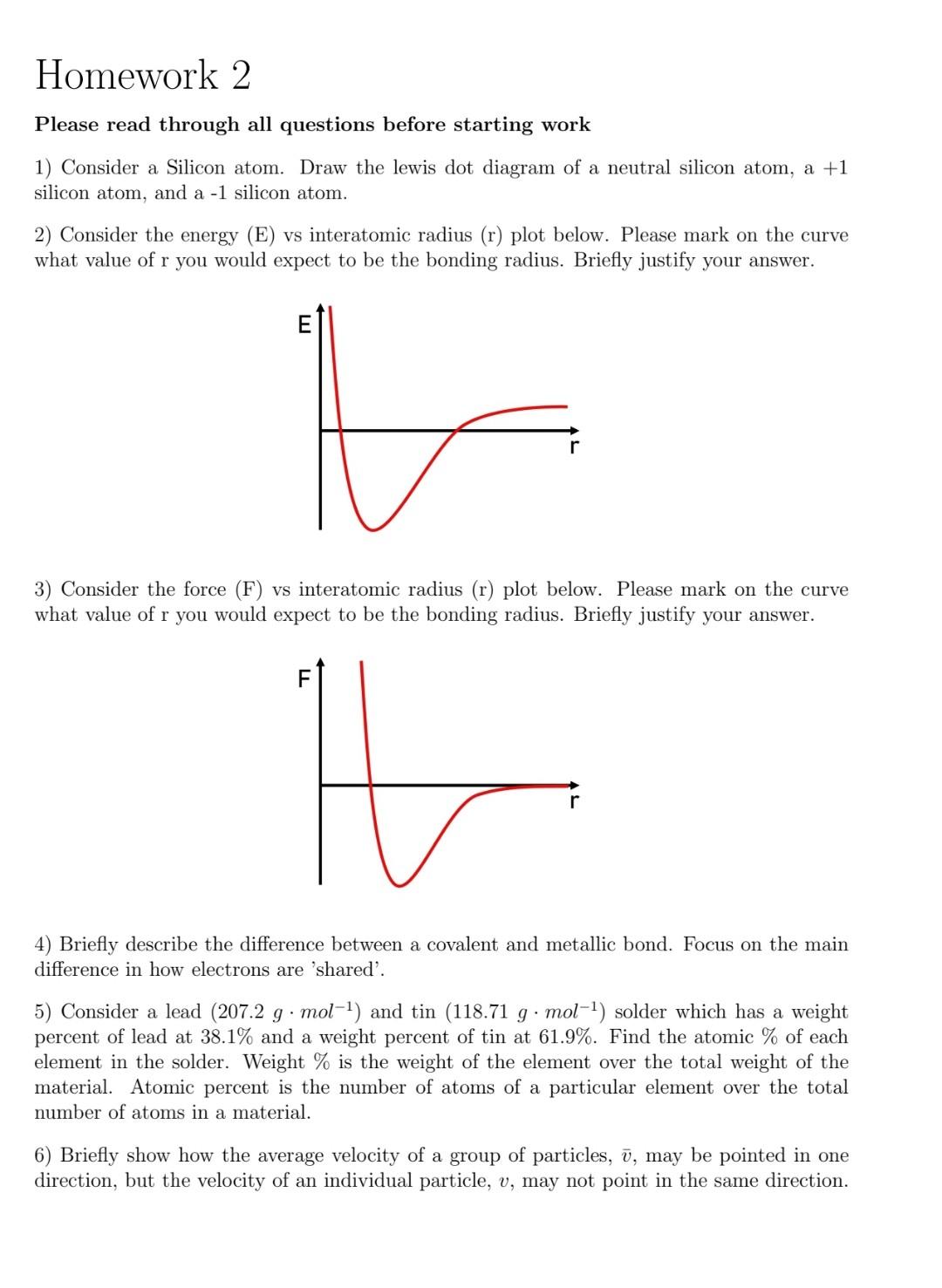
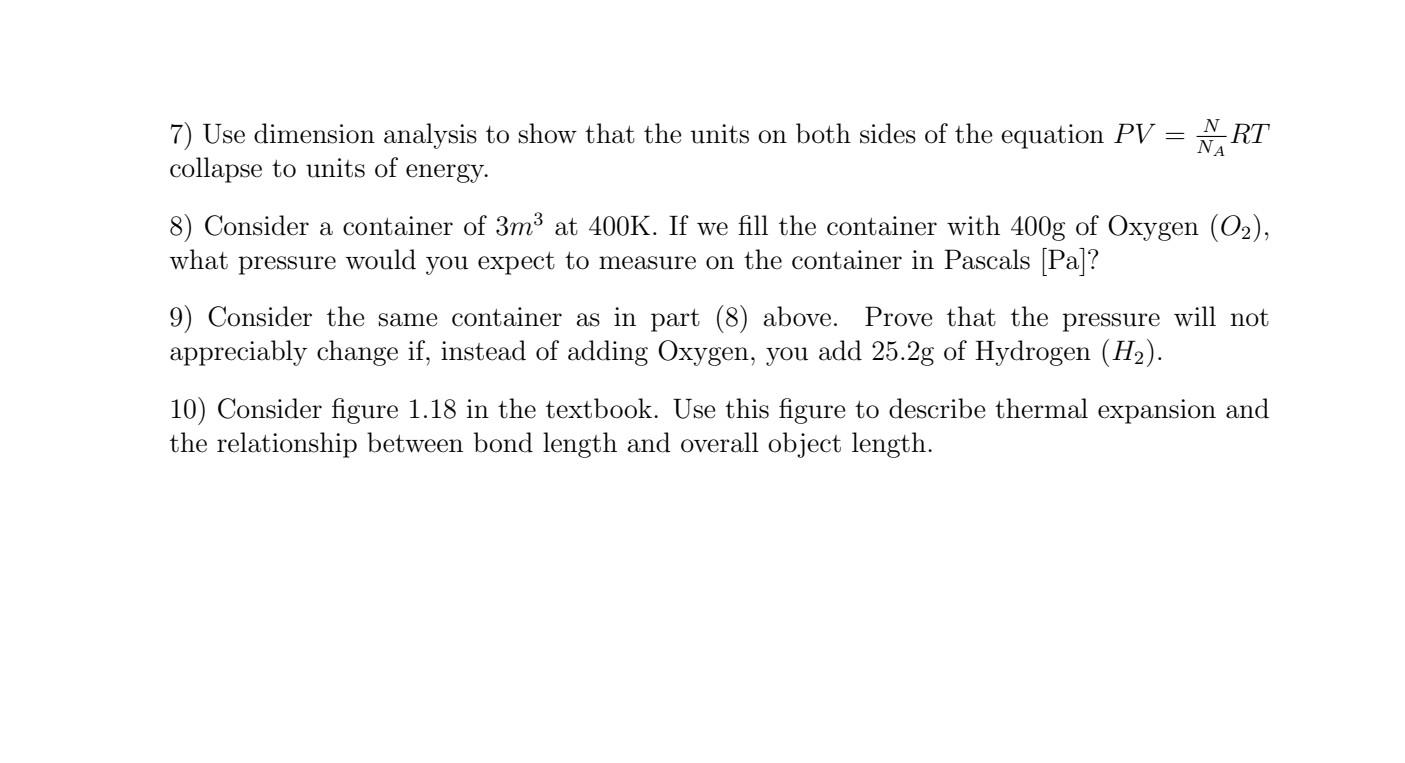
Homework 2 Please read through all questions before starting work 1) Consider a Silicon atom. Draw the lewis dot diagram of a neutral silicon atom, a +1 silicon atom, and a -1 silicon atom. 2) Consider the energy (E) vs interatomic radius (r) plot below. Please mark on the curve what value of r you would expect to be the bonding radius. Briefly justify your answer. 3) Consider the force (F) vs interatomic radius (r) plot below. Please mark on the curve what value of r you would expect to be the bonding radius. Briefly justify your answer. 4) Briefly describe the difference between a covalent and metallic bond. Focus on the main difference in how electrons are 'shared'. 5) Consider a lead (207.2gmol1) and tin(118.71gmol1) solder which has a weight percent of lead at 38.1% and a weight percent of tin at 61.9%. Find the atomic % of each element in the solder. Weight % is the weight of the element over the total weight of the material. Atomic percent is the number of atoms of a particular element over the total number of atoms in a material. 6) Briefly show how the average velocity of a group of particles, v, may be pointed in one direction, but the velocity of an individual particle, v, may not point in the same direction. 7) Use dimension analysis to show that the units on both sides of the equation PV=NANRT collapse to units of energy. 8) Consider a container of 3m3 at 400K. If we fill the container with 400g of Oxygen (O2), what pressure would you expect to measure on the container in Pascals [Pa] ? 9) Consider the same container as in part (8) above. Prove that the pressure will not appreciably change if, instead of adding Oxygen, you add 25.2g of Hydrogen (H2). 10) Consider figure 1.18 in the textbook. Use this figure to describe thermal expansion and the relationship between bond length and overall object length
Step by Step Solution
There are 3 Steps involved in it

Get step-by-step solutions from verified subject matter experts
 Study Help