







Question: Homework 7 ECON 302 - Fall 2022 DEADLINES: Due by 11:59 PM on Wednesday, Oct. 26. Part 1 Consider the two-period model from Chapter 9,
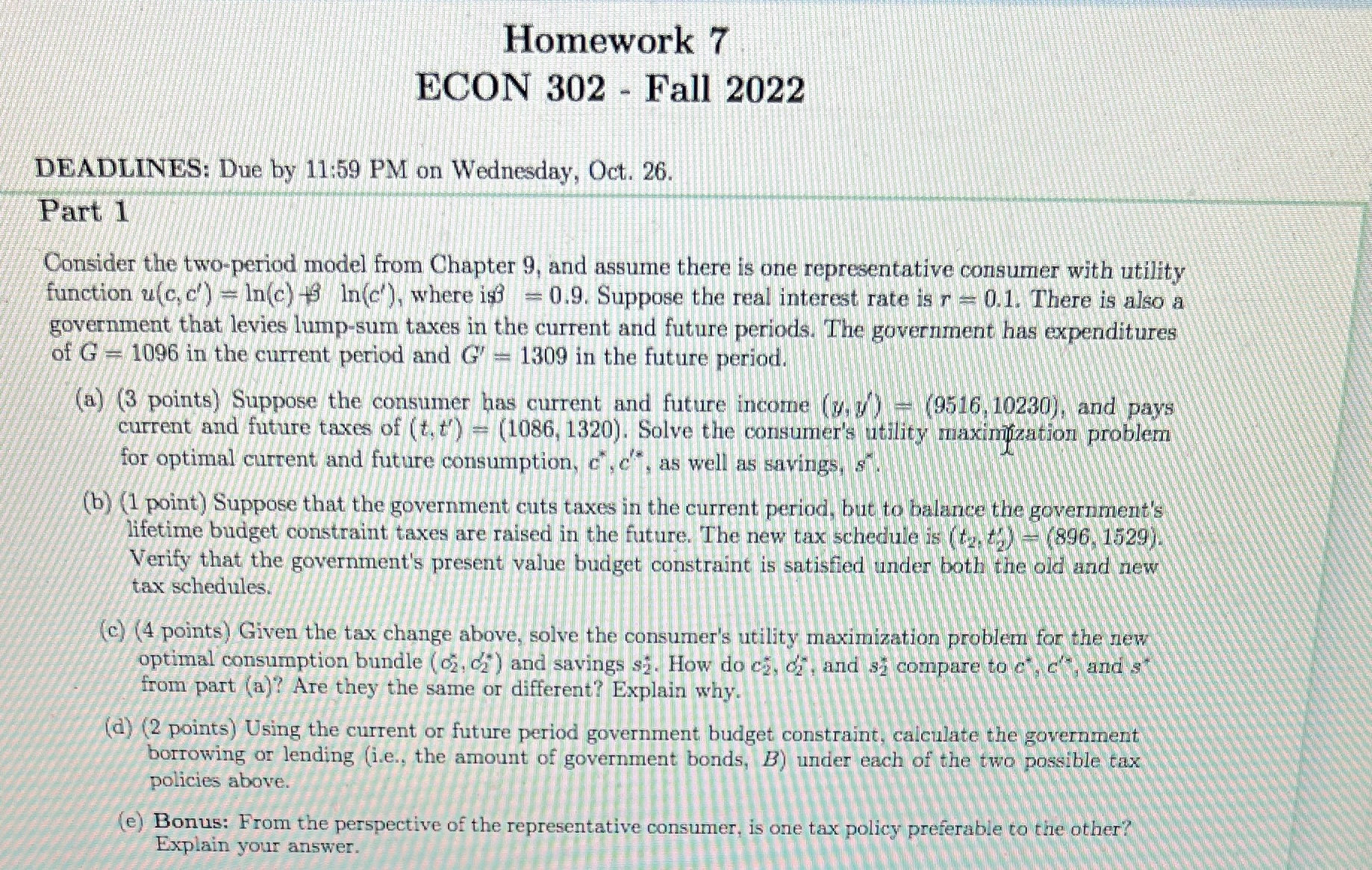
Homework 7 ECON 302 - Fall 2022 DEADLINES: Due by 11:59 PM on Wednesday, Oct. 26. Part 1 Consider the two-period model from Chapter 9, and assume there is one representative consumer with utility function u(c, c ) = In(c) IS In(c'), where is # 0.9. Suppose the real interest rate is r = 0.1. There is also a government that levies lump-sum taxes in the current and future periods. The government has expenditures of G - 1096 in the current period and G - 1309 in the future period. (a) (3 points) Suppose the consumer has current and future income (v. y ) - (9516, 10230), and pays current and future taxes of (t. t') = (1086, 1320). Solve the consumer's utility maximization problem for optimal current and future consumption, c, c', as well as savings, s. (b) (1 point) Suppose that the government cuts taxes in the current period, but to balance the government's lifetime budget constraint taxes are raised in the future. The new tax schedule is (t.. (:) - (896, 1529) Verify that the government's present value budget constraint is satisfied under both the old and new tax schedules. (c) (4 points) Given the tax change above, solve the consumer's utility maximization problem for the new optimal consumption bundle (of. c') and savings s;. How do ca, of , and s; compare to co, c and s from part (a)? Are they the same or different? Explain why. (d) (2 points) Using the current or future period government budget constraint, calculate the government borrowing or lending (i.e., the amount of government bonds, B) under each of the two possible tax policies above. (e) Bonus: From the perspective of the representative consumer, is one tax policy preferable to the other? Explain your
Step by Step Solution
There are 3 Steps involved in it

Get step-by-step solutions from verified subject matter experts
 Study Help