



Question: Homework #8 FALL 2020 1) COST-BASED WAREHOUSE JUSTIFICATION Currently, you ship cases of product directly from your factory in Dallas, TX to six individual customer
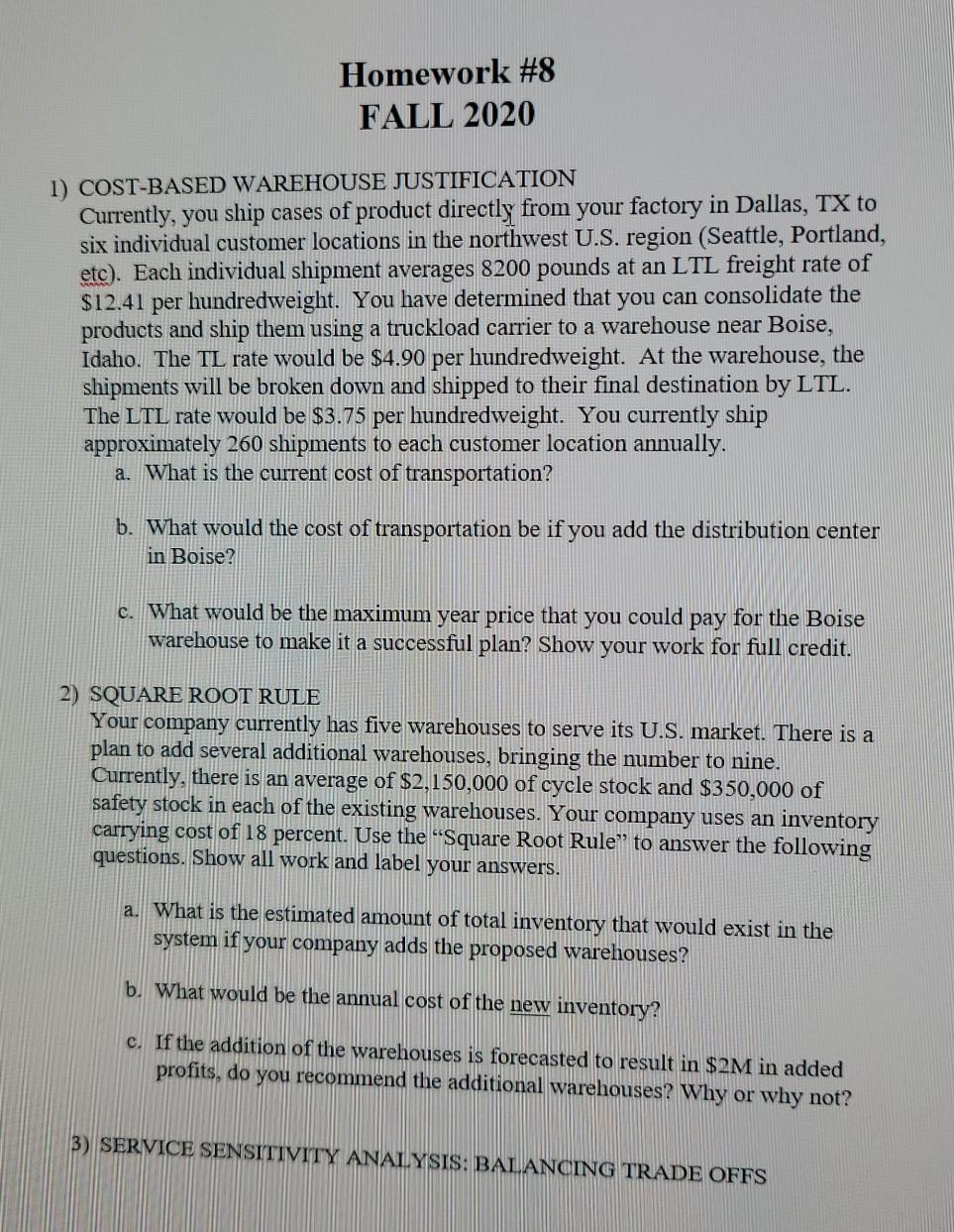
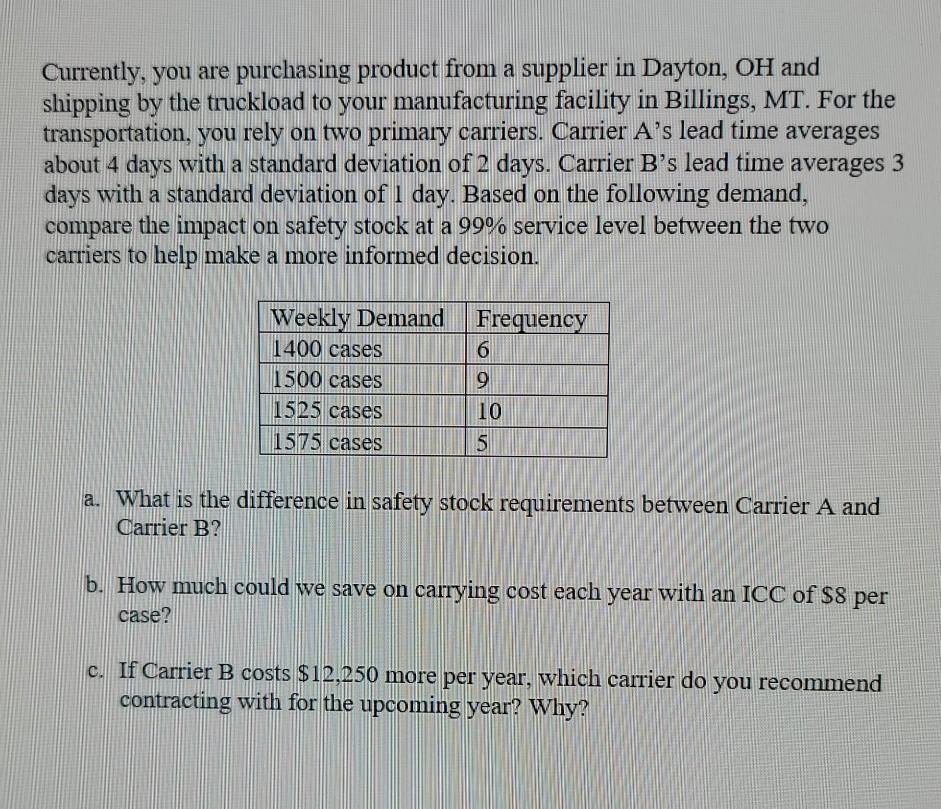
Homework #8 FALL 2020 1) COST-BASED WAREHOUSE JUSTIFICATION Currently, you ship cases of product directly from your factory in Dallas, TX to six individual customer locations in the northwest U.S. region (Seattle, Portland, etc). Each individual shipment averages 8200 pounds at an LTL freight rate of $12.41 per hundredweight. You have determined that you can consolidate the products and ship them using a truckload carrier to a warehouse near Boise, Idaho. The TL rate would be $4.90 per hundredweight. At the warehouse, the shipments will be broken down and shipped to their final destination by LTL. The LTL rate would be $3.75 per hundredweight. You currently ship approximately 260 shipments to each customer location annually. a. What is the current cost of transportation? b. What would the cost of transportation be if you add the distribution center in Boise? c. What would be the maximum year price that you could pay for the Boise warehouse to make it a successful plan? Show your work for full credit. 2) SQUARE ROOT RULE Your company currently has five warehouses to serve its U.S. market. There is a plan to add several additional warehouses, bringing the number to nine. Currently, there is an average of $2,150,000 of cycle stock and $350,000 of safety stock in each of the existing warehouses. Your company uses an inventory carrying cost of 18 percent. Use the "Square Root Rule to answer the following questions. Show all work and label your answers. a. What is the estimated amount of total inventory that would exist in the system if your company adds the proposed warehouses? b. What would be the annual cost of the new inventory? c. If the addition of the warehouses is forecasted to result in $2M in added profits, do you recommend the additional warehouses? Why or why not? 3) SERVICE SENSITIVITY ANALYSIS: BALANCING TRADE OFFS Currently, you are purchasing product from a supplier in Dayton, OH and shipping by the truckload to your manufacturing facility in Billings, MT. For the transportation, you rely on two primary carriers. Carrier A's lead time averages about 4 days with a standard deviation of 2 days. Carrier B's lead time averages 3 days with a standard deviation of 1 day. Based on the following demand, compare the impact on safety stock at a 99% service level between the two carriers to help make a more informed decision. Weekly Demand Frequency 1400 cases 6 1500 cases 9 1525 cases 10 1575 cases 5 a. What is the difference in safety stock requirements between Carrier A and Carrier B? b. How much could we save on carrying cost each year with an ICC of $8 per case? c. If Carrier B costs $12.250 more per year, which carrier do you recommend contracting with for the upcoming year? Why
Step by Step Solution
There are 3 Steps involved in it
1 Expert Approved Answer
Step: 1 Unlock

Question Has Been Solved by an Expert!
Get step-by-step solutions from verified subject matter experts
Step: 2 Unlock
Step: 3 Unlock