







Question: HOMEWORK, CHAPTER 14 Name Class day & time You have decided to earn some extra income and gain some real-world experience by starting your own
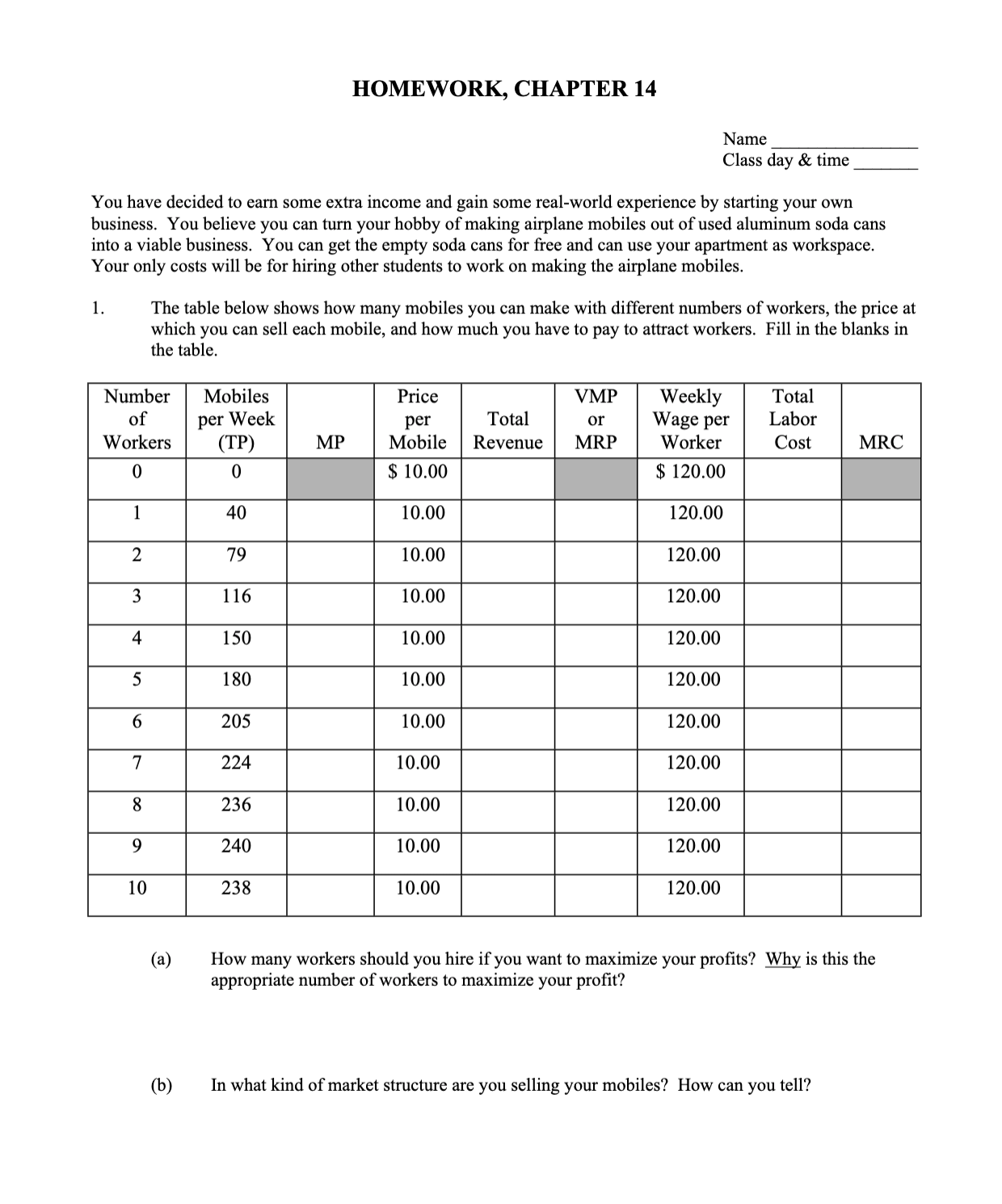
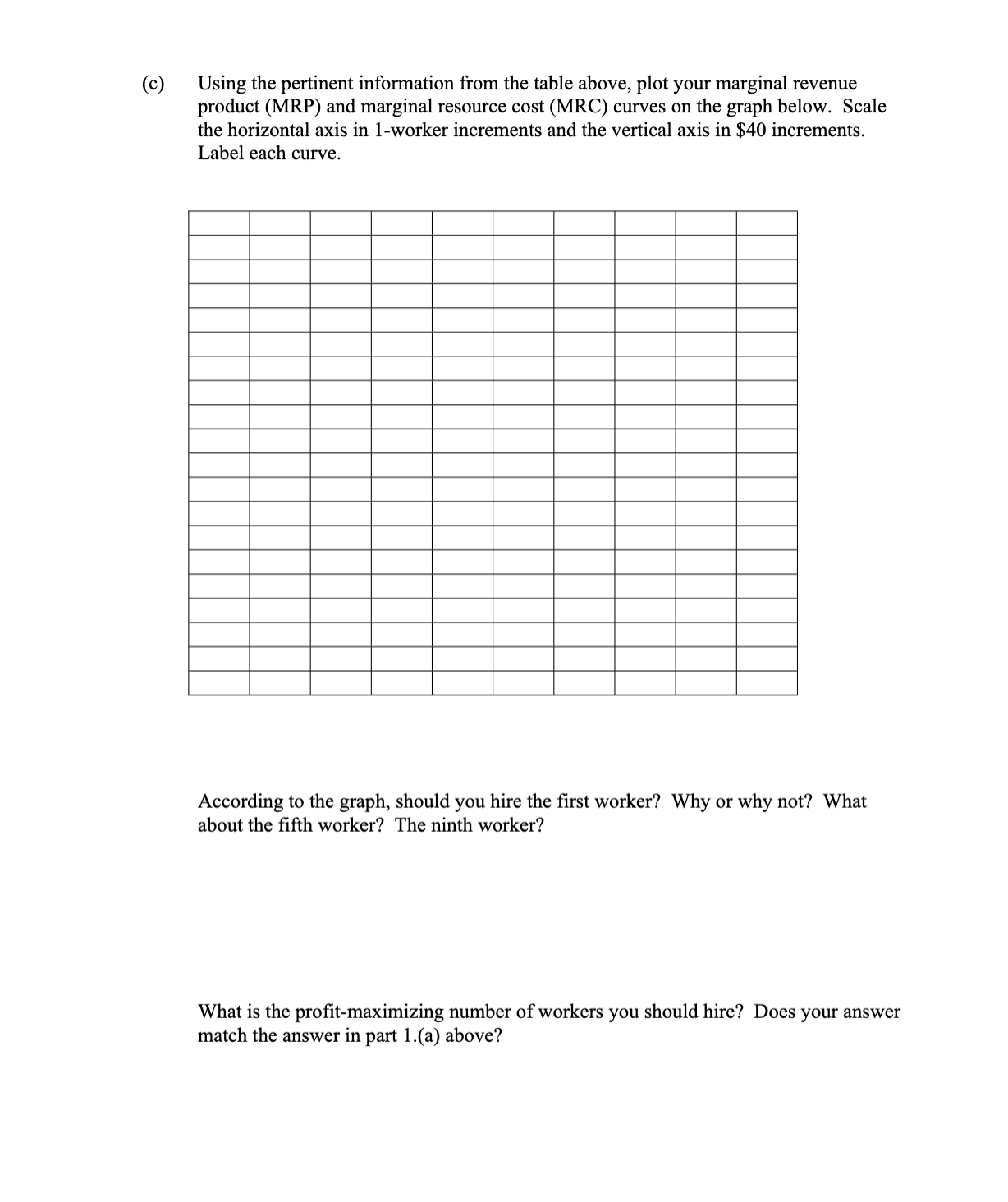
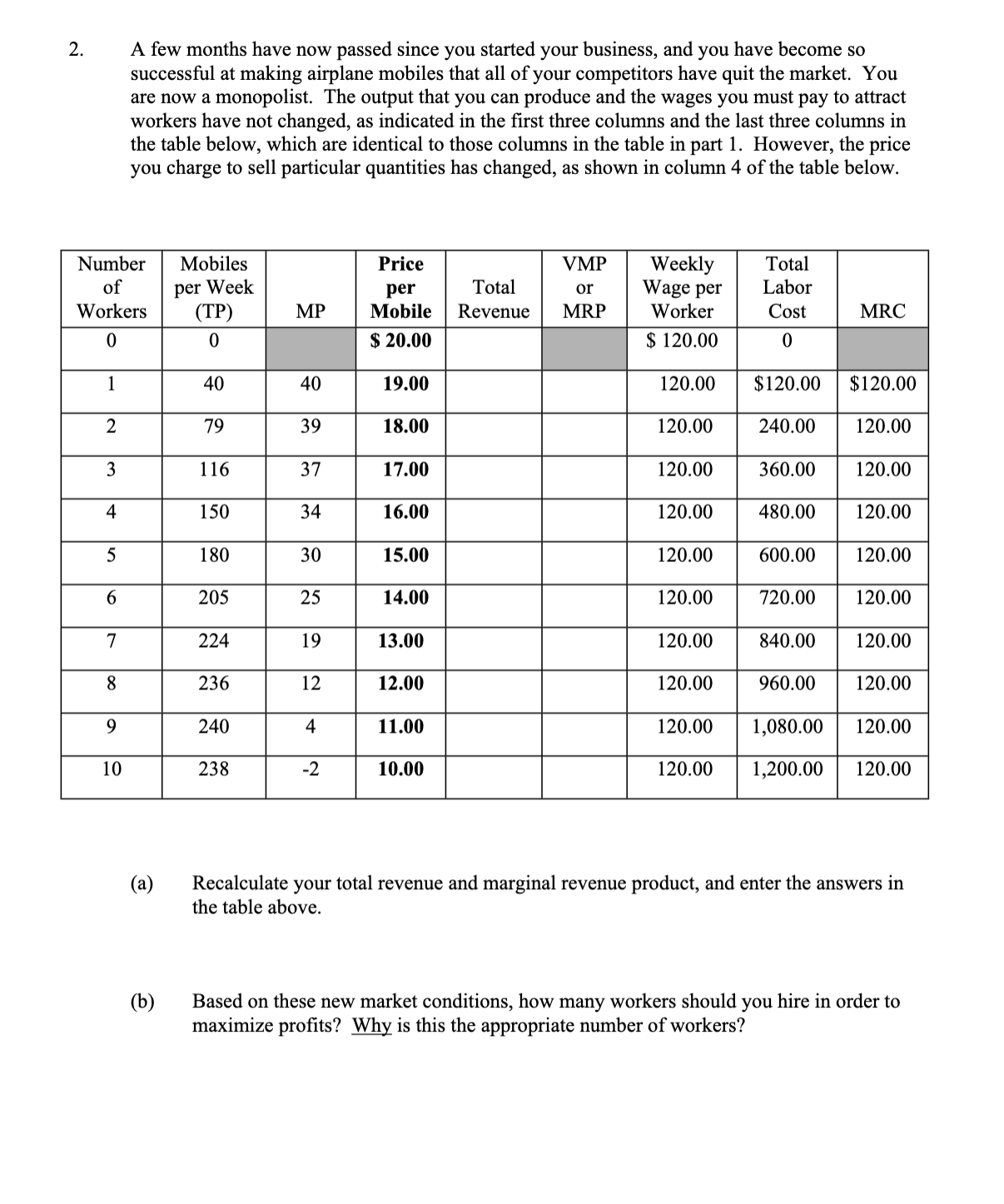
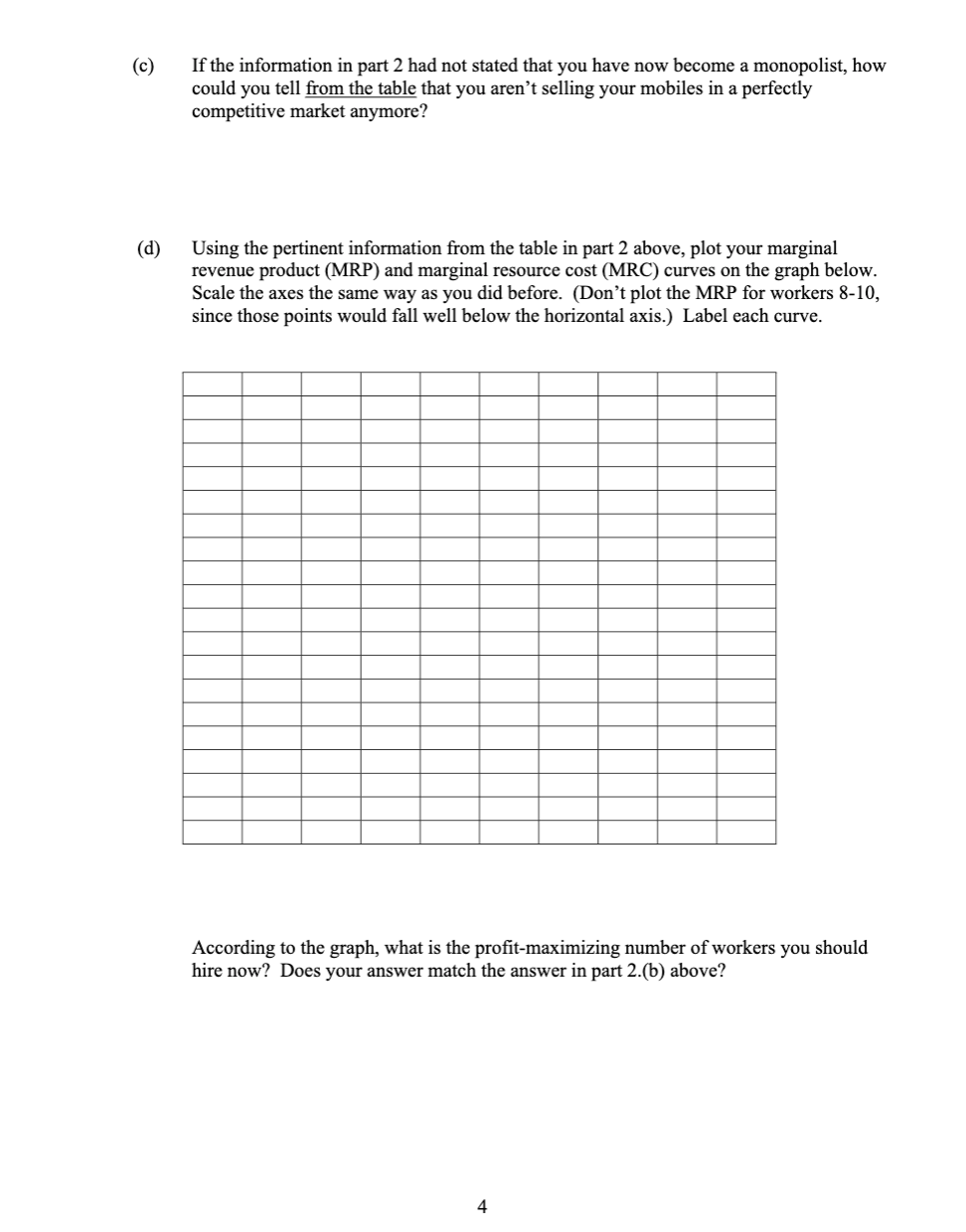
HOMEWORK, CHAPTER 14 Name Class day & time You have decided to earn some extra income and gain some real-world experience by starting your own business. You believe you can turn your hobby of making airplane mobiles out of used aluminum soda cans into a viable business. You can get the empty soda cans for free and can use your apartment as workspace. Your only costs will be for hiring other students to work on making the airplane mobiles. 1. The table below shows how many mobiles you can make with different numbers of workers, the price at the table. which you can sell each mobile, and how much you have to pay to attract workers. Fill in the blanks in Number Mobiles Price VMP of per Week Weekly Total per Total or Workers (TP) MP Wage per Labor Mobile Revenue MRP Worker Cost MRC 0 $ 10.00 $ 120.00 40 10.00 120.00 N 79 10.00 120.00 3 116 10.00 120.00 4 150 10.00 120.00 5 180 10.00 120.00 6 205 10.00 120.00 7 224 10.00 120.00 8 236 10.00 120.00 240 10.00 120.00 10 238 10.00 120.00 (a) How many workers should you hire if you want to maximize your profits? Why is this the appropriate number of workers to maximize your profit? (b) In what kind of market structure are you selling your mobiles? How can you tell?(0) Using the pertinent information from the table above, plot your marginal revenue product (MRP) and marginal resource cost (MRC) curves on the graph below. Scale the horizontal axis in 1-worker increments and the vertical axis in $40 increments. Label each curve. According to the graph, should you hire the rst worker? Why or why not? What about the fth worker? The ninth worker? What is the prot-maximizing number of workers you should hire? Does your answer match the answer in part 1.(a) above? 2. A few months have now passed since you started your business, and you have become so successful at making airplane mobiles that all of your competitors have quit the market. You are now a monopolist. The output that you can produce and the wages you must pay to attract workers have not changed, as indicated in the first three columns and the last three columns in the table below, which are identical to those columns in the table in part 1. However, the price you charge to sell particular quantities has changed, as shown in column 4 of the table below. Number Mobiles Price VMP Total of per Week Weekly per Total Workers Wage per Labor (TP) MP Mobile Revenue MRP Worker Cost MRC 0 0 $ 20.00 $ 120.00 0 40 40 19.00 120.00 $120.00 $120.00 2 79 39 18.00 120.00 240.00 120.00 3 116 37 17.00 120.00 360.00 120.00 4 150 34 16.00 120.00 480.00 120.00 5 180 30 15.00 120.00 600.00 120.00 6 205 25 14.00 120.00 720.00 120.00 7 224 19 13.00 120.00 840.00 120.00 236 12 12.00 120.00 960.00 120.00 9 240 4 11.00 120.00 1,080.00 120.00 10 238 -2 10.00 120.00 1,200.00 120.00 (a) Recalculate your total revenue and marginal revenue product, and enter the answers in the table above. ( b ) Based on these new market conditions, how many workers should you hire in order to maximize profits? Why is this the appropriate number of workers?(c) If the information in part 2 had not stated that you have now become a monopolist, how could you tell from the table that you aren't selling your mobiles in a perfectly competitive market anymore? (d) Using the pertinent information from the table in part 2 above, plot your marginal revenue product (MRP) and marginal resource cost (MRC) curves on the graph below. Scale the axes the same way as you did before. (Don't plot the MRP for workers 8-10, since those points would fall well below the horizontal axis.) Label each curve. According to the graph, what is the profit-maximizing number of workers you should hire now? Does your answer match the answer in part 2.(b) above? 4
Step by Step Solution
There are 3 Steps involved in it

Get step-by-step solutions from verified subject matter experts
 Study Help