







Question: Homework help. Please write 2-3 paragraphs. Do not use whats been posted on Chegg already. Thank you! Read the following case study and answer question
Homework help. 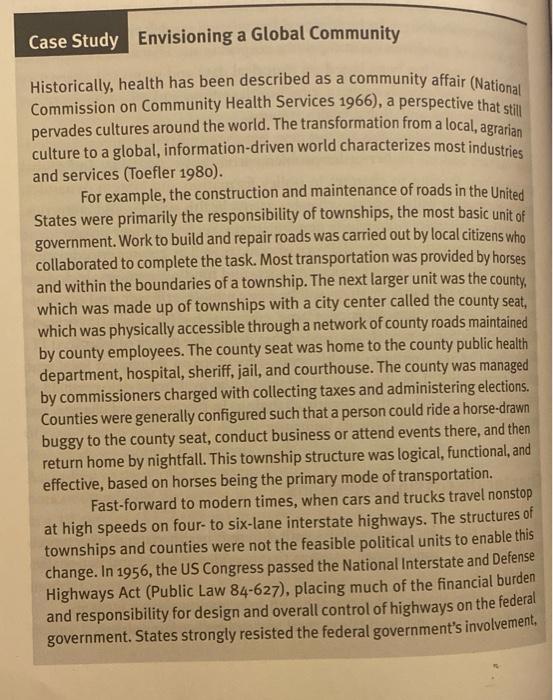
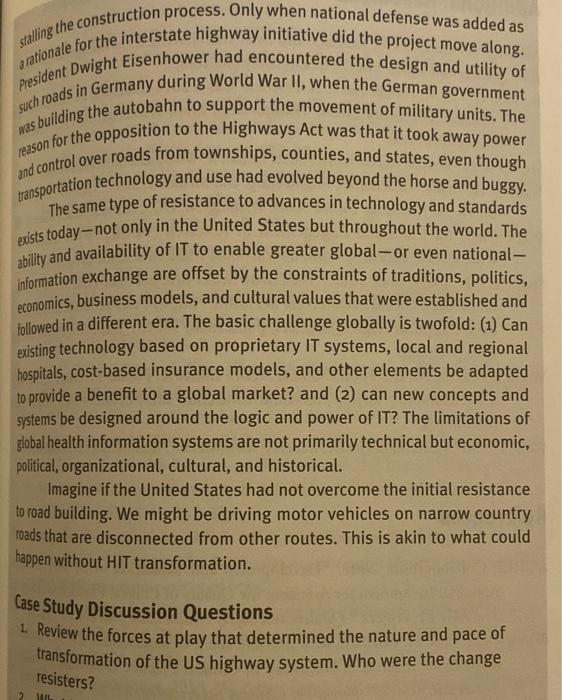
Case Study Envisioning a Global Community Historically, health has been described as a community affair (National Commission on Community Health Services 1966), a perspective that still pervades cultures around the world. The transformation from a local, agrarian culture to a global, information-driven world characterizes most industries and services (Toefler 1980). For example, the construction and maintenance of roads in the United States were primarily the responsibility of townships, the most basic unit of government. Work to build and repair roads was carried out by local citizens who collaborated to complete the task. Most transportation was provided by horses and within the boundaries of a township. The next larger unit was the county, which was made up of townships with a city center called the county seat, which was physically accessible through a network of county roads maintained by county employees. The county seat was home to the county public health department, hospital, sheriff, jail, and courthouse. The county was managed by commissioners charged with collecting taxes and administering elections. Counties were generally configured such that a person could ride a horse-drawn buggy to the county seat, conduct business or attend events there, and then return home by nightfall. This township structure was logical, functional, and effective, based on horses being the primary mode of transportation. Fast-forward to modern times, when cars and trucks travel nonstop at high speeds on four- to six-lane interstate highways. The structures of townships and counties were not the feasible political units to enable this change. In 1956, the US Congress passed the National Interstate and Defense Highways Act (Public Law 84-627), placing much of the financial burden and responsibility for design and overall control of highways on the federal government. States strongly resisted the federal government's involvement, - stalling the construction process. Only when national defense was added as a rationale for the interstate highway initiative did the project move along. President Dwight Eisenhower had encountered the design and utility of was building the autobahn to support the movement of military units. The such roads in Germany during World War II, when the German government reason for the opposition to the Highways Act was that it took away power and control over roads from townships, counties, and states, even though transportation technology and use had evolved beyond the horse and buggy. The same type of resistance to advances in technology and standards exists today-not only in the United States but throughout the world. The ability and availability of IT to enable greater global-or even national - information exchange are offset by the constraints of traditions, politics, economics, business models, and cultural values that were established and followed in a different era. The basic challenge globally is twofold: (1) Can existing technology based on proprietary IT systems, local and regional hospitals, cost-based insurance models, and other elements be adapted to provide a benefit to a global market? and (2) can new concepts and systems be designed around the logic and power of IT? The limitations of global health information systems are not primarily technical but economic, political, organizational, cultural, and historical. Imagine if the United States had not overcome the initial resistance to road building. We might be driving motor vehicles on narrow country roads that are disconnected from other routes. This is akin to what could happen without HIT transformation. Case Study Discussion Questions 1. Review the forces at play that determined the nature and pace of transformation of the US highway system. Who were the change resisters? TIL Please write 2-3 paragraphs.
Do not use whats been posted on Chegg already.
Thank you!
Read the following case study and answer question #1 which is at the bottom of the case study under case study discussion questions
Step by Step Solution
There are 3 Steps involved in it
1 Expert Approved Answer
Step: 1 Unlock

Question Has Been Solved by an Expert!
Get step-by-step solutions from verified subject matter experts
Step: 2 Unlock
Step: 3 Unlock
 Study Help