







Question: Homework1 - Pthread Mutex locks Outline Banking System Problem Consider a banking system that maintains an account balance (integer variable amount) with two functions: deposit
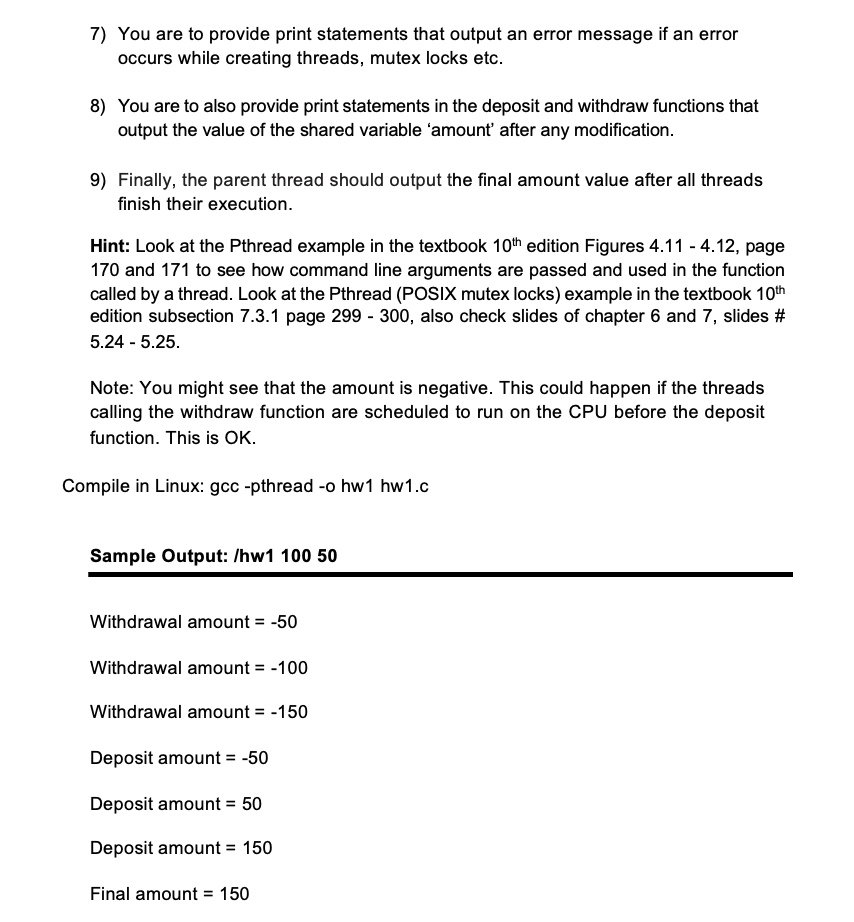
Homework1 - Pthread Mutex locks Outline Banking System Problem Consider a banking system that maintains an account balance (integer variable amount) with two functions: deposit and withdraw. These two functions are passed the amount that is to be deposited or withdrawn from the bank account balance. Assume that a husband and wife share a bank account. Concurrently, the husband calls the withdraw function and the wife calls deposit. Race condition is possible when the shared data (amount) is accessed by the two functions concurrently. In this lab you are to write a C program that provides a critical section solution to the Banking System Problem using mutex locks provided by the POSIX Pthreads API. In particular your solution needs to do the following: Steps to follow: 1) Initialize amount = 0 2) Take two command line arguments. First argument is the amount to be deposited (an integer value) and the second argument is the amount to be withdrawn (an integer value) 3) Create a total of 6 threads that run concurrently. 3 threads call the deposit function and the other 3 call the withdraw function. 4) When you create the thread calling the deposit function you need to pass the thread identifier, the attributes for the thread, name of the deposit function, and the first integer parameter that was provided on the command line, avg[1] (which is the amount to be deposited). 5) Similarly, when creating the thread calling the withdraw function you need to pass the thread identifier, the attributes for the thread, name of the withdraw function, and the second integer parameter that was provided on the command line, argv[2] (which is the amount to be withdrawn). 6) You are to use mutex locks provided by the Pthreads API to achieve mutual exclusion. 7) You are to provide print statements that output an error message if an error occurs while creating threads, mutex locks etc. 8) You are to also provide print statements in the deposit and withdraw functions that output the value of the shared variable amount after any modification. 9) Finally, the parent thread should output the final amount value after all threads finish their execution. Hint: Look at the Pthread example in the textbook 10th edition Figures 4.11 - 4.12, page 170 and 171 to see how command line arguments are passed and used in the function called by a thread. Look at the Pthread (POSIX mutex locks) example in the textbook 10th edition subsection 7.3.1 page 299 - 300, also check slides of chapter 6 and 7, slides # 5.24 - 5.25. Note: You might see that the amount is negative. This could happen if the threads calling the withdraw function are scheduled to run on the CPU before the deposit function. This is OK. Compile in Linux: gcc -pthread -o hw1 hw1.c Sample Output: /hw1 100 50 Withdrawal amount = -50 Withdrawal amount = -100 Withdrawal amount = -150 Deposit amount = -50 Deposit amount = 50 Deposit amount = 150 Final amount = 150 Homework1 - Pthread Mutex locks Outline Banking System Problem Consider a banking system that maintains an account balance (integer variable amount) with two functions: deposit and withdraw. These two functions are passed the amount that is to be deposited or withdrawn from the bank account balance. Assume that a husband and wife share a bank account. Concurrently, the husband calls the withdraw function and the wife calls deposit. Race condition is possible when the shared data (amount) is accessed by the two functions concurrently. In this lab you are to write a C program that provides a critical section solution to the Banking System Problem using mutex locks provided by the POSIX Pthreads API. In particular your solution needs to do the following: Steps to follow: 1) Initialize amount = 0 2) Take two command line arguments. First argument is the amount to be deposited (an integer value) and the second argument is the amount to be withdrawn (an integer value) 3) Create a total of 6 threads that run concurrently. 3 threads call the deposit function and the other 3 call the withdraw function. 4) When you create the thread calling the deposit function you need to pass the thread identifier, the attributes for the thread, name of the deposit function, and the first integer parameter that was provided on the command line, avg[1] (which is the amount to be deposited). 5) Similarly, when creating the thread calling the withdraw function you need to pass the thread identifier, the attributes for the thread, name of the withdraw function, and the second integer parameter that was provided on the command line, argv[2] (which is the amount to be withdrawn). 6) You are to use mutex locks provided by the Pthreads API to achieve mutual exclusion. 7) You are to provide print statements that output an error message if an error occurs while creating threads, mutex locks etc. 8) You are to also provide print statements in the deposit and withdraw functions that output the value of the shared variable amount after any modification. 9) Finally, the parent thread should output the final amount value after all threads finish their execution. Hint: Look at the Pthread example in the textbook 10th edition Figures 4.11 - 4.12, page 170 and 171 to see how command line arguments are passed and used in the function called by a thread. Look at the Pthread (POSIX mutex locks) example in the textbook 10th edition subsection 7.3.1 page 299 - 300, also check slides of chapter 6 and 7, slides # 5.24 - 5.25. Note: You might see that the amount is negative. This could happen if the threads calling the withdraw function are scheduled to run on the CPU before the deposit function. This is OK. Compile in Linux: gcc -pthread -o hw1 hw1.c Sample Output: /hw1 100 50 Withdrawal amount = -50 Withdrawal amount = -100 Withdrawal amount = -150 Deposit amount = -50 Deposit amount = 50 Deposit amount = 150 Final amount = 150
Step by Step Solution
There are 3 Steps involved in it

Get step-by-step solutions from verified subject matter experts
 Study Help