







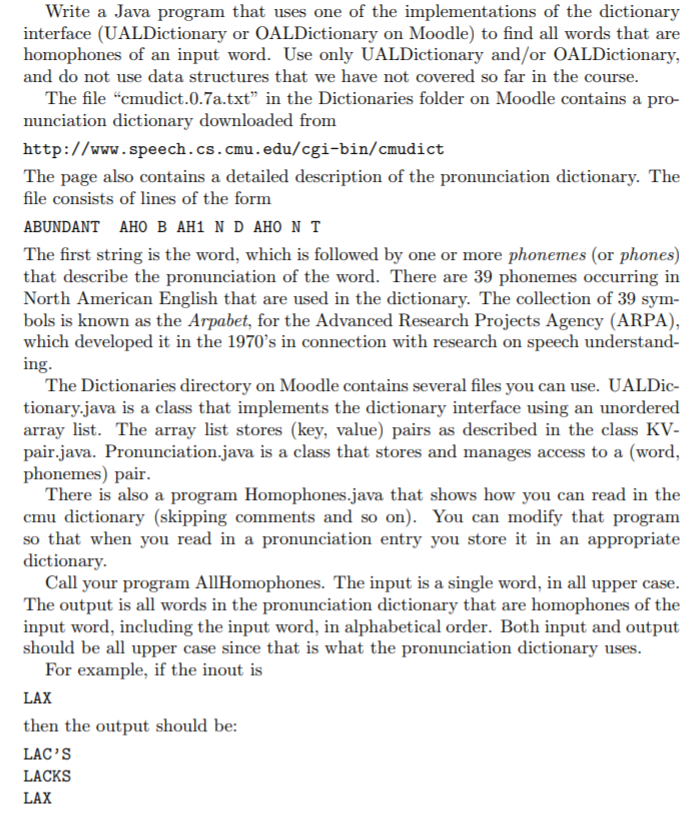
Question: Homophone.java import java.io.File; import java.io.FileNotFoundException; import java.util.Scanner; import java.util.ArrayList; public class Homophone { public static void main(String[] args) { UALDictionary PDict = new UALDictionary ();
Homophone.java
import java.io.File;
import java.io.FileNotFoundException;
import java.util.Scanner;
import java.util.ArrayList;
public class Homophone {
public static void main(String[] args) {
UALDictionary
File file = new File("cmudict.0.7a.txt");
//File file = new File("shuffledDictionary.txt");
final int len = 5; // we start with words of length 5 characters
long start = System.currentTimeMillis();
try {
Scanner scanner = new Scanner(file);
while (scanner.hasNextLine()) {
String line = scanner.nextLine();
if (line.substring(0, 3).equals(";;;"))
continue; // skip comment lines
Pronunciation p = new Pronunciation(line);
if ((p.getWord().length()
|| (p.getWord().length() > len))
continue;
if ((p.getWord().length() == len - 1)
|| (p.getWord().length() == len))
PDict.insert(p.getWord(), p);
}
scanner.close();
} catch (FileNotFoundException e) {
e.printStackTrace();
}
long middle = System.currentTimeMillis();
System.out.println("Loaded dictionary.");
for (Pronunciation p : PDict.values()) {
String w = p.getWord();
if (w.length() == len) {
String w1 = w.substring(1); // word obtained by removing first letter
String w2 = w.substring(0, 1) + w.substring(2); // and removing second letter
Pronunciation p1 = PDict.find(w1);
Pronunciation p2 = PDict.find(w2);
if ((p1 != null)
&& (p2 != null)
&& (p.getPhonemes().equals(p1.getPhonemes()))
&& (p1.getPhonemes().equals(p2.getPhonemes()))) {
System.out.println("An answer is: " + w);
}
}
}
long end = System.currentTimeMillis();
System.out.println("Run times: load dictionary= " + (middle - start)
+ " process= " + (end - middle) + " total= " + (end - start));
}
}
Dictionary.java
public interface Dictionary
public void clear();
public void insert(Key k, E e);
public E remove(Key k); // Null if none
public E removeAny(); // Null if none
public E find(Key k); // Null if none
public Iterable
public Iterable
public int size();
};
KVpair.java
/** Container class for a key-value pair */
class KVpair
private Key k;
private E e;
/** Constructors */
KVpair() {
k = null;
e = null;
}
KVpair(Key kval, E eval) {
k = kval;
e = eval;
}
/** Data member access functions */
public Key key() {
return k;
}
public E value() {
return e;
}
}
OALDictionary.java
import java.util.ArrayList;
class OALDictionary
private static final int defaultSize = 10;
private ArrayList
// Constructors
OALDictionary() {
this(defaultSize);
}
OALDictionary(int sz) {
list = new ArrayList
}
public void clear() {
list.clear();
}
/** Insert an element: append to list */
public void insert(Key k, E e) {
KVpair
int i = 0;
while ((i 0))
++i;
list.add(i, temp);
}
/** Remove element with key k, return element */
public E remove(Key k) {
E temp = find(k);
if (temp != null)
list.remove(new KVpair
return temp;
}
/** Remove any element */
public E removeAny() {
return list.remove(list.size()-1).value();
}
/**
* Find k using sequential search
*
* @return Record with key value k
*/
public E sfind(Key k) {
for (KVpair
if (k.compareTo(t.key()) == 0)
return t.value();
return null; // "k" does not appear in dictionary
}
/**
* Find k using binary search
*
* @return Record with key value k
*/
public E find(Key k) {
int low = 0;
int hi = list.size() - 1;
int mid = (low + hi) / 2;
while (low
if (k.compareTo(list.get(mid).key()) == 0)
return list.get(mid).value();
else if (k.compareTo(list.get(mid).key()) > 0)
low = mid+1;
else
hi = mid-1;
mid = (low + hi) / 2;
}
return null; // "k" does not appear in dictionary
}
/* findAll implementation using inefficient sequential search.
*
*/
public Iterable
ArrayList
for (KVpair
if (k.compareTo(t.key()) == 0)
al.add(t.value());
return al;
}
public Iterable
ArrayList
int fidx = -1;
int low = 0;
int hi = list.size() - 1;
int mid = (low + hi) / 2;
while ((low
if (k.compareTo(list.get(mid).key()) == 0)
fidx = mid;
else if (k.compareTo(list.get(mid).key()) > 0)
low = mid+1;
else
hi = mid-1;
mid = (low + hi) / 2;
}
if(fidx
int i = fidx;
for(i=fidx; i>=0;--i)
if(k.compareTo(list.get(i).key()) != 0)
break;
fidx = i+1; // the first instance of key k
for(i=fidx; i { if(k.compareTo(list.get(i).key()) == 0) al.add(list.get(i).value()); else break; } return al; } public int size() { return list.size(); } /** Returns an iterable collection of the dictionary. */ public Iterable ArrayList for (KVpair elements.add(t.value()); return elements; } } Pronounciation.java import java.util.LinkedList; import java.util.Scanner; public class Pronunciation { private String word; private String pronounce; Pronunciation(String p) { int i = p.indexOf(' '); word = p.substring(0, i); pronounce = p.substring(i+1); } public String getWord() { return word; } public String getPhonemes() { return pronounce; } public String toString() { String s = word + " " + pronounce; return s; } } UALDictionary.java import java.util.ArrayList; import java.util.Collections; class UALDictionary private static final int defaultSize = 10; private ArrayList // Constructors UALDictionary() { this(defaultSize); } UALDictionary(int sz) { list = new ArrayList } public void clear() { list.clear(); } /** Insert an element: append to list */ public void insert(Key k, E e) { KVpair list.add(temp); } /** Remove element with key k, return element */ public E remove(Key k) { E temp = find(k); if (temp != null) list.remove(new KVpair return temp; } /** Remove any element */ public E removeAny() { return list.remove(list.size()-1).value(); } /** * Find k using sequential search * * @return Record with key value k */ public E find(Key k) { for (KVpair if (k.compareTo(t.key())==0) return t.value(); return null; // "k" does not appear in dictionary } public Iterable ArrayList for (KVpair if (k.compareTo(t.key()) == 0) al.add(t.value()); return al; } public int size(){ return list.size(); } /** Returns an iterable collection of the dictionary. */ public Iterable ArrayList for(KVpair elements.add(t.value()); return elements; } }
Step by Step Solution
There are 3 Steps involved in it

Get step-by-step solutions from verified subject matter experts
 Study Help