







Question: How can a high - performance company align its compensation system with its new work environment? Gilbert Porterfield, vice president for compensation at Top Chemical
How can a highperformance company align its compensation system with its new work environment?
Gilbert Porterfield, vice president for compensation at Top Chemical Company, watched nervously as the
special committee for compensation redesign gathered to discuss the proposed pay plan. Members from
top and middle management, as well as peer group representatives from throughout the company,
settled into their seats holding copies of his plan for this yearold, $ billion company.
TopChem's CEO, Sam Verde opened the meeting. "Three years ago, when we launched our Quality For
All QFA program at TopChem, we expected a great deal of resistance from our troops," Verde began.
"People don't like to have their jobs questioned, let alone redesigned. But now they are listening. We're
starting to make real changes in the way people work together. And we're making progress in speeding
products to market, improving product quality, and routing out inefficiencies.
"But as you all know, change is a process, not an event. That's why we've gathered this committee to
investigate how to develop a pay system congruent with the philosophy of QFA. Becauseemployeeinvolvement
is critical to everything we do under this new mindset, all of you have been gleaning information from your
peers. Gil's plan reflects your preliminary feedback. Now that it is on the table, I want to move towards
implementation. Gil, "why don't you give us some background?"
Porterfield stood and addressed the group. As you know, under QFA we've reorganized employees
into productoriented teams. We had a solid business reason for that: to allow and encourage employees at
all levels to develop products quicker, better, and cheaper. As Sam said, the company's organization is
starting to reflect that philosophy.
"But," he said, pausing for effect, "our compensation hasn't. Our old system just doesn't work anymore.
It pays by the old values of hierarchy, rank, seniority hours worked, and a lot of other standards that
don't mean much in the new organization. We have moved to an all salaried work force, which
caused grumblings, sure, it's time to go way beyond that."
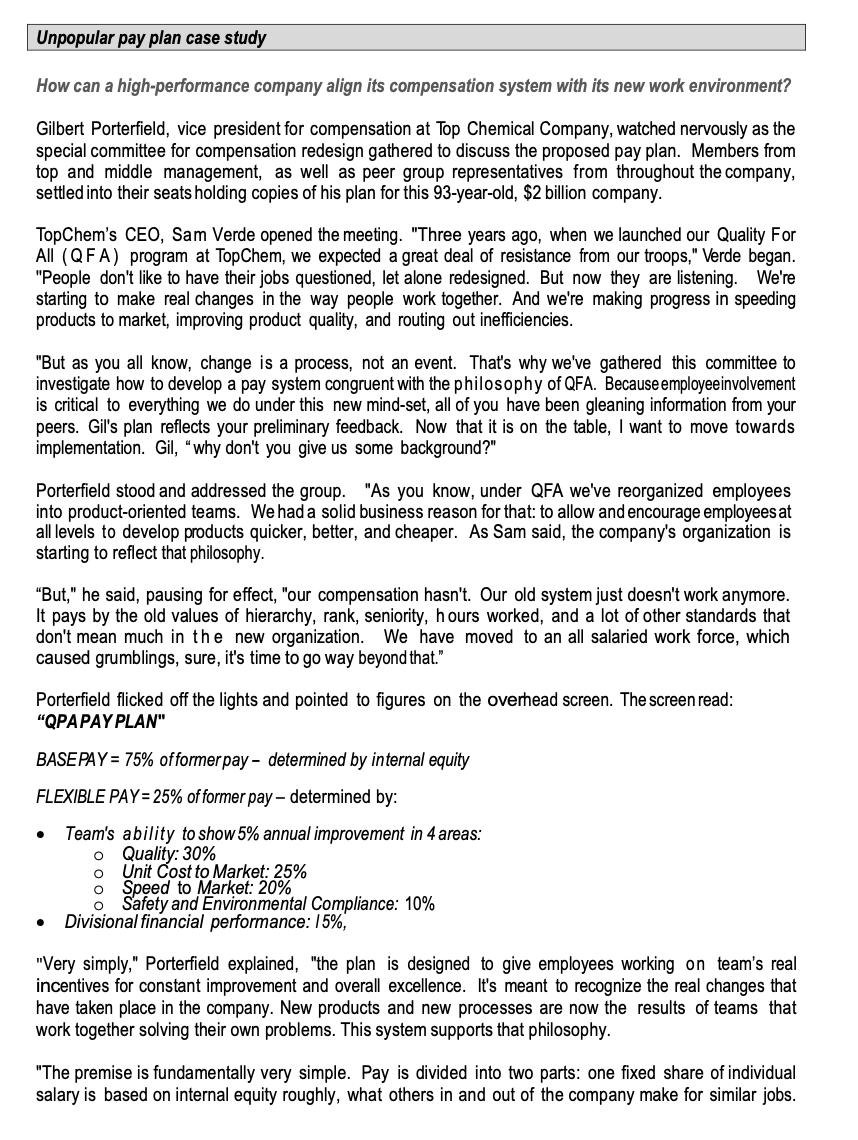
Porterfield flicked off the lights and pointed to figures on the overhead screen. The screen read:
"QPAPAYPLAN"
BASEPAY offormerpay determined by internal equity
FLEXIBLE PAY of former pay determined by:
Team's ability to show annual improvement in areas:
Quality:
Unit Cost to Market:
Speed to Market:
Safety and Environmental Compliance:
Divisional financial performance:
"Very simply," Porterfield explained, "the plan is designed to give employees working on team's real
incentives for constant improvement and overall excellence. It's meant to recognize the real changes that
have taken place in the company. New products and new processes are now the results of teams that
work together solving their own problems. This system supports that philosophy.
"The premise is fundamentally very simple. Pay is divided into two parts: one fixed share of individual
salary is based on internal equity roughly, what others in and out of the company make for similar jobs.
Step by Step Solution
There are 3 Steps involved in it
1 Expert Approved Answer
Step: 1 Unlock

Question Has Been Solved by an Expert!
Get step-by-step solutions from verified subject matter experts
Step: 2 Unlock
Step: 3 Unlock
 Study Help