



Question: How can I apply material balance? materials at room temperature using sunlight and semiconducting metal oxides ( TiO2,ZnO and etc.) materials as catalysts. The photocatalytic
How can I apply material balance?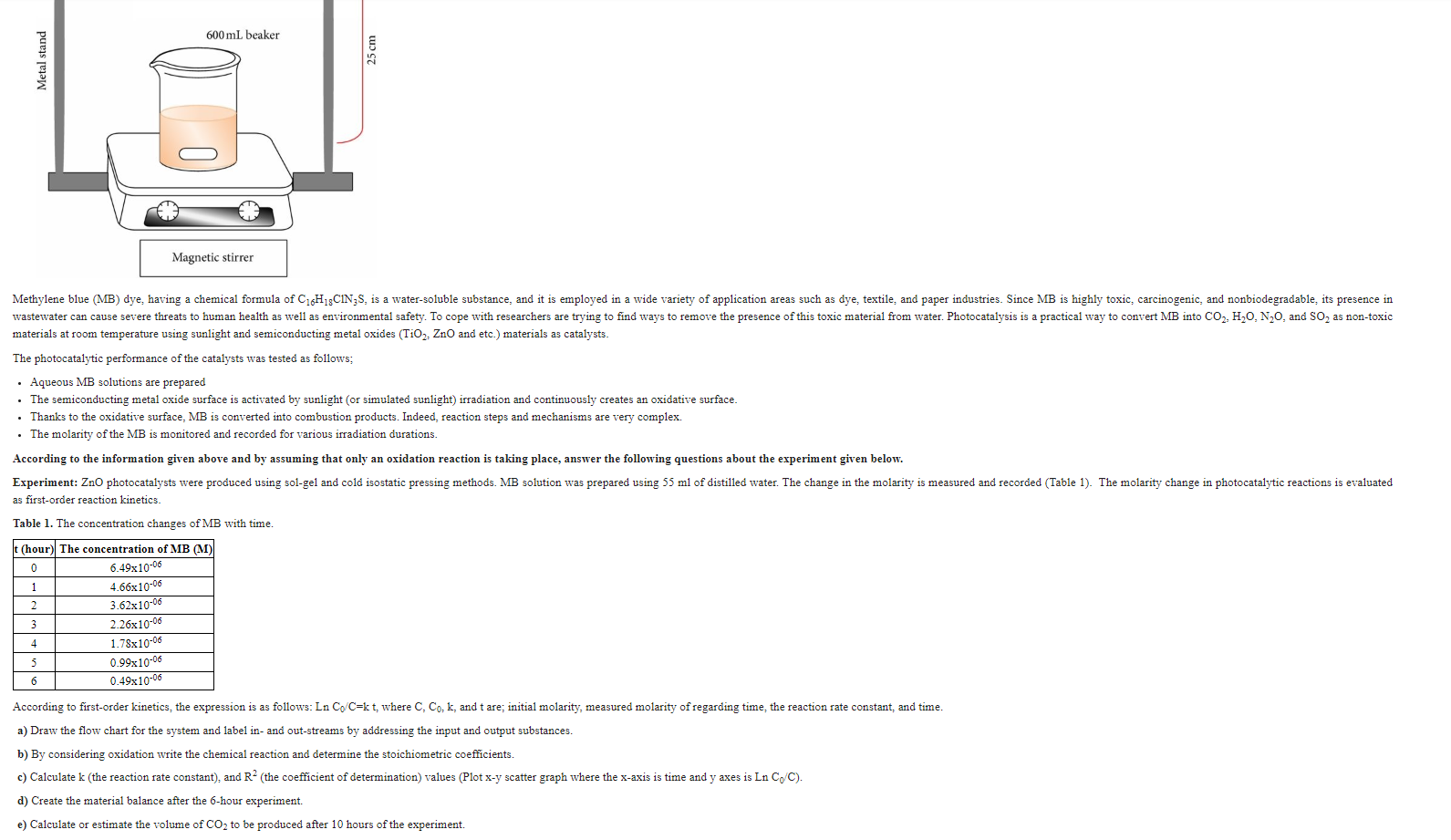
materials at room temperature using sunlight and semiconducting metal oxides ( TiO2,ZnO and etc.) materials as catalysts. The photocatalytic performance of the catalysts was tested as follows; - Aqueous MB solutions are prepared - The semiconducting metal oxide surface is activated by sunlight (or simulated sunlight) irradiation and continuously creates an oxidative surface. - Thanks to the oxidative surface, MB is converted into combustion products. Indeed, reaction steps and mechanisms are very complex. - The molarity of the MB is monitored and recorded for various irradiation durations. According to the information given above and by assuming that only an oxidation reaction is taking place, answer the following questions about the experiment given below. as first-order reaction kinetics. Table 1. The concentration changes of MB with time. According to first-order kinetics, the expression is as follows: LnC0/C=kt, where C,C0,k, and t are; initial molarity, measured molarity of regarding time, the reaction rate constant, and time. a) Draw the flow chart for the system and label in- and out-streams by addressing the input and output substances. b) By considering oxidation write the chemical reaction and determine the stoichiometric coefficients. c) Calculate k (the reaction rate constant), and R2 (the coefficient of determination) values (Plot x - y scatter graph where the x-axis is time and y axes is L n C0/C ). d) Create the material balance after the 6-hour experiment. e) Calculate or estimate the volume of CO2 to be produced after 10 hours of the experiment
Step by Step Solution
There are 3 Steps involved in it

Get step-by-step solutions from verified subject matter experts