







Question: How do buffer overflow attacks differ from mobile code attacks in cybersecurity? Both buffer overflow and mobile code attacks are designed to encrypt the victim's
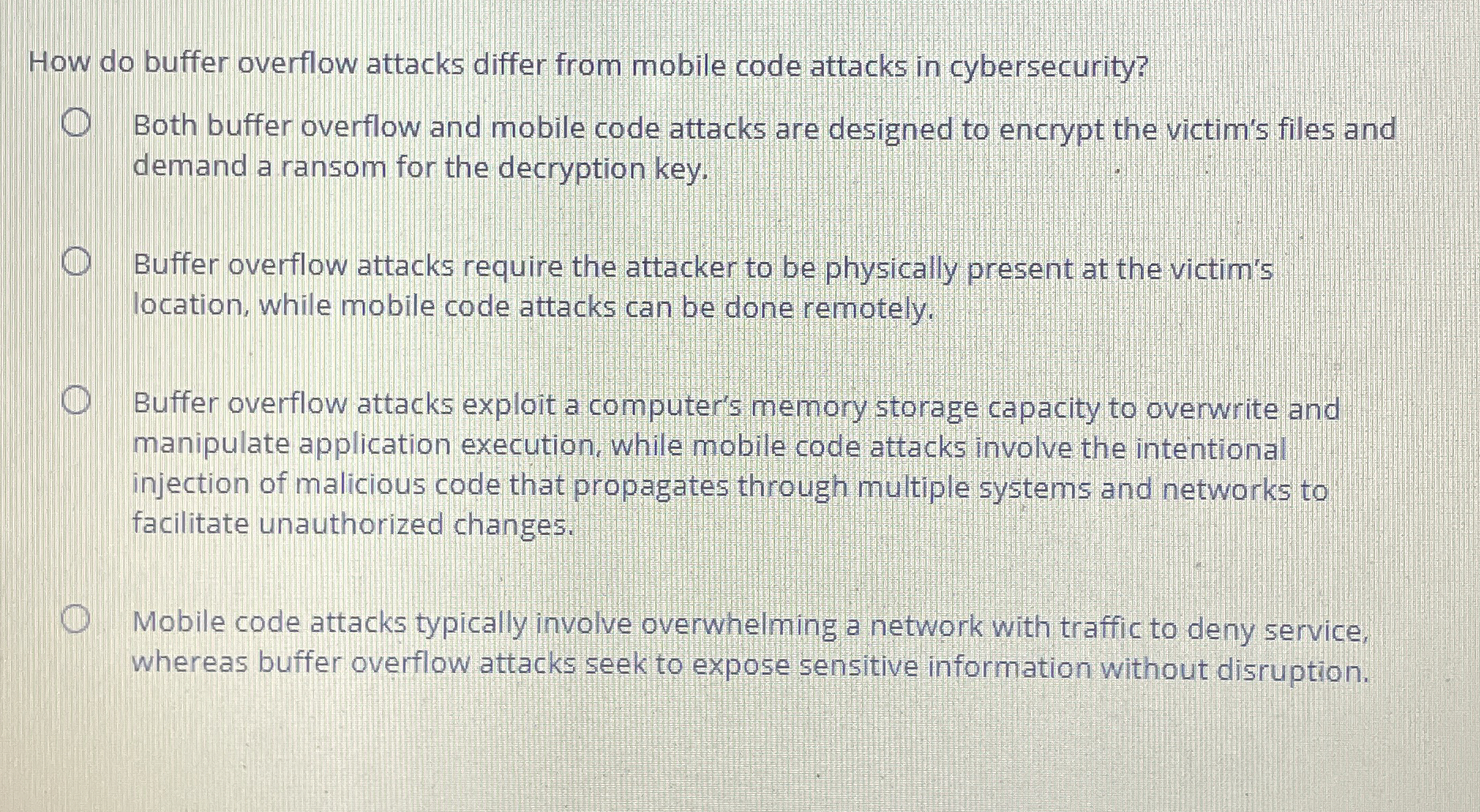
How do buffer overflow attacks differ from mobile code attacks in cybersecurity?
Both buffer overflow and mobile code attacks are designed to encrypt the victim's files and
demand a ransom for the decryption key.
Buffer overflow attacks require the attacker to be physically present at the victim's
location, while mobile code attacks can be done remotely.
Buffer overflow attacks exploit a computer's memory storage capacity to overwrite and
manipulate application execution, while mobile code attacks involve the intentional
injection of malicious code that propagates through multiple systems and networks to
facilitate unauthorized changes.
Mobile code attacks typically involve overwhelming a network with traffic to deny service,
whereas buffer overflow attacks seek to expose sensitive information without disruption.
Step by Step Solution
There are 3 Steps involved in it
1 Expert Approved Answer
Step: 1 Unlock

Question Has Been Solved by an Expert!
Get step-by-step solutions from verified subject matter experts
Step: 2 Unlock
Step: 3 Unlock
 Study Help