







Question: How do data scientists use cross-validation and holdout samples? A. Data scientists use cross-validation models and holdout sarvples to identify a recehver operating characteristing curve
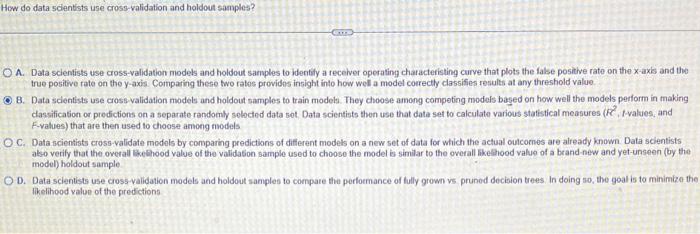
How do data scientists use cross-validation and holdout samples? A. Data scientists use cross-validation models and holdout sarvples to identify a recehver operating characteristing curve that plots the false positive rate on the X-axis and the true positive rate on the y-axis. Comparing there two ratos provides insight into how well a model correctly classifies results at any threshold value. 8. Data scientists use cross validation models and holdout samples to train models. They choose among competing models basged on how well the models perform in making dassification or predictions on a separate randomly solocted data sot, Data scientists then wse that data set to calculate various statistical measures ( RR2, t-values, and F-values) that are then used to choose anong tuodels C. Data scientists cross validate modols by comparing predictions of different models on a new set of data for which the actual outcomes are already known. Data scientists atso verify that the overall likelhood value of the validation sample used to choose the model is similar to the overall likelihood value of a brand new and yet-unseen (by the model) holdout sample D. Data scientists use cross validation models and holdout samples to compare the perfoemance of fully grown vs pruned decision trees: In doing so, the goal is to minimien the Tikelihood valun of the predictions
Step by Step Solution
There are 3 Steps involved in it

Get step-by-step solutions from verified subject matter experts
 Study Help